
Compare rooftop LED and taxi tablet all-in CPMs by matching impressions, fees, targeting, and delivery data.
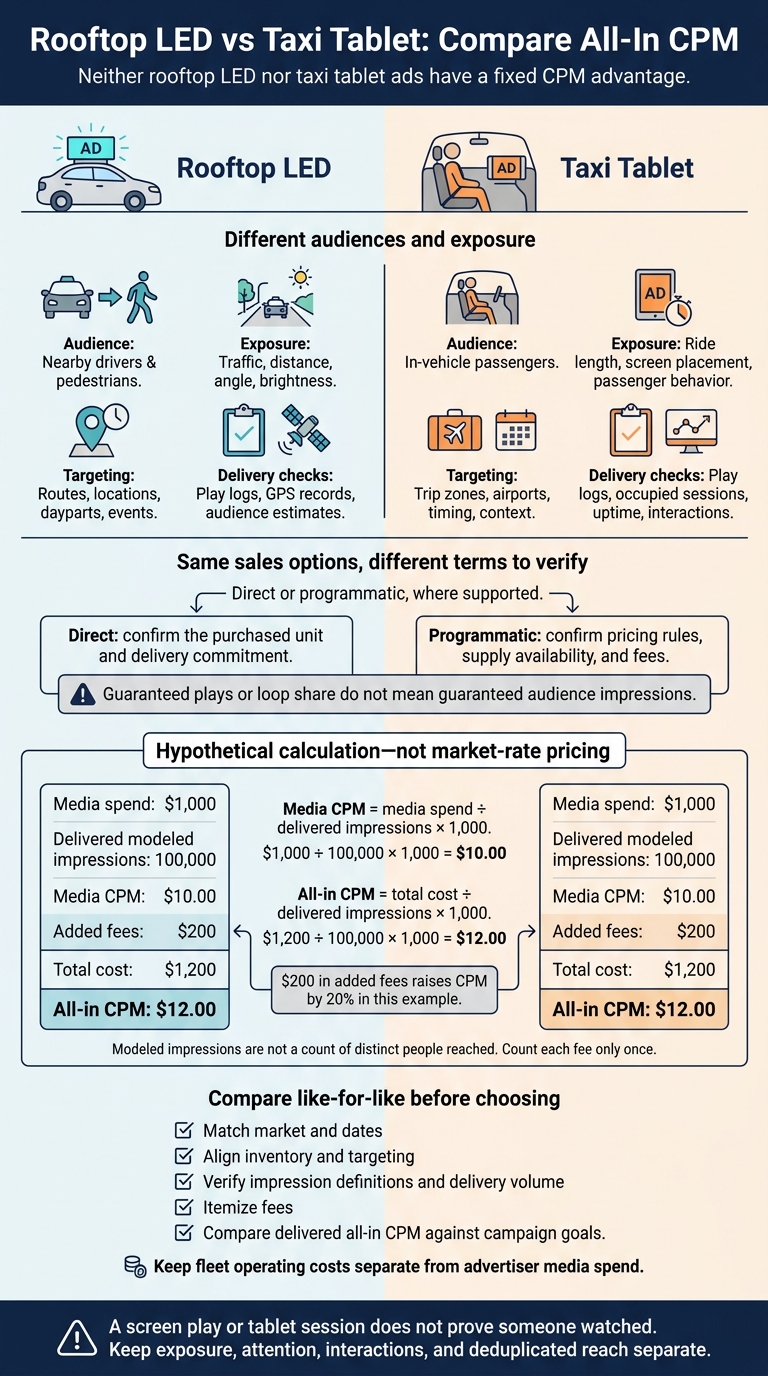
Neither rooftop LED nor taxi tablet ads have a fixed CPM advantage. Compare quotes using the same market, dates, impression rules, and fees - not price alone. For example, $1,000 for 100,000 impressions equals a $10 media CPM; adding $200 in fees makes the all-in CPM $12, or 20% more. This is a sample calculation, not a market rate.
Rooftop LEDs reach people outside the vehicle. Taxi tablets reach passengers inside, with more time for longer messages and interaction. In both cases, an ad play does not prove someone watched.
Quick Comparison
| Comparison | Rooftop LED | Taxi tablet |
|---|---|---|
| Audience | Nearby drivers and pedestrians | In-vehicle passengers |
| Exposure | Depends on traffic, distance, angle, and screen brightness | Depends on ride length, screen placement, and passenger behavior |
| Targeting | Routes, locations, dayparts, and events | Trip zones, airports, timing, and context |
| Sales options | Direct or programmatic, where supported | Direct or programmatic, where supported |
| Delivery checks | Play logs, GPS records, and audience estimates | Play logs, occupied sessions, uptime, and interactions |
| Cost checks | Media, production, platform, data, and measurement fees | Media, platform, data, interaction, and reporting fees |
For fleets using Enroute View Media’s DigiStreamView, request separate format quotes and confirm software, hardware, support, and reporting terms. Keep fleet costs separate from advertiser media spend, then judge delivered all-in CPM against reach, viewing time, and campaign goals.
Rooftop LED vs Taxi Tablet: Compare All-In CPM
Compare exposure quality, not just quoted impressions. Roadside viewing conditions change by route, intersection, district, and event. Ask for GPS records, audience estimates, and proof-of-play logs linked to each route or location.
Speed, dwell time, viewing angle, brightness, ad length, and loop frequency all affect exposure. Targeting by route, geofence, neighborhood, ZIP code, daypart, event, or weather can limit available inventory and change pricing. Request eligible hours and delivered plays for each area.
Beyond who sees the ad, check how that inventory is sold and priced.
Keep eligible rides, occupied rides, passenger sessions, and deduplicated passengers separate. Check occupancy, uptime, and screen visibility before accepting a passenger-impression total - and don't count occupancy twice.
Longer rides allow more potential viewing time. But screen placement, passenger behavior, audio where permitted, and vehicle motion affect exposure. Report interactions and conversions separately from playback.
Targeting also reaches people at different moments.
An airport corridor rooftop placement and an airport pickup or drop-off tablet serve different exposure moments.
Confirm whether supported targeting - by trip zone, airport, venue, timing, language, or context - uses deterministic, modeled, or inferred signals.
Compare the formats using the factors that change CPM:
| Measurement factor | Rooftop LED | Taxi tablet | CPM effect | Required evidence |
|---|---|---|---|---|
| Total impressions | Estimated roadside or pedestrian audience during ad plays | Estimated passenger audience during eligible rides or sessions | Larger audience estimates can lower quoted CPM without improving exposure | Impression definition, audience multipliers, source data, and calculation method |
| Deduplicated reach | Distinct people or modeled devices across routes | Distinct passengers across rides or sessions | Net reach changes frequency and CPM value | Deduplication method and reporting universe |
| Attention opportunities | Exposure depends on distance, angle, traffic speed, brightness, obstructions, and dwell time | Exposure depends on placement, passenger position, lighting, motion, and viewing time | Longer exposure may support a premium when measured consistently; visibility adjustments can reduce counted impressions | Visibility model, exposure duration, adjustment factors, and attention methodology |
| Geographic and contextual targeting | Route, geofence, neighborhood, ZIP code, daypart, event, and weather | Trip zone, airport, venue, timing, language, and permitted contextual signals | Narrower targeting may reduce scale and increase CPM while improving relevance | Targeting definitions, eligible inventory, delivered units, and exclusions |
| Delivered playback | Timestamped plays, GPS position, screen status, and creative ID | Timestamped plays, vehicle ID, session status, uptime, and completion records | Verified playback supports delivery reconciliation but does not establish audience impressions | Playback logs, completion rules, outages, and failed-play treatment |
A lower CPM can reflect looser counting, not better value. For rooftop screens, check exposure-zone estimates and repeat encounters. For tablets, check passenger occupancy and repeat plays within rides. Neither rides nor sessions establish deduplicated person-level reach.
| Counting rule | Rooftop LED application | Taxi tablet application | Buyer check |
|---|---|---|---|
| Visibility adjustments | Direction, distance, speed, and angle | Placement, passenger presence, lighting, motion, and viewing direction | Require documented exclusions, not just screen uptime |
| Deduplicated reach | May use modeled audience duplication | Requires a method beyond distinct ride IDs | Confirm the reporting period, identity limits, and uncertainty |
| Targeting definitions | Route or geofence eligibility during selected hours | Trip-zone, session, or contextual eligibility | Confirm signal sources, exclusions, and delivered inventory against selected criteria |
With audience and counting rules aligned, the next CPM gap comes from direct packages versus programmatic delivery.
Direct and programmatic describe how inventory is sold - not the screen format. Rooftop LEDs and taxi tablets can use either model when the supply path is connected.
The sales model affects how CPM is quoted, delivery is tracked, and results are verified. Here’s what to check when comparing offers.
| Pricing factor | Direct sales | Programmatic sales | Buyer check |
|---|---|---|---|
| Rate control | Negotiated package, flat fee, CPM, or share-of-voice pricing | Floor CPM, auction clearing price, or fixed PG price | Is the rate gross or net? Is it based on plays or impressions? |
| Deal unit and delivery commitment | Vehicles, routes, markets, dayparts, dates, plays, loop share, sessions, or estimated impressions | Bid requests, impressions, deal IDs, or reserved delivery | What unit are you buying? Is delivery guaranteed or estimated? |
| Targeting | Geography, route, daypart, vehicle group, audience, or trip area | Geographic, time, audience, contextual, device, or frequency rules supported by the DSP and supply path | Which targeting options are available and validated? |
| Setup | Ad approval, trafficking, scheduling, and reporting | DSP seat, deal ID, ad approval, integration, and bid settings | Who handles approvals, trafficking, and troubleshooting? |
| Reporting | Proof of play, delivery logs, impression reports, reach, and frequency where available | Bid, win, delivery, pacing, and fee reports | Which reports are included? |
| Optimization | Manual changes to routes, vehicles, dayparts, ads, or loop share | Automated bidding, pacing, frequency, and targeting | What can change midcampaign, and how quickly? |
| Fees | Production, trafficking, ad serving, measurement, or management | DSP, SSP, data, ad-serving, verification, or measurement | Are fees itemized or included in CPM? |
These terms help you judge whether a lower CPM means better efficiency - or simply fewer delivery commitments.
Direct rooftop packages may specify vehicles, routes, markets, dayparts, dates, plays, or share of voice. Tablet packages may use eligible passenger sessions or trip geography.
Guaranteed plays or loop share do not mean guaranteed audience impressions. Ask for documented audience assumptions and an impression method, then recalculate CPM using the final report. Put reporting deadlines and remedies for underdelivery in the agreement.
An open auction makes eligible inventory available through competitive bidding, without assured volume. A private marketplace (PMP) limits access to selected buyers. Programmatic guaranteed (PG) reserves inventory, price, and delivery through an automated workflow where supported.
Before launch, confirm the floor CPM, pricing rules, delivery priority rules, available volume, and pacing. State whether billing uses audience impressions, screen plays, or modeled impressions. Itemize DSP, supply-side, data, and measurement fees, including embedded charges. Narrow targeting can limit supply, so check whether delivery can meet the campaign deadline.
Hypothetical calculation - not market-rate pricing: For either format, $1,000 in media spend ÷ 100,000 delivered modeled impressions × 1,000 produces a $10.00 media CPM. Adding $200 in disclosed fees makes the total $1,200 and the all-in CPM $12.00.
| Cost measure | Rooftop LED hypothetical | Taxi tablet hypothetical | Interpretation using identical assumptions |
|---|---|---|---|
| Media spend | $1,000 | $1,000 | Equal working-media budgets |
| Delivered modeled impressions | 100,000 | 100,000 | Same assumed, documented count - not a count of distinct people reached |
| Media CPM | $10.00 | $10.00 | Media spend per 1,000 impressions |
| Added fees | $200 | $200 | Separate charges, counted once |
| Total cost | $1,200 | $1,200 | Media spend plus added fees |
| All-in CPM | $12.00 | $12.00 | Total cost per 1,000 impressions |
For actual quotes, match markets, dates, inventory, impression methods, and delivery volume. Separate included fees, deducted fees, and separately billed fees so you don’t count any charge twice. These distinctions matter most when one operator manages both formats in the same reporting system.
When one platform manages both rooftop LEDs and tablets, how the quote is structured matters as much as CPM.
Enroute View Media offers rooftop LED screens, in-taxi touch-screen tablets, and DigiStreamView, a cloud-based white-label ad and screen-management platform. Fleet owners and operators can use it to manage content, scheduling, and device monitoring across both formats.
DigiStreamView supports geo-time scheduling, custom CPM settings, real-time analytics, and programmatic integrations. Check whether your deployment supports targeting by geofence, route, daypart, vehicle group, or individual screen.
Keep each format’s CPM settings separate and label the unit being counted. A configured CPM is a pricing input - not a delivery guarantee. For direct sales, confirm the scheduling controls. For programmatic sales, check the integrations and deal terms.
Ask for separate reporting fields for uptime, proof of play, estimated audience impressions, and tablet interactions. Multilingual support, motion sensing, and audience detection depend on the deployment. Clarify whether sensors measure presence, dwell, or interaction. Keeping these fields separate helps you compare rooftop and tablet CPMs on the same reporting basis.
Request current pricing from Enroute View Media. Before comparing packages, confirm plan names, what’s included, vehicle and screen limits, supported hardware, white-label terms, analytics depth, and API access. Also check uptime commitments, support levels, and cancellation or overage rules.
Ask whether billing is per screen, per vehicle, per month, or based on usage. Get uptime, support, overage, and cancellation terms in writing. Hardware is priced separately from software.
Request separate rooftop LED and tablet quotes with matching vehicle counts, markets, dates, dayparts, ad specifications, targeting, sales channel, and reporting needs. Each quote should itemize hardware, installation, maintenance, software, connectivity, data, measurement, support, and API fees. Keep these fleet operating costs separate from advertiser media CPM, and clearly identify any campaign-related fees.
For the price comparison, use delivered CPM, not just list price.
Once impression rules, sales terms, and fees align, compare what each format delivers.
Rooftop LEDs focus on roadside reach; taxi tablets focus on in-vehicle attention. Judge CPM against the campaign goal, using the delivery data behind the price.
| Campaign need | Rooftop LED consideration | Taxi tablet consideration | Evidence to request |
|---|---|---|---|
| Local reach | Repeated roadside visibility can build frequency without reaching more people | Passenger exposure concentrates delivery within selected trip zones | Route maps, vehicle count, operating hours, projected reach, and delivered impressions |
| Longer messaging | Brief, high-contrast ad content suits short exposure windows | Longer messages and interactions may justify a premium if viewing time supports them | Viewing or trip duration, completion rate, ad specifications, and interaction data |
| Targeting | Geographic, route, time-of-day, and day-of-week restrictions can limit inventory | Passenger-zone, trip context, and time-based targeting can limit inventory, where supported | Targeting definitions, eligible inventory, match rate, and delivery by segment |
| Costs | Compare package price, production, route fees, and data fees | Compare media, platform, data, hardware, interaction, and reporting fees | Rate card, minimums, fee schedule, delivered-impression methodology, and all-in CPM |
Use the same counting rules to compare unduplicated reach and repeat exposure. And keep exposure separate from attention: a screen play or tablet session does not prove someone watched.
For the buying decision, check quote structure, delivery proof, and total cost. Request separate direct and programmatic quotes for rooftop routes or passenger trip zones, using the same dates, audience, and delivery objective.
Confirm delivery commitments, applicable sales terms, and fees. Base your choice on documented reach, attention, targeting performance, and all-in CPM.
A higher CPM can be worth the cost when better audience engagement, precise targeting, or premium ad placement improves your return on investment (ROI).
Premium placements may offer more value during peak traffic, high-demand events, or in high-value geographic areas. These placements can reduce wasted impressions and drive more conversions.
To judge whether the higher cost per thousand impressions pays off, compare the added expense with campaign results, including engagement and ROI.
Measure reach with GPS data and sensors. For rooftop LED screens, optional, privacy-compliant devices use AI-based computer vision to count viewers looking at ads and measure impressions.
For in-taxi tablets, touchscreen interactions, motion sensors, and GPS data track engagement by individual viewers, dwell time, and interaction rates. Combining both formats in one report helps separate total impressions from the number of distinct viewers.
Start by testing programmatic buying. It connects your fleet’s available ad slots to a larger pool of buyers, which can improve fill rates and revenue through real-time auctions.
These systems also cut down on manual rate negotiations and scheduling. They use historical data to adjust bidding strategies, helping high-demand slots earn premium prices while supporting growth and access to more advertisers.
Need pricing details?
EnrouteViewMedia is a Canadian technology company based in Edmonton, Alberta, Canada. The company was founded by a group of media entrepreneurs and engineering executives. Our mission is developing leading-edge digital media display technologies for taxicab rooftops and taxicab interiors advertising market. Through our easy to use ad delivery and management system, we assist our clients in reaching their customers with targeted exposure. EnRouteViewMedia continuously strives to be the global leader in digital geo-time targeted advertising media systems for modern taxi fleets.