
Mobile taxi screens using geo-time targeting, fast activation, and GPS-stamped reporting close five common urban reach gaps.

Most city ads miss people because the audience moves and the screen does not. I’d sum it up like this: programmatic taxi ads help fill 5 common reach gaps by moving through the city, switching ads by place and time, launching fast, and logging where each ad ran.
If you want the short version, here it is:
The article’s core point is simple: taxi-based digital out-of-home can follow traffic flow across business areas, airport routes, shopping streets, and home neighborhoods in the same day. That matters when city movement changes by hour. It also helps that screens can update within minutes and that ad plays can be tied to GPS, route data, and timestamps.
One stat stands out: a 2025 New York taxi campaign used GPS-led scheduling during commuter peaks and saw a 30% increase in audience engagement versus static scheduling. That’s the clearest proof in the piece: when media moves with people, reach gaps shrink.
Quick comparison
| Reach gap | What goes wrong with fixed screens | How taxi ads help |
|---|---|---|
| Peak commute reach | People split across routes and times | Screens move with traffic flow |
| Cross-neighborhood coverage | One screen stays in one place | Vehicles pass through many zones |
| Short launch windows | Setup can take too long | Ads can go live in minutes |
| Local timing and zone control | Hard to match place + hour | GPS and geofencing guide delivery |
| Proof of delivery | Limited visibility after launch | GPS-stamped playback and route logs |
My takeaway: if you need city reach, timing control, and proof that ads ran, this format fixes several weak spots at once.
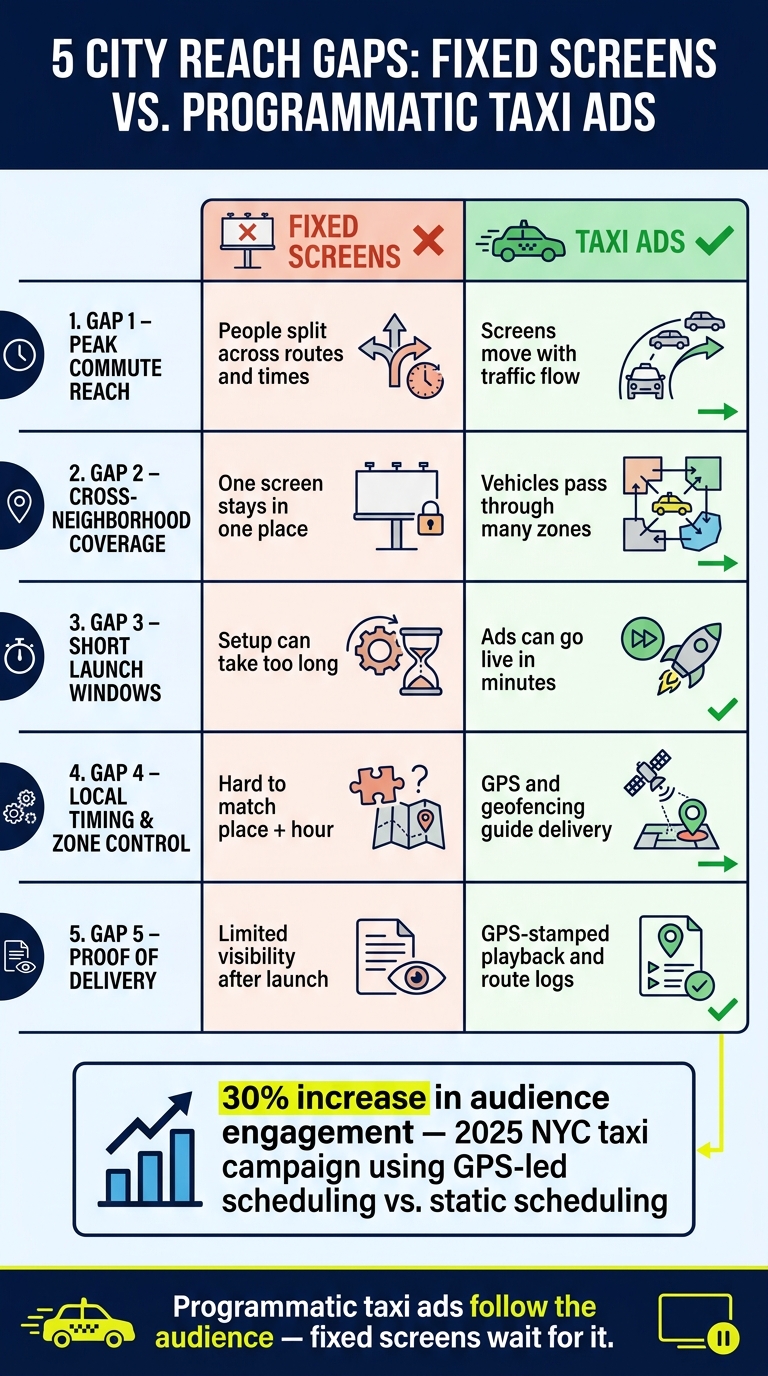
5 City Reach Gaps: Fixed Screens vs. Programmatic Taxi Ads
Commuter audiences don’t stay put. They shift by hour, route, and neighborhood, which is exactly why fixed placements miss key travel windows. Peak traffic patterns can change fast, and a static screen can’t keep up across the full span of a workday.
Taxi-based DOOH moves with that flow. It can reach people during curbside pickups, airport rides, and downtown commutes in the same day. In 2025, a large New York taxi fleet used real-time reporting and GPS-enabled digital tops to change ad delivery during peak commuter hours. By shifting ad frequency to match high-density times and locations, the campaign achieved a 30% increase in audience engagement compared with static scheduling.
Time is only half the issue. Place matters too.
Taxi screens travel through the city as people do, moving across business, retail, and residential areas in a single route. One vehicle might pass through a business district in the morning, a shopping corridor at noon, and a residential neighborhood by evening, all in one shift.
That’s the big split: fixed screens stay in one spot and wait for people to pass by, while taxi screens move through the routes people already take. In a city where few trips look the same twice, that mobility gives campaigns a better shot at staying in front of the right audience.
Weekend promos, flash sales, and event campaigns all run into the same problem: there’s no room for delay.
Programmatic taxi ads cut down most of that lag. Creative can update on vehicle screens within minutes. Campaigns can run for a few days, focus on specific zones during specific hours, and shift while they’re live. That makes short campaign windows far more workable.
This matters even more when a campaign also needs to narrow by zone, time, and audience flow.
Once a campaign is live fast, the next hurdle is control. Speed matters. But for city campaigns, zone-level precision matters too.
Geo-time targeting lets ads run only in the places that matter and only at the hours that make sense. So a campaign can focus on a downtown retail district during lunch, then shift to a commuter corridor in the evening, and pause when those conditions no longer apply. That kind of control helps cut waste.
A restaurant, for example, can target commuters heading home through a specific corridor at the exact hour they’re deciding where to eat. It’s a simple idea, but it changes how local media works.
Precise targeting is only half the job. The other half is proving the ad actually ran.
Taxi-based DOOH improves attribution by tying each ad play to a GPS-stamped route and timestamp. That gives advertisers a clear view of what happened, where it happened, and when. In one dashboard, they can track:
That mix only works when one platform handles both targeting and reporting. Enroute View Media brings rooftop LED screens, in-taxi tablets, geo-time targeting, real-time analytics, and programmatic integration into a single platform. So mobility, targeting, and measurement all happen in the same workflow.
With those controls in place, programmatic taxi ads close more than one urban reach gap at the same time.
Put those five gaps together, and the pattern is hard to miss: fixed urban media leaves reach on the table. City advertising still misses commuters, entire neighborhoods, short launch windows, and impressions you can verify. Programmatic taxi ads close all five gaps in one format.
Why does that work? Because mobility, geo-time targeting, fast activation, and GPS-stamped reporting don't work in isolation. They work as one system to deliver each impression, time it well, and prove it happened.
Programmatic taxi ads solve city reach gaps by following the audience, not waiting for it.
Taxi ads help brands reach more of the city by turning everyday fleets into mobile, data-driven billboards. Unlike fixed screens, they move with traffic, commuters, and foot traffic, so your message isn’t stuck in one place.
With geo-time targeting, Enroute View Media’s DigiStreamView platform can serve ads based on a vehicle’s GPS location. That means brands can show relevant messages in specific neighborhoods and along commuter routes. Add programmatic integration and real-time analytics, and you get a smarter way to maximize exposure across the city.
Yes. Taxi ads can target specific zones and times with geofencing around places like airports or business districts.
You can also adjust campaigns by day and time, which helps show ads when they make the most sense as vehicles move through set parts of the city.
Ad delivery is checked through detailed playback reports. These reports show timestamps, GPS locations, ad duration, and impression counts. They also account for multiple views during a single ride, which gives advertisers a clearer picture of how often an ad was seen.
Real-time device monitoring adds another layer of visibility. It confirms that screens are online, shows live screenshots, sends offline alerts, and gives advertisers access to reports and vehicle movement maps. That way, they can verify that campaigns ran as planned.
Need pricing details?
EnrouteViewMedia is a Canadian technology company based in Edmonton, Alberta, Canada. The company was founded by a group of media entrepreneurs and engineering executives. Our mission is developing leading-edge digital media display technologies for taxicab rooftops and taxicab interiors advertising market. Through our easy to use ad delivery and management system, we assist our clients in reaching their customers with targeted exposure. EnRouteViewMedia continuously strives to be the global leader in digital geo-time targeted advertising media systems for modern taxi fleets.