
Rooftop LED displays beat static taxi ads for visibility, flexibility, targeting, and long-term ROI despite higher startup costs.
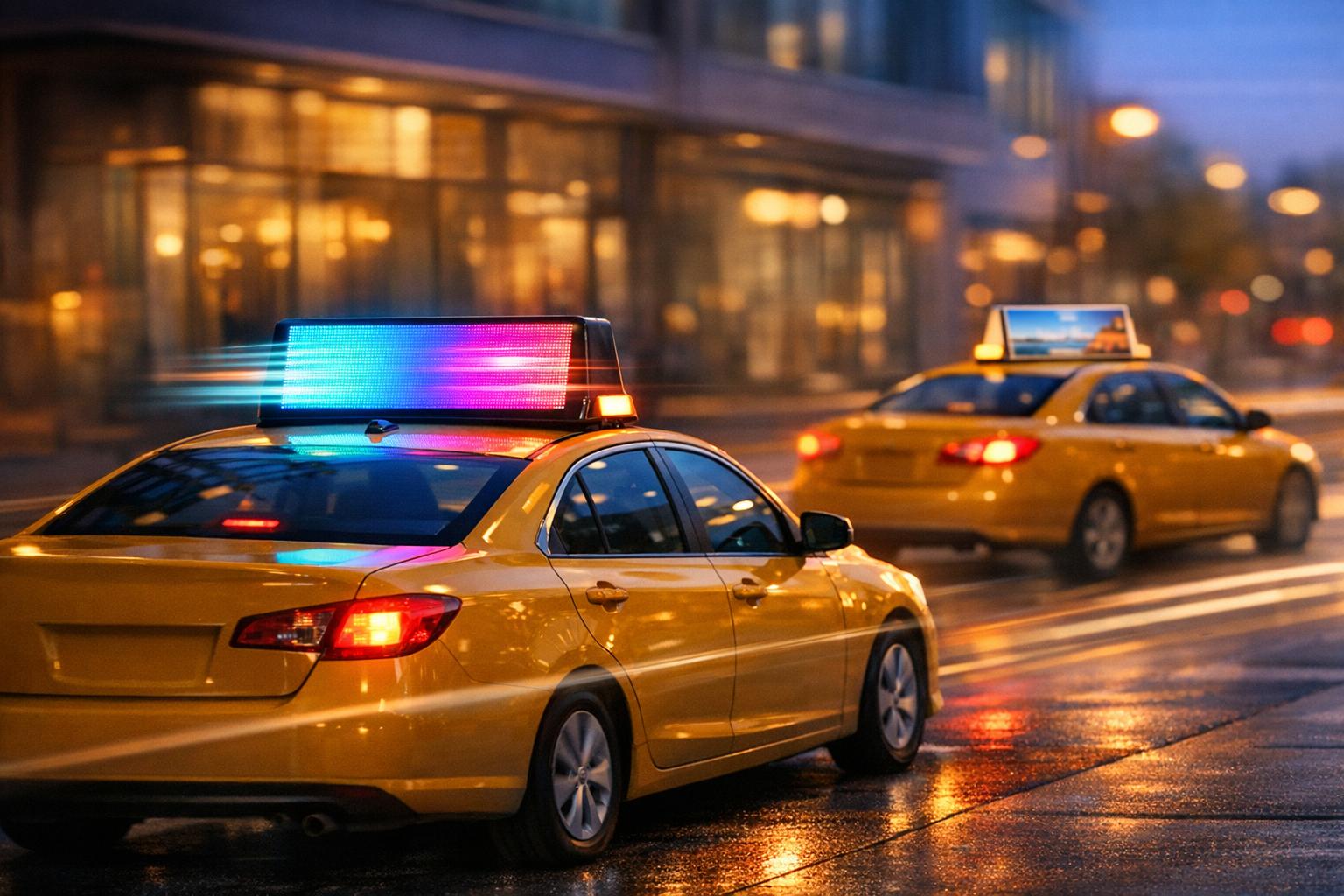
Rooftop LED displays outperform static taxi ads in flexibility, visibility, and long-term cost efficiency. While static ads have lower upfront costs, they lack the dynamic capabilities of LED displays, which can show videos, animations, and location-targeted content. LED screens allow advertisers to update campaigns remotely, avoid printing expenses, and reach more people with brighter displays that work 24/7. Although the initial investment is higher, LED displays often deliver better returns through shared ad space, geo-targeting, and increased viewer engagement.
| Criteria | Rooftop LED Displays | Static Taxi Ads |
|---|---|---|
| Upfront Cost | $3,950–$5,450 + installation fees | Lower (printing and frame costs) |
| Maintenance | 4G fees ($10/month) + occasional repairs | Printing and labor for replacements |
| Content Updates | Instant via cloud-based systems | Manual replacement required |
| Ad Formats | Video, animation, scrolling text | Single static image |
| Visibility | Bright in all conditions, 24/7 | Limited in sunlight or at night |
| Targeting | GPS and time-based ads | Fixed messaging |
| Impressions | ~30,000 daily | Fewer, location-dependent |
| ROI | Achievable in ~6 months | Slower due to recurring costs |
For campaigns needing dynamic, flexible, and high-impact advertising, LED displays are the better choice despite higher startup costs. Static ads, however, remain a suitable option for simpler, lower-budget campaigns.
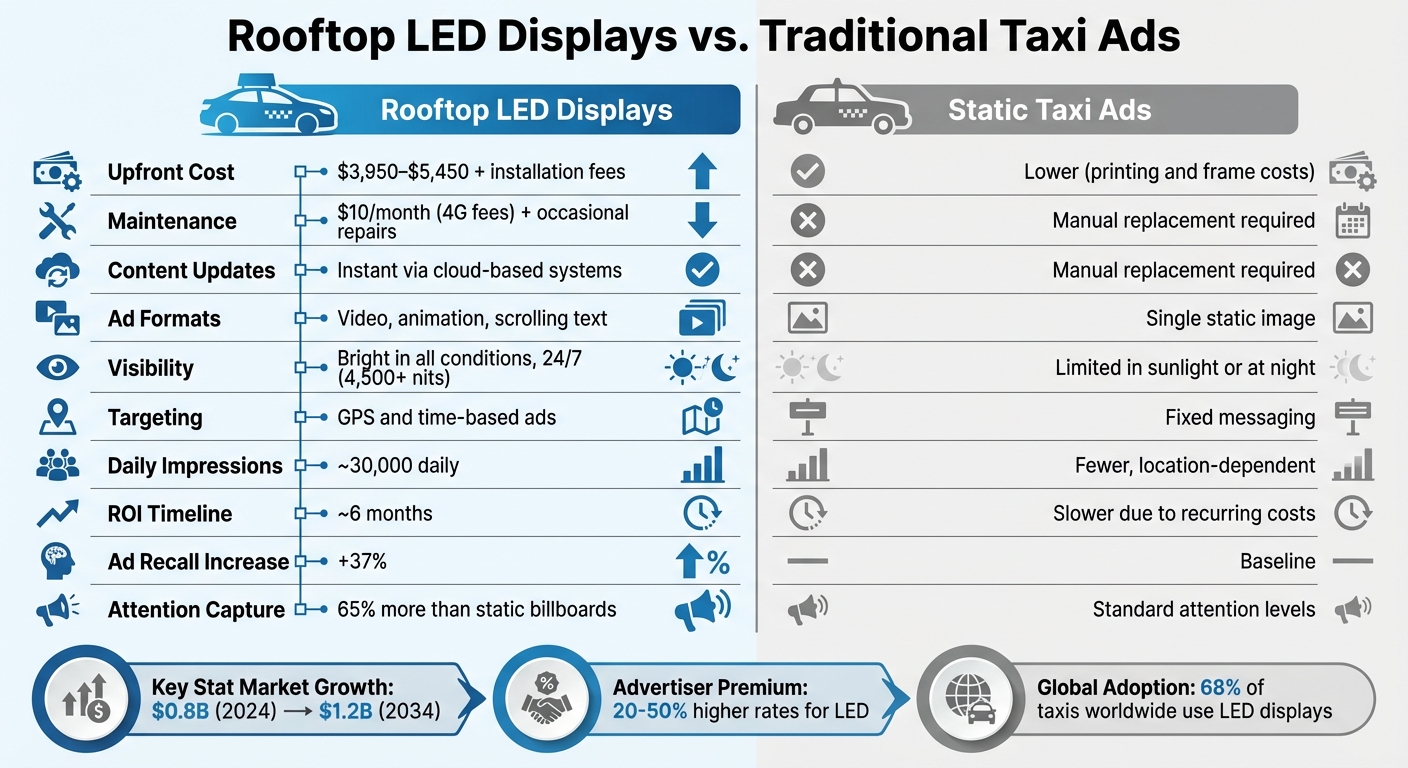
Rooftop LED Displays vs Traditional Taxi Ads Comparison Chart
When comparing LED displays to traditional static ads, the differences in initial costs are striking. Rooftop LED displays require a higher upfront investment, with prices typically ranging from $3,950 for standard P2.5 units to $5,450 for premium P1.6 high-resolution screens. Additionally, mounting kits cost around $350, and professional installation - taking about two hours per vehicle - adds to the overall expense. These displays come equipped with features like weatherproof panels, GPS, 4G/LTE connectivity, and smart power management systems compatible with 12V vehicle batteries.
On the other hand, traditional static ads involve much lower hardware costs. These primarily include the production of printed vinyl or plastic signs, which are manually installed into existing frames. To offset the higher LED costs, many fleet operators turn to financing options, revenue-sharing agreements with advertisers, or hardware-as-a-service models, where equipment costs are covered by tech partners in exchange for a share of ad revenue.
LED displays come with recurring expenses that static ads typically avoid. For instance, you’ll need to account for 4G connectivity fees, which are about $10 per month, and software subscriptions for cloud-based ad management platforms. However, these units are designed to be field-serviceable, allowing for the replacement of individual defective pixels instead of entire panels. With an expected lifespan of approximately 100,000 hours, LED displays can operate for years before their brightness diminishes significantly.
Static ads, by comparison, require physical replacement whenever they fade, tear, or need updating. Each new campaign involves costs for printing, labor, and potential vehicle downtime. While there are no connectivity fees or power usage to consider, the cumulative expense of repeatedly producing and installing new signs can add up quickly over time.
These recurring costs highlight the importance of evaluating the long-term value of each option.
When looking at long-term cost efficiency, LED displays often prove to be the better choice. Unlike static ads, LED displays eliminate recurring production and labor costs. Content updates can be done instantly through cloud-based management, avoiding the need for physical replacements.
"The ability to change advertisements remotely means that businesses can adapt their campaigns quickly, responding to market trends or seasonal changes without incurring extra costs for new print materials." - LumenMatrix
LED displays also open up revenue opportunities that static ads can’t provide. For example, multiple advertisers can share the same display space, and geo-targeted content can command 20% to 50% higher rates compared to traditional taxi toppers. Some operators even report achieving full ROI within six months. While static ads are less expensive initially, LED displays often deliver greater long-term value for fleets engaged in ongoing advertising campaigns.
One major advantage of LED displays over traditional taxi ads is how quickly you can update your messaging. With printed ads, any changes require manual installation and replacement, which can take days to complete. In contrast, LED displays are connected to cloud-based content management systems via 4G/LTE networks, allowing advertisers to make updates remotely with just a few clicks. Whether you're reacting to sudden weather changes, breaking news, or shifting market trends, you can refresh your entire fleet's messaging in mere minutes instead of waiting days.
"The content's not fixed - you can update it remotely, tailoring ads to the time, place, or audience." – NY Taxi Ads
This flexibility eliminates the delays and labor costs tied to replacing static signs. Plus, a single LED unit can display multiple ads throughout the day, enabling several advertisers to share the same screen space. This feature also allows for diverse content formats to cycle seamlessly, keeping the messaging dynamic and engaging.
Traditional taxi ads are limited to a single, static printed design for the length of a campaign. Once installed, that image remains unchanged until it's manually replaced. LED displays, on the other hand, offer a wide range of media options, including video, animations, scrolling text, and rotating static images. These formats grab attention in ways static messaging simply can't. For example, an LED unit can cycle between a video, a series of static images, and animated text, all within a matter of seconds.
"Modern-day advertisers are able to serve video, animation, or even real-time messages through LED taxi tops." – Chris Bates
Statistics back up the effectiveness of these displays: taxi-top LED ads attract 65% more viewer attention than their static counterparts, and digital taxi ads are 20% more memorable than online ads. With brightness levels exceeding 4,500 nits, these displays ensure your content remains visible even in direct sunlight.
LED displays take things a step further by using GPS-based geofencing and time-based scheduling to deliver highly targeted content. Unlike static ads that show the same message regardless of time or place, these displays can automatically adjust their messaging based on a taxi's location and the time of day. For instance, a taxi might advertise coffee in office districts during the morning, switch to lunch promotions at noon, and highlight nightlife venues in the evening. This approach, known as Geotargeting-Time with Advertising (GTWA), can pinpoint locations with remarkable precision - up to about 1 meter.
Platforms like Enroute View Media utilize these advanced targeting features to ensure campaigns reach the right audience at the right moment, maximizing their impact in busy urban areas.
In 2025, a food delivery app used NY Taxi Ads' geofencing capabilities to target Manhattan office districts during lunch hours, leading to a 50% increase in app installations. Similarly, a 50-car taxi fleet in San Francisco ran a morning coffee campaign exclusively between 7:00 AM and 10:00 AM in office districts. This campaign generated an estimated 500,000 weekly impressions and boosted brand recall by 10% compared to static ads. These precise targeting capabilities have led advertisers to pay premiums of 20% to 50% for dynamic rooftop ads, reflecting their value in delivering timely, relevant messages.
In the world of digital advertising, consistent visibility is a must, especially in bustling urban settings. LED displays excel here, offering round-the-clock performance that traditional taxi ads often can't match. Unlike static ads that struggle in bright sunlight or fade into the background at night, rooftop LED units shine with brightness levels ranging from 5,000 to 10,000 nits. This ensures ads remain sharp and vivid, even under direct sunlight.
What makes these displays even more effective is their ability to adapt. Equipped with built-in light sensors, LED screens automatically adjust brightness - running at full power during the day and scaling down to 30%–50% at night. This prevents glare while keeping the message crystal clear, whether the taxi is navigating busy city streets at noon or quieter areas after dark.
"The effectiveness of taxi digital signage hinges primarily on display technology capable of maintaining visibility in direct sunlight." – KSSDISPLAY
Many LED units are also double-sided, giving them an edge over single-sided static ads. This design ensures visibility for both pedestrians and drivers on either side of the street, effectively doubling the exposure.
Motion has a way of grabbing attention, and this is where LED displays truly stand out. Studies reveal that digital taxi ads capture up to 59% more attention compared to static billboards.
The versatility of LED screens allows advertisers to experiment with formats like videos, animations, scrolling text, and rotating images. These dynamic elements are far more engaging than a single printed design. For example, in 2022, KSSDISPLAY rolled out over 500 dual-sided LED screens across Istanbul's taxi fleet. During a 90-day pilot, viewers spent an average of 5.4 seconds engaging with the displays, resulting in a 37% increase in ad recall compared to static alternatives. By keeping the content fresh and eye-catching, these displays hold viewer interest over time, ensuring that the message sticks.
When paired with the constant movement of taxis, this ability to attract attention translates into massive audience coverage.
LED displays don’t just stand out because of their brightness or dynamic content - they also excel in reach, thanks to the mobility of taxis. Unlike fixed billboards, which are limited to one location, taxis travel through business districts, shopping centers, and residential neighborhoods, exposing ads to a diverse audience throughout the day. A single taxi equipped with a digital display can generate about 30,000 daily impressions, adding up to over 100,000 impressions each month in densely populated urban areas.
Platforms like Enroute View Media take this a step further with GPS-enabled geofencing technology. This allows advertisers to target specific audiences at the right time and place. Their rooftop LED screens combine high-brightness displays with cloud-based content management, ensuring ads are seen in multiple high-traffic areas throughout the day. By blending mobility, double-sided screens, and dynamic content, these displays achieve a level of reach that traditional taxi ads simply can’t compete with.
LED displays give brands a sleek, tech-forward image, standing out against the dated feel of static printed ads. Unlike traditional taxi toppers that can fade or wear out due to weather, LED screens stay sharp and vibrant 24/7.
These screens also allow brands to showcase dynamic, real-time content, keeping their messaging timely and relevant. Take Casper Mattresses, for example. Their taxi-top campaign in New York City leveraged digital displays to deliver high-frequency exposure across numerous neighborhoods - something stationary billboards simply can't achieve.
"Digital taxi tops are a huge part of this outdoor advertising game, giving brands a slick way to reach New Yorkers and commuters alike." – Kenneth Chukwu, NY Taxi Ads
This modern approach directly impacts campaign results. Advertisers are willing to pay 20–50% more for the increased engagement that LED displays deliver.
LED displays also simplify fleet operations and make scaling campaigns effortless. Changing static ads involves printing, shipping, and manual installation - a time-consuming process that relies on local resources in each market. With cloud-based content management systems (CMS), operators can update campaigns across hundreds of vehicles instantly with just a few clicks.
In 2022, KSSDISPLAY rolled out over 500 LED screens on taxis in Istanbul, using dual-sided P3.33 outdoor panels controlled via 4G/5G networks. Over the first 90 days, the fleet generated 2.1 million impressions per month and saw a 37% boost in ad recall compared to static ads. This entire operation was managed remotely, showcasing a level of efficiency that traditional methods can't match.
Scalability is further enhanced through programmatic integration. Modern LED networks connect with digital out-of-home platforms, enabling automated ad buying and real-time bidding. Enroute View Media's cloud-based platform takes this a step further by offering geo-time targeted advertising and programmatic ad network integration. This allows fleet owners and marketing teams to manage campaigns across multiple markets from a single dashboard. Their white-labeled solutions eliminate recurring costs like printing and manual labor, making campaign management seamless.
Today, over 68% of taxis worldwide use LED displays to monetize their roof space, and the taxi LED screen market is expected to exceed $3.1 billion by 2025. For brands looking to expand quickly across fleets and markets, the ability to update content remotely offers unmatched speed and cost efficiency.
When deciding on an advertising method, consider factors like cost, content flexibility, visibility, and scalability. Traditional static ads come with lower upfront costs but are limited to fixed messaging that requires physical replacement for updates. On the other hand, LED displays involve a higher initial investment but eliminate ongoing printing expenses and allow for dynamic content like videos, animations, and GPS-targeted messaging.
LED panels stand out with their brightness of over 4,500 nits, ensuring 24/7 visibility, even in direct sunlight - something static ads can't match as they fade under bright conditions. This enhanced visibility and engagement explain why advertisers are willing to pay premiums of 20% to 50% for digital ad inventory.
For businesses planning fleet expansions or multi-market campaigns, LED technology offers unparalleled efficiency. Remote management simplifies multi-vehicle campaigns, while traditional ads involve the time and expense of printing, shipping, and manual installation. Supporting this trend, the global in-taxi digital signage market is expected to grow from $0.8 billion in 2024 to $1.2 billion by 2034.
Enroute View Media provides a complete solution for rooftop LED advertising, tailored for fleet owners and advertisers seeking higher returns. Their platform features dual-sided LED screens paired with geo-time targeted advertising (GTWA) technology, offering location accuracy within one meter. Additionally, their white-labeled, cloud-based system integrates programmatic ad networks and delivers real-time analytics, making it easy for operators to manage campaigns and monetize vehicles efficiently. With features like power monitoring and $10 per month 4G/LTE connectivity, this solution addresses both operational and performance needs.
If your campaign requires frequent updates, precise targeting, or multi-vehicle coordination, LED displays deliver superior results despite higher upfront costs. However, for static, long-term messaging, traditional ads remain a practical choice. Ultimately, your decision should align with your campaign's frequency, targeting requirements, and scalability goals.
When deciding between the two, think about what aligns best with your goals. LED rooftop displays provide eye-catching, dynamic visuals, the ability to update content in real-time, and the option for geo-targeted campaigns. These are perfect for grabbing attention and driving engagement, especially in busy urban settings. On the other hand, static taxi ads come with a lower upfront cost and work well for steady, consistent branding. However, they don't offer the flexibility or visual impact of digital displays. If adaptability and precision targeting are your priorities, go with LED. If you’re looking for a straightforward and budget-friendly option, static ads are the way to go.
To set up rooftop LED ads, you'll rely on a dependable power source, usually the vehicle's battery, which powers the LED panels (commonly 12V, around 21W). These systems use cloud-based software to handle real-time updates and deliver geo-targeted ads effectively. While most regions don't require permits for mobile digital signage, it's always a good idea to double-check with local authorities to stay compliant. For added flexibility, LED signs often come with an on/off switch, making it easy to disable them in restricted areas.
Tracking the ROI for rooftop LED taxi campaigns relies on detailed analytics and reporting. These reports provide real-time data on key metrics like ad impressions, audience reach, and viewer engagement. To ensure accurate performance insights, advanced tools such as AI-powered computer vision and crowd measurement hardware are used to monitor exposure and count viewers effectively.
Need pricing details?
EnrouteViewMedia is a Canadian technology company based in Edmonton, Alberta, Canada. The company was founded by a group of media entrepreneurs and engineering executives. Our mission is developing leading-edge digital media display technologies for taxicab rooftops and taxicab interiors advertising market. Through our easy to use ad delivery and management system, we assist our clients in reaching their customers with targeted exposure. EnRouteViewMedia continuously strives to be the global leader in digital geo-time targeted advertising media systems for modern taxi fleets.