
Programmatic, location-based ads threaten privacy via precise tracking and opaque RTB—privacy must be built into campaign setup.

Location-based programmatic ads can improve targeting, but they also create privacy risk fast. From RTB data sharing to sub-1-meter GPS precision, the main issue is simple: the more exact the location data, the easier it is to expose routines, sensitive places, and passenger behavior.
If I had to boil this article down, I’d say this:
A few facts stand out:
My takeaway: privacy in vehicle and mobile programmatic ads should start at campaign setup, not after launch. If data moves across many partners in milliseconds, every rule around notice, sharing, storage, and access needs to be set before the first impression is served.
These problems begin with a simple issue: location data doesn't stay in one place. It moves fast, passes through many hands, and can remain exposed longer than most people expect.
In taxi or rideshare programmatic ads, a single impression can send location and identifier data to multiple buyers in milliseconds, along with time and route context. That means one ad opportunity can trigger a burst of data sharing before anyone has time to see where it went.
Vehicle-based DOOH adds even more complexity. Location data can pass through several third parties under broad software licenses that allow downstream use of that data. On paper, that may look routine. In practice, it creates a messy handoff chain that's tough to audit later.
The end result is simple: once the campaign is live, the data trail can become hard to trace.
Precise GPS tracking in vehicle media can reach accuracy of less than 1 meter. That's close enough to place a vehicle near a clinic, place of worship, or someone's home. At that level of precision, location data stops feeling abstract. It starts pointing to intimate parts of a person's life.
Consent practices often lag behind that precision. In-vehicle sensing tools, including cameras used for demographic detection such as age and gender, can create legal exposure when passengers are not clearly notified. Use a clear on-screen privacy notice before camera-based detection begins. If that notice is weak, buried, or missing, fines can follow.
Then there's the security side. If data sent over LTE or 4G is not encrypted, or if the hardware lacks proper access controls, a breach can expose passenger movement patterns. That's not a small slip. It's the kind of failure that can turn an ad system into a liability.
To close those gaps, teams need active enforcement through:
| Problem Area | Legal Risk | Trust Impact | Operational Burden |
|---|---|---|---|
| Opaque RTB Flows | High (state privacy law exposure) | Moderate (no visibility into data recipients) | High (requires API auditing) |
| Precise Location Tracking | High (sensitive geofencing restrictions) | High (surveillance concerns) | Moderate (requires GPS calibration) |
| Weak Consent Flows | Moderate (consent violation risk) | High (passenger discomfort with cameras) | Low (UI/UX updates) |
| Security Gaps | High (breach liability) | High (brand reputation loss) | High (ongoing firmware and security updates) |
Under U.S. privacy rules, these risks don't stay boxed in as media issues. They shift into compliance issues fast.
The risks above don't stay theoretical for long. In the U.S., they turn into compliance duties. For vehicle-based DOOH, that means notice, consent, data sharing rules, and geofencing limits need to be part of the setup before a campaign goes live.
Put simply, you can't tack privacy on at the end. Teams need to plan for transparency, data minimization, and geotargeting that can stand up to scrutiny from day one. The rules below connect those risks to the controls that help lower them.

The Federal Trade Commission expects companies that collect location data to tell people what they're collecting and why. The FTC also supports privacy-by-design, which means safeguards should be built into the system early instead of added later.
For vehicle media, that usually means sticking to the location data the campaign actually needs and keeping that data aggregated or anonymized. If a campaign doesn't need highly detailed movement records, it shouldn't collect them in the first place.
California's CCPA and CPRA add another layer. California residents can ask for a list of personal information disclosed to third parties for marketing, along with the identities of those third parties. They also have opt-out rights for data sharing or sale.
For programmatic campaigns, this has a direct impact. Operators need a plain way to explain:

Industry self-regulation also points in the same direction. It favors consent-aware measurement and clear data governance. In practice, privacy-conscious systems often avoid invasive identifiers such as phone IDs.
When camera-based sensing is part of the setup, there's another line not to cross: avoid camera-based demographic inference on minors. That's the kind of use case that can move from risky to problematic fast.
Sensitive geofencing needs the same level of care. Vehicle-based campaigns should screen geofences before launch and avoid ad triggers around sensitive facilities. The aim is simple: keep precise location targeting useful without turning detailed movement data into a privacy problem.
The table below turns those rules into campaign requirements for vehicle DOOH.
| Framework | Notice Requirement | Key Privacy Control | Practical Implication for Vehicle DOOH |
|---|---|---|---|
| FTC Guidance | Notice of data collection | Privacy-by-design and data minimization | Use anonymized, aggregated data; avoid storing identifiable passenger footage |
| CCPA / CPRA | Disclosure of data categories shared for marketing | Right to request information about personal data disclosed to third parties | Give California residents a way to request disclosure lists and document third-party recipients |
| Industry Self-Regulation / DAA Principles | Transparent governance and consent-aware measurement | Caution around sensitive geofencing and invasive identifiers | Pre-screen geofences against sensitive facilities and avoid phone ID-based tracking |
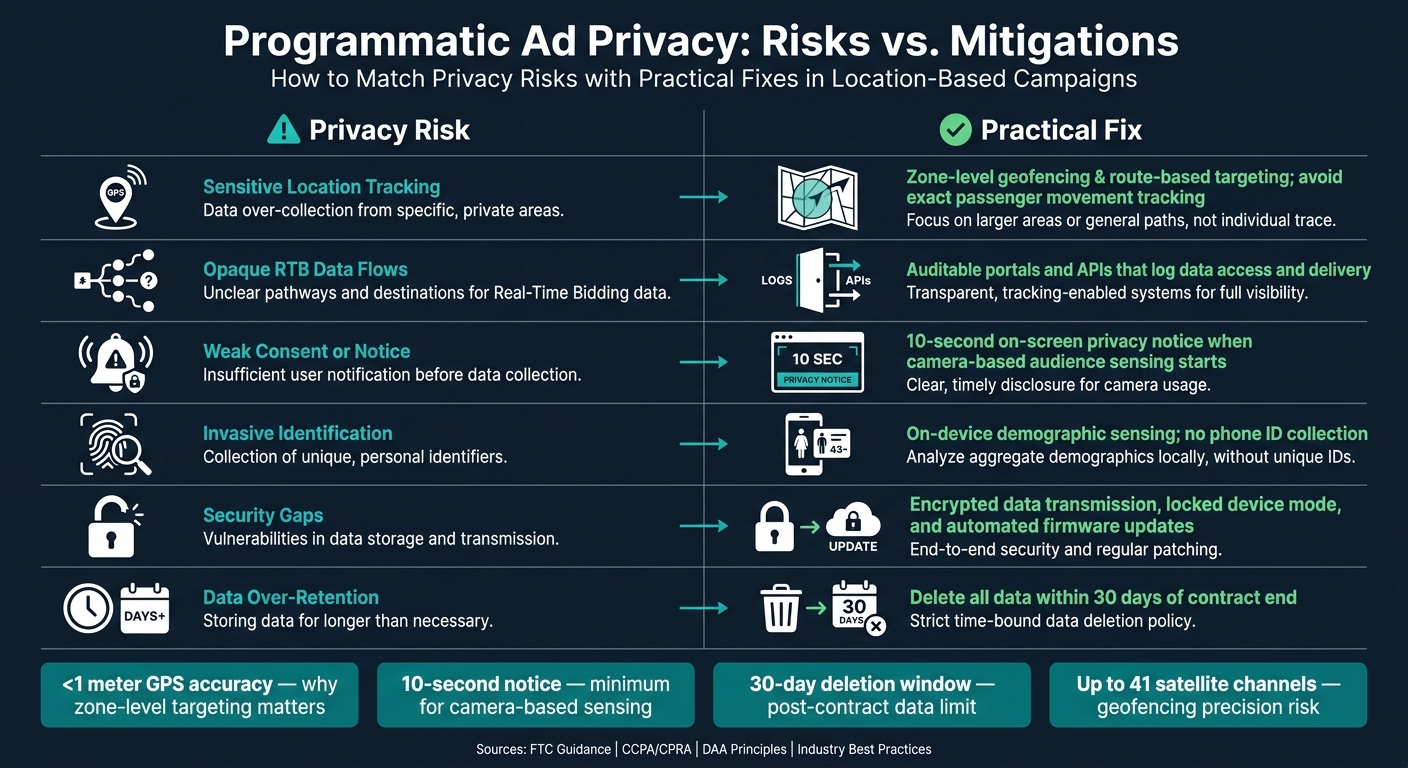
Programmatic Ad Privacy Risks vs. Mitigations: A Quick Reference Guide
These rules matter only if they show up in day-to-day campaign work. Privacy-safe programmatic advertising still uses geo-time targeting and analytics, but it cuts back on what gets collected, processed, and shared. The controls below help turn policy into routine action.
Start with the simplest rule: target zones or routes, not individual trips. In RTB, that means sending zone-level or route-level signals into the auction instead of detailed movement data.
Camera signals should be processed on-device, with only aggregated, non-identifiable outputs stored. And anyone under 18 should be left out of audience analysis altogether.
Retention needs a firm cutoff, too. Delete customer and location records within 30 days of contract end so data doesn’t just sit there forever.
Notice should appear where the data collection happens. For in-vehicle screens, show a 10-second on-screen privacy notice when camera-based audience sensing starts.
Security risks don’t live in just one place. They can show up between the screen, the network, and the reporting tools. So encrypt data in transit and at rest, limit access by role, lock devices, and automate firmware updates. It also helps to review partners on a regular basis to check how they use data downstream.
The table below pairs common privacy risks with the most direct fixes.
| Privacy Risk | Practical Fix |
|---|---|
| Sensitive location tracking | Zone-level geofencing and route-based targeting; avoid tracking exact passenger movements |
| Opaque data flows | Auditable portals and APIs that log data access and delivery |
| Weak consent or notice | 10-second on-screen privacy notice when camera-based audience sensing starts |
| Invasive identification | On-device demographic sensing; no phone ID collection |
| Security gaps | Encrypted data transmission, locked device mode, and automated firmware updates |
| Data over-retention | Delete data within 30 days of contract end |
Once a campaign goes live, the job isn't done. You need to check that privacy controls still do what they're supposed to do.
On the compliance side, keep a close eye on privacy notice delivery, retention compliance, and access audit results. These aren't items to review once and forget. They need regular checks.
Trust signals matter too. Passenger complaint volume and opt-out rates show how people react to your data practices. If those numbers start to climb, that's often an early sign that something feels off to the audience.
On the performance side, track screen uptime, playback verification, fill rate, CPM, impressions per ride, and QR/NFC engagement. If a campaign looks good on paper but screens are offline or playback is failing, the numbers won't tell the full story.
| Metric Category | What to Track | Why It Matters |
|---|---|---|
| Compliance | Privacy notice delivery, retention compliance, access review results | Confirms legal alignment and reduces exposure |
| Trust | Opt-out rates, passenger complaint volume | Flags audience friction early |
| Delivery | Screen uptime, connectivity status, playback verification | Catches delivery failures before they compound |
| Revenue | Fill rate, CPM, impressions per ride, QR/NFC engagement | Shows whether privacy-safe delivery still drives results |
Taken together, these metrics show whether privacy controls can hold up in day-to-day operations.
Fleet-level privacy monitoring needs one central place to manage everything. Enroute View Media's cloud-based ad and screen management platform gives operators that single control point, so they can apply and enforce privacy rules on a continuous basis.
A centralized dashboard can enforce geo-time rules, log device status, verify playback, and limit access with role-based controls. It can also surface access logs, offline alerts, and playback failures in real time. That matters because problems get caught fast instead of showing up weeks later during a manual audit.
Privacy controls and campaign performance don't have to compete with each other. When the data side is handled well, reporting gets cleaner, operations get safer, and campaign performance is easier to maintain over time.
Sensitive location data includes GPS-based information that can show a person’s exact location or movement. That includes the precise place and timestamp tied to ad delivery and verification.
It also covers precise geofencing or geo-targeting used to detect when someone enters a set area for ad serving. Why does that matter? Because it can reveal very detailed patterns about where someone goes and when.
Brands can use programmatic advertising without invading privacy by taking a privacy-by-design approach built around anonymization and data minimization.
At Enroute View Media, that means we don’t store or share identifiable footage. We use real-time anonymized demographic detection, then rely on aggregated, consent-aware measurement instead of invasive phone ID tracking.
Focus on three things.
First, check whether data is collected only in privacy-preserving form, with no identifiable data kept in storage. That means no names, no device IDs tied back to a person, and no records that can be used to single out an individual later.
Second, review any face or camera analytics closely. They should be limited to anonymized reporting only and must not store footage or share it outside the system. Put plainly: the system can count or summarize, but it shouldn't keep video files or send them elsewhere.
Third, make sure consent and disclosure steps work the way they’re supposed to. If users are meant to see a notice, get a prompt, or give permission, test that flow end to end and confirm it fires at the right time.
You should also confirm that data-minimization rules are being enforced in practice, not just written down on paper. The system should collect only what it needs for the stated purpose and nothing extra.
Pay close attention to protected groups as well. Sensitive populations must be excluded where the law requires it, including a hard rule that no analysis is performed on anyone under 18.
Need pricing details?
EnrouteViewMedia is a Canadian technology company based in Edmonton, Alberta, Canada. The company was founded by a group of media entrepreneurs and engineering executives. Our mission is developing leading-edge digital media display technologies for taxicab rooftops and taxicab interiors advertising market. Through our easy to use ad delivery and management system, we assist our clients in reaching their customers with targeted exposure. EnRouteViewMedia continuously strives to be the global leader in digital geo-time targeted advertising media systems for modern taxi fleets.