
Five location-based DOOH tactics—geo-targeting, geofencing, POI targeting, dayparting, and demographic layering—to improve ad relevance and ROI.
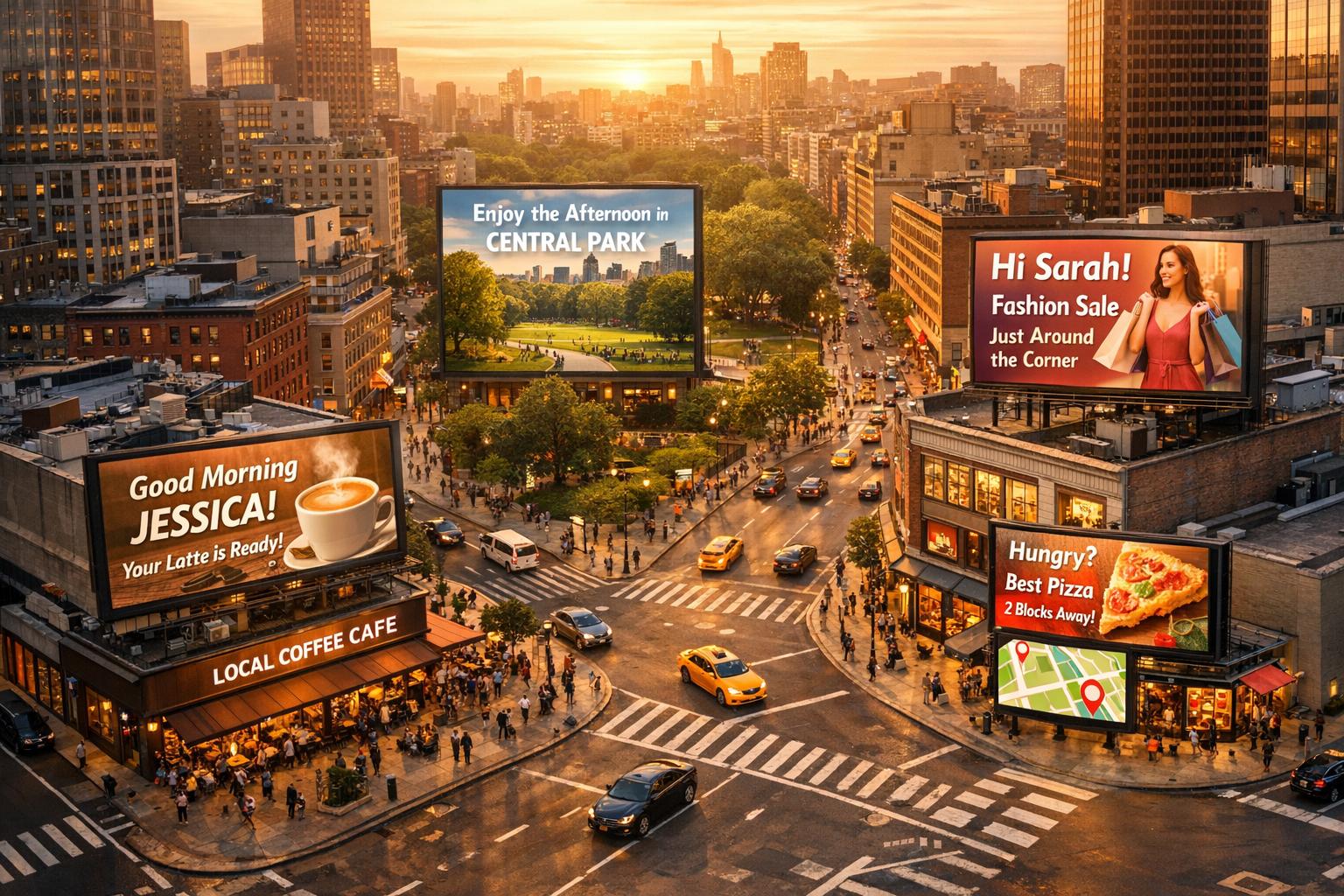
Digital Out-of-Home (DOOH) advertising now allows brands to connect with audiences in real-time by leveraging location data. Here's how you can use it effectively:
Using platforms like Enroute View Media, advertisers can automate these strategies, ensuring ads dynamically update based on location, time, and audience data. This approach not only increases relevance but also improves engagement and ROI.
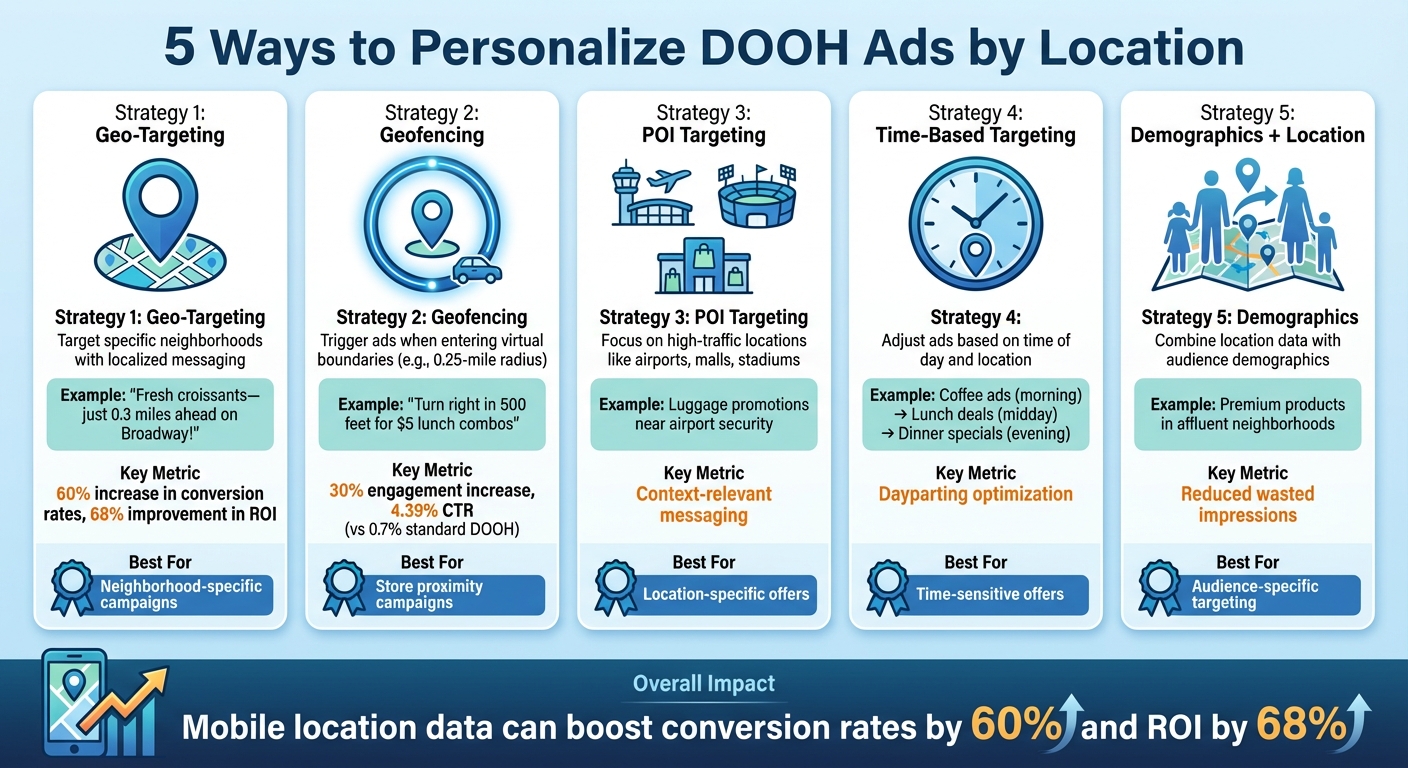
5 Location-Based DOOH Advertising Strategies with Performance Metrics
Geo-targeting allows you to craft ads that speak directly to specific neighborhoods rather than broadcasting the same message across an entire city. By tapping into GPS, Wi-Fi, and mobile location data, you can tailor your ads to match the unique vibe of each area. Picture this: a taxi rooftop LED screen cruising through a busy downtown business district in the morning could feature promotions for coffee shops, while later in the day, as the same taxi drives through a residential neighborhood, it switches to ads for family-friendly restaurants. This kind of hyper-local targeting ensures your ads feel relevant and timely.
For even more precision, you can define custom areas - like specific blocks, shopping streets, or ZIP codes - rather than relying on broader, less accurate circles that might include irrelevant locations. Exclusion zones can also help you focus your budget on the areas most likely to drive results. With these localized zones in place, your ad content can be designed to resonate with the people in those areas.
Including references to nearby streets, landmarks, or even beloved neighborhood nicknames can make your ads feel personal. For example, a bakery could run ads on DOOH screens in high-traffic areas saying, "Fresh croissants - just 0.3 miles ahead on Broadway!" This kind of messaging grabs the attention of nearby commuters and encourages them to stop by.
The impact of geo-targeting is clear. Forrester reports that incorporating mobile location data into campaigns can boost conversion rates by 60% and improve ROI by 68%. Platforms like Enroute View Media take this a step further for vehicle-based DOOH, automatically updating ads as vehicles move, ensuring that every impression is locally relevant.
To get started, use foot traffic data to identify neighborhoods that align with your target audience. Test different ad creatives that reference local streets or hotspots, then shift your budget toward the areas delivering the best results. This approach ensures your message hits home - literally.
Geofencing lets you create virtual boundaries around specific areas - like a 0.25-mile radius around your store, a stadium outline, or even a competitor's location - to display ads at the perfect time and place. This approach ensures your ads reach people when they’re most likely to connect with your message.
Setting it up is straightforward. You define a zone in your ad platform, whether it’s a simple circle or a custom shape. When a vehicle crosses into this zone, its GPS triggers the assigned ad. As soon as it enters, the screen displays your tailored creative. When it leaves, the ad updates to stay relevant.
The impact is hard to ignore. Data shows geofencing can increase engagement by as much as 30%, with click-through rates hitting 4.39% - compared to just 0.7% for standard digital out-of-home (DOOH) ads. Plus, mobile retargeting linked to geofencing can boost conversions by another 30%.
You can use geofencing in several effective ways: deliver last-minute messages near your stores (like "Turn right in 500 feet for $5 lunch combos"), promote event-specific deals near venues, or even target competitors’ locations with better offers. Just make sure your campaigns follow privacy regulations by using data from users who’ve opted in - 42% of mobile users willingly share their location.
Platforms like Enroute View Media simplify geofencing with a cloud-based system. You can easily draw geofences, update screens in real time, and set time-specific rules (e.g., breakfast specials in the morning, happy hour deals in the evening). These tools make it easy to keep your ads relevant and seamlessly integrate geofencing into your broader DOOH strategy.
POI targeting zeroes in on specific landmarks and venues like airports, stadiums, shopping malls, and transit hubs, rather than casting a wide net over neighborhoods or ZIP codes. It works hand-in-hand with neighborhood-focused messaging and geofencing, honing in on spots where people are already engaged. Imagine this: a luggage brand promoting carry-ons right by airport security, or a sports bar advertising game-day specials just steps from a stadium. These ads feel timely and relevant because they connect directly to what people are doing in the moment.
This hyper-local approach takes contextual relevance to the next level. The message aligns perfectly with the viewer’s current mindset - whether they’re leaving a mall and thinking about shopping, waiting at an airport with travel on their mind, or heading to a stadium ready for some entertainment.
To set up a POI campaign, start by identifying high-traffic locations that align with your business goals. Dive into geospatial analysis and foot traffic data to pinpoint where your audience is likely to go - think convention centers during trade shows, big-box stores on weekends, or popular dining districts during lunch hours. Once you’ve mapped these hotspots, create geofences around them and craft ads that reference the location directly. For example: "Hungry after the game? We’re just a two-minute walk away on 5th Ave."
For vehicle-based DOOH (Digital Out-of-Home) advertising, POI targeting can dynamically adjust ads as vehicles approach or leave high-traffic zones. Picture a taxi near a convention center displaying parking deals, then switching to restaurant promotions as it moves toward a dining district. Platforms like Enroute View Media make this possible by defining zones around key areas like airports or shopping districts, ensuring ads automatically adapt in real-time without needing constant manual updates.
To make your ads resonate even more, tailor the creative to the environment. Use clear directional cues like "across from Gate B" to help viewers locate you easily. Highlight localized offers in U.S. dollars, such as "Save $10 today", and design your message to match the setting. For fast-moving traffic, keep it short and bold. For areas where people linger, provide concise yet engaging content. When your ad fits seamlessly into the viewer’s context, it stops feeling like an ad and starts being genuinely helpful.
Dayparting takes DOOH advertising to the next level by combining time-based scheduling with location data. This lets you tailor your messaging to fit the needs of your audience at specific times and places. Picture this: a coffee shop promotes breakfast specials in business districts during the early morning rush, switches to lunch deals by midday, and later, in residential neighborhoods, showcases dessert options after 6:00 PM. This strategy ensures your ads are aligned with what people are looking for at that moment, in that exact location, making your messaging far more relevant.
Studies confirm that syncing location and time data can significantly improve engagement and conversion rates.
For vehicle-based DOOH, like taxi rooftop screens, geo-time targeting takes this concept even further. Content updates automatically as vehicles move through different areas at different times. By leveraging GPS data, platforms like Enroute View Media seamlessly trigger the right ad creative in real-time, without requiring manual input. This ensures your message is always in sync with the viewer’s immediate surroundings and context.
To get started, break the day into key timeframes - such as the morning commute (7:00 AM–9:00 AM), lunch hours (11:30 AM–1:30 PM), and evening drive (5:00 PM–7:00 PM). Pair these time slots with specific zones like office districts, shopping areas, or entertainment hubs. Then, upload your time-specific ads to a programmatic DOOH platform and let the system handle the rest. Testing different variations can help identify the most effective messaging for each audience segment.
The real magic happens when your ad fits seamlessly into someone’s daily routine. Think about it: stressed professionals on their way to work value speed and efficiency, while families heading home after a long day are looking for comfort and relaxation. When your message aligns with what someone needs in that moment, it stops feeling like an ad and becomes genuinely helpful.
Expanding on location-based strategies, combining location data with demographic insights takes ad targeting to a whole new level. Knowing where someone is gives you part of the picture, but understanding who they are transforms your approach. By layering demographic details - like age, income, household size, and lifestyle preferences - on top of location signals, you move from generic placements to highly tailored audience targeting. For instance, the same screen can display entirely different ads depending on whether it’s located in a neighborhood of young professionals or suburban families. This level of precision reduces wasted impressions and delivers better results. Achieving this requires reliable demographic data, easily obtainable from official sources and mobile analytics.
Sources like the Census, ACS, and anonymized mobile data from opted-in devices can help you map audience profiles down to ZIP codes or census tracts. Additionally, third-party providers offer behavioral segments such as “frequent travelers” or “luxury shoppers.” By aligning these profiles with DOOH screens, you can focus your ad spend on inventory that directly reaches your target audience instead of blanketing an entire city.
Here’s an example: A financial services company promoting a premium credit card identifies neighborhoods across the U.S. where median household incomes exceed $120,000 and professionals aged 30–55 are highly concentrated. They then target screens near Class A office buildings, upscale malls, and airport lounges with ads highlighting travel rewards and concierge perks. Meanwhile, suburban retail screens in areas with different income profiles display a more general offer. This tailored messaging ensures the product resonates with each audience.
In mobile DOOH, this strategy enables real-time, audience-specific messaging. For instance, taxi rooftop screens powered by platforms like Enroute View Media use live GPS data and demographic patterns along routes to serve dynamic ads. Business travelers might see one message, while nightlife-goers downtown see another. The system seamlessly integrates route-level location data with demographic segments, automating message delivery for maximum relevance.
"Promotional messages are broadcasted to the right people, in the right place, at the right time for optimal delivery. Create geo-fences and target based on demographic information."
- Enroute View Media
To test this approach, start small: pick a single metro area, define a clear target audience, and partner with a DOOH provider that supports audience-based planning. Run two campaigns side by side - one with a standard city-wide buy and another using location-plus-demographic targeting. Measure the difference in metrics like store visits, app downloads, or sales lift. Once the results show promise, you can roll out the strategy on a larger scale.
Location-based personalization takes digital-out-of-home (DOOH) advertising from a broad, awareness-focused approach to a precision-driven, performance-oriented strategy. By leveraging tools like geo-targeting, geofencing, POI targeting, time-of-day adjustments, and demographic layering, advertisers can move beyond generic messaging. Instead, they can deliver highly relevant ads tailored to specific moments - whether it's reaching morning commuters near transit hubs, shoppers in retail zones, or nightlife enthusiasts in entertainment areas. This level of precision leads to results you can measure.
Consider this: mobile location data can increase conversion rates by 60% and boost ROI by 68%. Geofencing alone can raise engagement by 30%, with click-through rates hitting 4.39% compared to just 0.7% for standard DOOH campaigns. These numbers speak volumes about the power of location-based strategies.
For businesses looking to streamline this process, automated platforms offer practical solutions. Take Enroute View Media's cloud-based system, for example. It automates geo-time targeting, provides real-time analytics, and integrates programmatically. As vehicles move through different neighborhoods, the platform dynamically updates ad content based on location, time of day, and audience data - ensuring the right message reaches the right audience without manual input.
To get started, treat location as a dynamic layer in your targeting strategy. Begin with a pilot campaign in a single metro area, focusing on refining audience segments and comparing geo-targeted ads against standard placements. Measure key performance indicators like store visits, app downloads, or sales lift. Once you see clear improvements, scale your efforts, confident that every screen and every time slot is optimized to deliver measurable business results.
Geo-targeting improves ad relevance by customizing messages based on specific locations, making them more relatable to local audiences. Leveraging location data, advertisers can craft content that aligns with the area’s context, increasing engagement and delivering stronger outcomes.
Enroute View Media takes this a step further with its geo-time targeted advertising technology for taxi and rideshare fleets. This innovation allows brands to reach mobile audiences in real-time, creating a more tailored and meaningful advertising experience for both businesses and consumers.
Geofencing takes digital out-of-home (DOOH) advertising to the next level by zeroing in on specific locations to target audiences. This means your ads can reach the right people at the right place, making them more relevant and increasing viewer engagement while cutting down on wasted impressions.
Another advantage? You can tweak campaigns in real time based on shifting conditions or audience behavior, keeping your ads as effective as possible. And with access to detailed analytics, you can track performance closely and fine-tune your approach to maximize your return on investment (ROI).
Demographic data plays a crucial role in fine-tuning location-based ad targeting. It provides valuable insights into essential audience traits such as age, gender, income levels, and lifestyle choices. With this information, advertisers can craft messages that connect more effectively with specific audience segments.
When demographic insights are paired with location data, ads can be customized to align with the distinct preferences and needs of local audiences. This approach not only enhances engagement but also boosts the likelihood of conversions.
Need pricing details?
EnrouteViewMedia is a Canadian technology company based in Edmonton, Alberta, Canada. The company was founded by a group of media entrepreneurs and engineering executives. Our mission is developing leading-edge digital media display technologies for taxicab rooftops and taxicab interiors advertising market. Through our easy to use ad delivery and management system, we assist our clients in reaching their customers with targeted exposure. EnRouteViewMedia continuously strives to be the global leader in digital geo-time targeted advertising media systems for modern taxi fleets.