
How motion sensors enable real-time DOOH audience measurement, targeting, and privacy-compliant analytics to boost ad relevance and ROI.
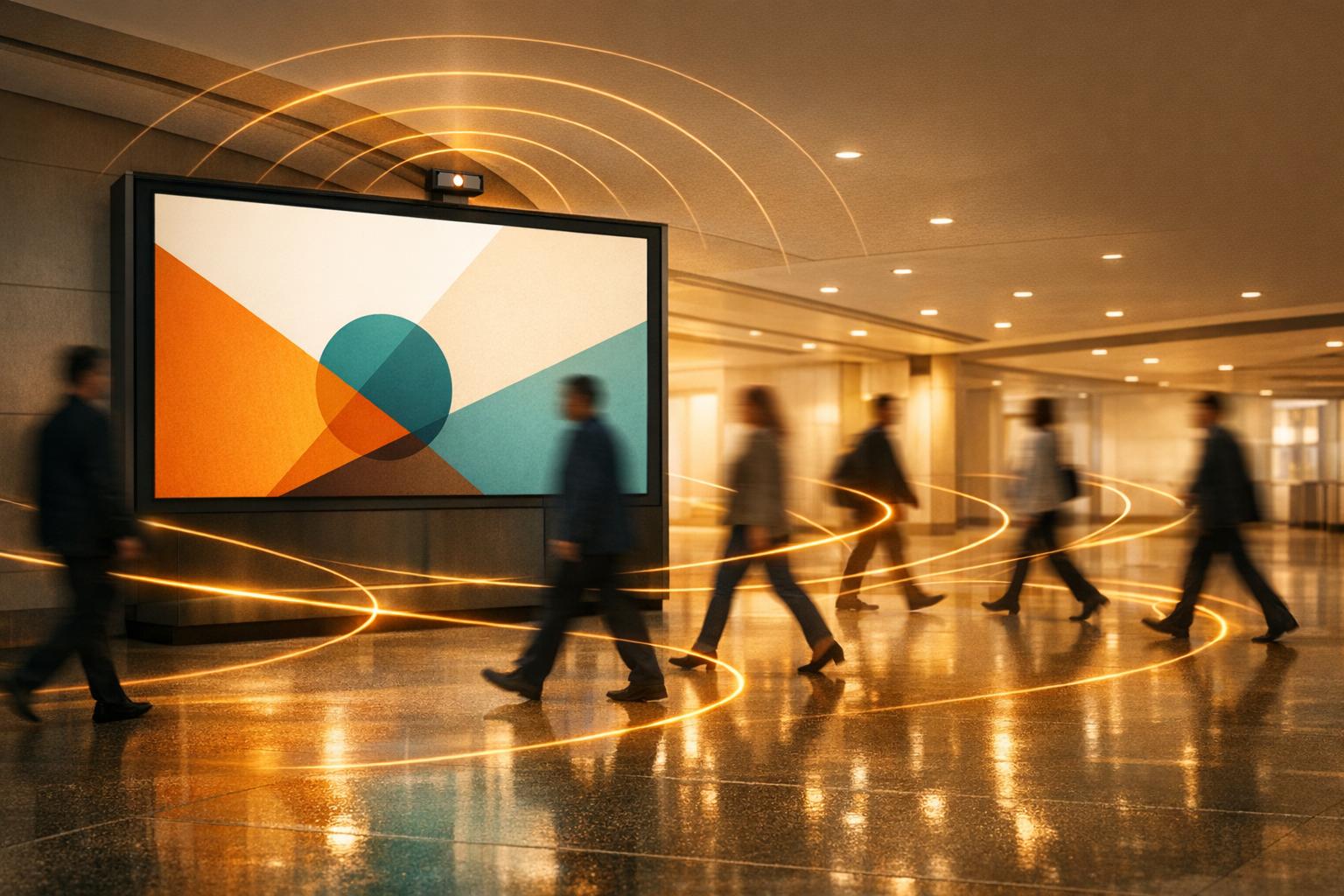
Motion sensors are transforming how advertisers measure and target audiences in Digital Out-of-Home (DOOH) campaigns. By using technologies like camera-based sensors, wireless signal detectors, and mobile SDKs, advertisers can gather real-time data on foot traffic, dwell time, and viewer demographics. This shift from broad estimations to precise, data-driven strategies is reshaping ad performance and ROI.
Motion sensors are helping advertisers deliver more relevant ads while respecting privacy, driving better results across static and mobile DOOH platforms.
Motion sensors in advertising don't rely on just one method - they combine multiple technologies to capture how audiences interact with ads. These systems integrate camera-based optic sensors, wireless signal detectors, and mobile SDKs to provide a detailed picture of audience exposure and engagement.
Camera sensors, enhanced by artificial intelligence and computer vision, are used to count people passing by an ad and analyze their demographics, such as age, gender, and even emotional reactions. With an accuracy rate of 85–90% for measuring real-time exposure, these sensors help answer a critical question: Did someone actually see the ad?.
Wi-Fi and Bluetooth sensors take a different route by detecting signals from mobile devices. This allows them to track foot traffic and identify repeat visitors without requiring a direct line of sight. These sensors are particularly useful for mapping movement patterns and understanding audience loyalty.
Mobile SDK data adds another layer of insight. By using anonymized location data from smartphone apps, advertisers can track roughly 15% to 30% of mobile devices. This data helps create detailed audience profiles, offering a deeper understanding of who interacts with the ads.
By combining these technologies, modern DOOH systems provide a comprehensive view of traffic, exposure, and engagement. This fusion of data sources enables advertisers to not only count viewers but also understand how they interact with the content.
Now that we’ve covered the sensor types, let’s dive into the kinds of data they capture.
Quantitative metrics form the backbone of campaign analysis. These include total impressions, foot traffic counts, and the number of people exposed to a screen. Such data is essential for measuring the reach of DOOH campaigns and shaping dynamic ad strategies.
Engagement metrics go a step further, focusing on how audiences interact with ads. For example, dwell time - how long someone stays engaged - can be measured in intervals as short as 15 minutes. This helps identify peak engagement times. Additionally, tracking movement patterns reveals how people navigate spaces, which can guide decisions about where to place screens for maximum impact.
Demographic and behavioral insights are another key area. Camera feeds and mobile signals can estimate age ranges, gender, and even emotional responses in real time. When combined with mobile SDK data, advertisers can also gain insights into purchase intent, interests, and income levels.
Contextual data adds even more depth. By factoring in elements like weather, time of day, and location, advertisers can create highly targeted campaigns. For instance, a taxi with rooftop LED screens - like those from Enroute View Media - can adjust its ads based on the neighborhood, the stage of the commute, or even the weather. This level of adaptability makes these ads far more relevant than static billboards ever could.

Traditional vs Motion Sensor Tracking in DOOH Advertising
Motion sensor technology has brought measurable advancements to DOOH (Digital Out-of-Home) advertising. Studies reveal that optic sensor-based computer vision can measure real-time exposure with impressive precision. This marks a major departure from the rough estimations advertisers had to rely on for decades.
Switching to motion sensor tracking has dramatically improved the accuracy of audience measurement. Traditional methods relied on manual counts and broad assumptions, often offering data as infrequent as monthly or weekly averages. In contrast, motion sensors provide real-time insights, updating as frequently as every 15 minutes. Here's a side-by-side comparison:
| Feature | Traditional Tracking | Motion Sensor Tracking |
|---|---|---|
| Accuracy | Low; based on rough estimates | High; uses real-time data |
| Real-Time Capability | Static; monthly or weekly averages | Real-time; 15-minute intervals |
| Measurement Type | Potential contact (OTC) | Actual viewed impressions (VAC) |
| Data Granularity | Broad geography | Individual movement patterns |
| Privacy | Manual observation or surveys | Anonymized sensor data |
A major drawback of traditional mobile tracking, like Wi-Fi or Bluetooth, is the issue of "fidelity." Devices are often detected through walls or floors, leading to inflated counts. Optic sensors solve this by identifying whether a person is actively facing a screen, ensuring more accurate data collection.
These advancements not only refine measurement accuracy but also open doors for better performance tracking.
The benefits of motion sensor tracking are backed by real-world data. Advanced estimation techniques have cut measurement errors by over 50% compared to older manual or polygon-based methods. In areas with fluctuating traffic, using historical data for comparison has further reduced errors by 38%.
"The application of VACs [Visibility Adjusted Contacts] makes the accuracy of OOH audience measurement unparalleled within the media measurement landscape." - JCDecaux
This level of precision doesn’t just improve measurement - it also drives smarter, more targeted advertising strategies.
For example, Sea-Doo experienced a 130% boost in positive brand perception, while Holt Renfrew saw a 7% weekly in-store conversion rate, all thanks to enhanced audience tracking. These results highlight how accurate data can translate into tangible business benefits.
Motion sensors are reshaping digital out-of-home (DOOH) advertising by turning it from a broad-reaching medium into a precise tool for targeting audiences. These sensors collect real-time data on movement patterns, demographics, and behaviors - insights that traditional methods simply can't provide. This means advertisers can focus on reaching the right people at the right time, rather than casting a wide, less effective net.
Research shows the impact of programmatic DOOH campaigns is hard to ignore. These efforts deliver a 40% stronger lift in brand awareness, an 11% boost in purchase intent, and a 42% increase in consideration compared to untargeted campaigns. By reducing wasted impressions, advertisers ensure every dollar spent is working harder.
Motion sensors allow advertisers to align their messaging with real-world behaviors and conditions. Optical sensors, boasting an accuracy rate of 85–90%, can determine audience density and trigger creative content accordingly. When combined with factors like weather, time of day, or specific events, this technology enables highly relevant, real-time ad delivery.
"By mapping these real-world journeys, brands can serve ads to the right people, in the right place, at the right time." – Aliana Heffernan, Vistar Media
Take UGG, for example. In 2024, the brand launched a DOOH campaign promoting its "rain-or-shine" collection. Using weather-based triggers and proximity targeting across urban panels, taxis, and rideshares, the campaign achieved a 7% lift in awareness, a 6% lift in consideration, and a 6% increase in purchase intent. Michelle Hernandez, Director of Omni Digital Marketing, led the initiative.
Another standout example is Decathlon in the Netherlands. By using Talon NL's sensor-driven DOOH screens near its stores, Decathlon matched ad placements with shopper movements. This strategy led to a 46% increase in foot traffic at targeted locations. These campaigns highlight how DOOH can influence consumers in the moments leading up to a purchase.
Motion sensors and camera-based analytics also make it easier to segment audiences in real time. By capturing demographic data like age and gender, along with movement patterns and dwell time, advertisers can adapt their creative content on the fly to better connect with specific groups.
"Data targeting helps you focus media spend on who, where and when it will have the biggest impact. It maximizes ROI by eliminating wasted impressions and concentrating directly in the moments and locations that matter most." – Vistar Media
In 2024, Jack in the Box used this approach to promote its Cheddar Loaded Cheeseburger. Partnering with Vistar Media and Posterscope, the campaign used proximity targeting and audience data to generate 49 million impressions, resulting in an 8.8% increase in foot traffic and over 1.3 million store visits. Senior Regional Marketing Manager Jaime Ogus oversaw the project.
Today, advertisers have access to more than 17,000 global audience segments based on demographics, behaviors, and interests. By integrating first-party data from CRM systems with sensor-derived movement data, brands can target existing customers or find new ones with similar habits. This moves DOOH from generic geographic targeting to highly relevant, behavior-based strategies.
For vehicle-based campaigns, like those run by Enroute View Media, motion sensors take targeting even further. These sensors track when vehicles enter high-value areas and adjust ad content to match the audience and surroundings in real time. This ensures ads stay relevant throughout the journey, maximizing their effectiveness.
Building on the success of motion sensor tracking in stationary digital out-of-home (DOOH) advertising, vehicle-based campaigns bring these capabilities to moving environments. What started as static vinyl wraps on vehicles has evolved into a dynamic advertising channel. With motion sensors and GPS technology, taxis and rideshare vehicles are now mobile platforms delivering contextually relevant ads. These systems track movement, proximity, and surrounding conditions to trigger ads at the right time and place.
Motion sensors in vehicle-based advertising operate in two main areas: rooftop LED screens aimed at pedestrians and drivers, and in-taxi touchscreens designed to engage passengers during their ride.
Rooftop LED displays use GPS sensors to deliver location-specific ads. For instance, when a taxi enters a geofenced area - like a busy downtown district during rush hour - the system automatically displays ads tailored to that environment. These screens maintain high visibility with 4,500-nit brightness, even in direct sunlight, while consuming minimal power.
Inside the vehicle, touchscreens equipped with eye-tracking technology monitor passenger interaction. These sensors capture data such as dwell time, touch activity, and overall engagement.
Both rooftop and in-cabin systems are managed through a cloud-based platform. This allows fleet operators to schedule ads remotely and target them based on real-time factors like GPS location, time of day, or movement patterns. The platform also includes features like low-voltage cut-offs and smart shutdown timers to prevent battery drain.
The results speak for themselves. Research shows that taxi-top LED ads grab 65% more attention compared to traditional static displays. This increased visibility has led advertisers to pay 20% to 50% more for dynamic rooftop ads. The market for in-taxi digital signage is also on the rise, with projections showing growth from $0.8 billion in 2024 to $1.2 billion by 2034, reflecting a compound annual growth rate of 4.8%.
This seamless integration of sensors not only improves ad delivery but also sets the stage for advanced programmatic advertising.
Just like traditional DOOH platforms, vehicle-based advertising uses sensor data to fuel automated, data-driven campaigns. By leveraging this data, ad delivery becomes more precise and efficient through programmatic platforms. With GPS and computer vision sensors, every ad unit becomes measurable and comparable over time.
Multiple data streams power this system. GPS sensors track routes and speed, environmental sensors monitor weather and temperature, and eye-tracking sensors measure passenger engagement. All this information feeds into real-time analytics platforms, which map impression performance to identify high-impact "hotspots".
"StreetMetrics' complete set of measurement and attribution tools gives us the ability to provide our advertisers with data beyond just impression numbers." – Ranjit Phagura, CEO, AdLoad
Programmatic platforms use this data to automate ad delivery based on contextual triggers. For example, a vehicle passing a highway might display fuel station ads, while one entering a shopping area at lunchtime could promote nearby restaurants. The content adjusts automatically, requiring no manual input.
Enroute View Media's platform integrates with programmatic ad networks to make this real-time optimization possible. It generates automated proof-of-play logs, verifying when and where ads were shown, which helps advertisers calculate ROI. Additionally, the system can dim or pause ads when vehicles exceed certain speeds, ensuring compliance with safety regulations.
The adoption of programmatic buying has revolutionized vehicle-based advertising. Advertisers no longer need to purchase routes or zones; they can now target audience behaviors and movement patterns. This approach brings the precision of mobile and web advertising into the physical world.
DOOH motion sensor tracking presents unique privacy challenges because, unlike online tracking, it doesn't prompt individuals for explicit consent. When people pass by a digital billboard or ride in a taxi, they aren’t asked to opt in, which raises concerns about consent and transparency in public spaces.
Most motion sensor systems are built with privacy safeguards to address these concerns. Rob Côté, Content Strategy Lead at Broadsign, explains:
"The anonymized nature of DOOH audience data means that DOOH audience data falls outside the scope of GDPR".
However, privacy risks arise when sensor data is combined with other sources, such as mobile app data, location histories, or social media profiles, potentially creating more detailed and identifiable user profiles.
Modern motion sensors prioritize privacy by processing data directly on the device, avoiding the transmission of raw footage to the cloud. These systems typically extract basic metadata - such as age range, gender, or group size - and delete visual data almost instantly. For example, Advertima's technology ensures visual data is erased within 70 milliseconds of capture.
"Our technology immediately deletes the visual information after extracting the anonymized data within 70 milliseconds." – Advertima
This ensures that no images or videos are stored, with only anonymized demographic information retained. When mobile identifiers are used, they are hashed or aggregated to prevent linking data to specific individuals. Other technologies, such as infrared sensors for foot traffic counting or WiFi detection, focus solely on volume metrics without capturing visual details. These methods form the backbone of privacy-conscious data collection.
In addition to anonymization, operators must navigate compliance with regulations like GDPR, CCPA/CPRA, and Virginia's VCDPA. The Center for Democracy and Technology emphasizes the importance of privacy controls:
"CDT believes consumer privacy controls are essential for digital signage advertising to gain consumer trust, which in turn is crucial if the industry is to continue growing at its current explosive pace".
Operators are also expected to respect device-level privacy settings, such as "Limit Ad Tracking" on iOS or "Opt out of interest-based ads" on Android. Systems should honor signals like "Do Not Track" and Global Privacy Control as valid opt-out requests. Interestingly, in 2024, Vistar Media reported receiving no data deletion, access, or opt-out requests from California consumers regarding their DOOH services.
Ethical guidelines strictly prohibit using motion sensor data for discriminatory purposes, such as evaluating employment eligibility, creditworthiness, or insurance rates. Data contracts must clearly ban these practices and require partners to adhere to GDPR, CCPA, and similar standards. Despite these efforts, transparency remains a challenge, and operators are exploring ways to inform viewers about tracking practices without disrupting their experience.
Motion sensors have transformed the way DOOH (Digital Out-of-Home) advertising measures and targets audiences. The move from static estimates, which relied on zip codes and DMAs, to real-time coordinate tracking has significantly reduced measurement errors - by over 50% compared to 2019 methods. For vehicle-based advertising, platforms now log precise coordinates at the start and end of ad campaigns, offering a clear picture of the audience reached.
The OAAA explains:
"The methodology uses additional input data to provide more context to traditional mobile location information. By capturing two sets of timestamped latitude and longitude data... and media position... you can generate definitive insights about who was exposed, and where".
This leap in accuracy allows advertisers to target audiences based on movement patterns and intent instead of relying on broad geographic assumptions, leading to better ad targeting and stronger ROI.
Advancements in this space also enable mobile advertising platforms to deliver highly dynamic, location-based campaigns. Companies like Enroute View Media are capitalizing on this with tools like rooftop LED screens and in-taxi touchscreens. Their cloud-based platforms combine real-time analytics with programmatic ad networks, giving advertisers the flexibility to adjust campaigns based on location, time, and audience behavior. With the DOOH market projected to reach $3 billion by 2025 and consumer exposure to these ads on the rise, the potential for precise audience engagement continues to grow. These innovations are helping advertisers achieve measurable returns and deeper connections with their audiences across various DOOH channels.
As targeting becomes more precise, protecting user privacy remains critical. Anonymized data collection methods, which process information directly at the device level, ensure compliance with regulations like GDPR and CCPA. The industry's pivot toward targeted, data-driven campaigns shows that it’s possible to balance accuracy with privacy, setting the stage for a sustainable future in DOOH advertising.
Motion sensors use cutting-edge technologies like facial recognition, motion detection, and engagement tracking to monitor audience behavior in real time. By analyzing this data with advanced algorithms, they can measure viewer attention and interactions, providing insights into whether an ad successfully captured an audience's focus.
Using motion-sensor targeting in Digital Out-of-Home (DOOH) campaigns can greatly elevate engagement and performance. Research shows that incorporating real-time location and movement data can boost relevance and effectiveness by as much as 30%. This strategy allows ads to be more precisely tailored to the audience, making campaigns far more impactful.
Audience tracking prioritizes privacy and regulatory compliance, such as GDPR and CCPA, by handling data directly on edge systems. Instead of storing or streaming raw data, insights are generated through inferences and aggregated information. This method ensures audience anonymity while adhering to strict privacy standards.
Need pricing details?
EnrouteViewMedia is a Canadian technology company based in Edmonton, Alberta, Canada. The company was founded by a group of media entrepreneurs and engineering executives. Our mission is developing leading-edge digital media display technologies for taxicab rooftops and taxicab interiors advertising market. Through our easy to use ad delivery and management system, we assist our clients in reaching their customers with targeted exposure. EnRouteViewMedia continuously strives to be the global leader in digital geo-time targeted advertising media systems for modern taxi fleets.