
GPS, 4G/5G, AI and AR turn in-taxi screens into targeted, programmatic ad platforms with real-time analytics and passenger engagement.

Interactive in-taxi screens have transformed from simple payment tools into advanced advertising platforms. By combining GPS targeting, programmatic bidding, and real-time analytics, these screens offer advertisers the ability to reach a captive audience during taxi rides. Modern features include 4G/5G connectivity, AI-driven personalization, and AR interactivity, enabling tailored ads and passenger engagement.
Key Highlights:
These advancements make in-taxi screens a powerful tool for urban advertising, offering brands a way to connect with consumers in real-time during their journeys.
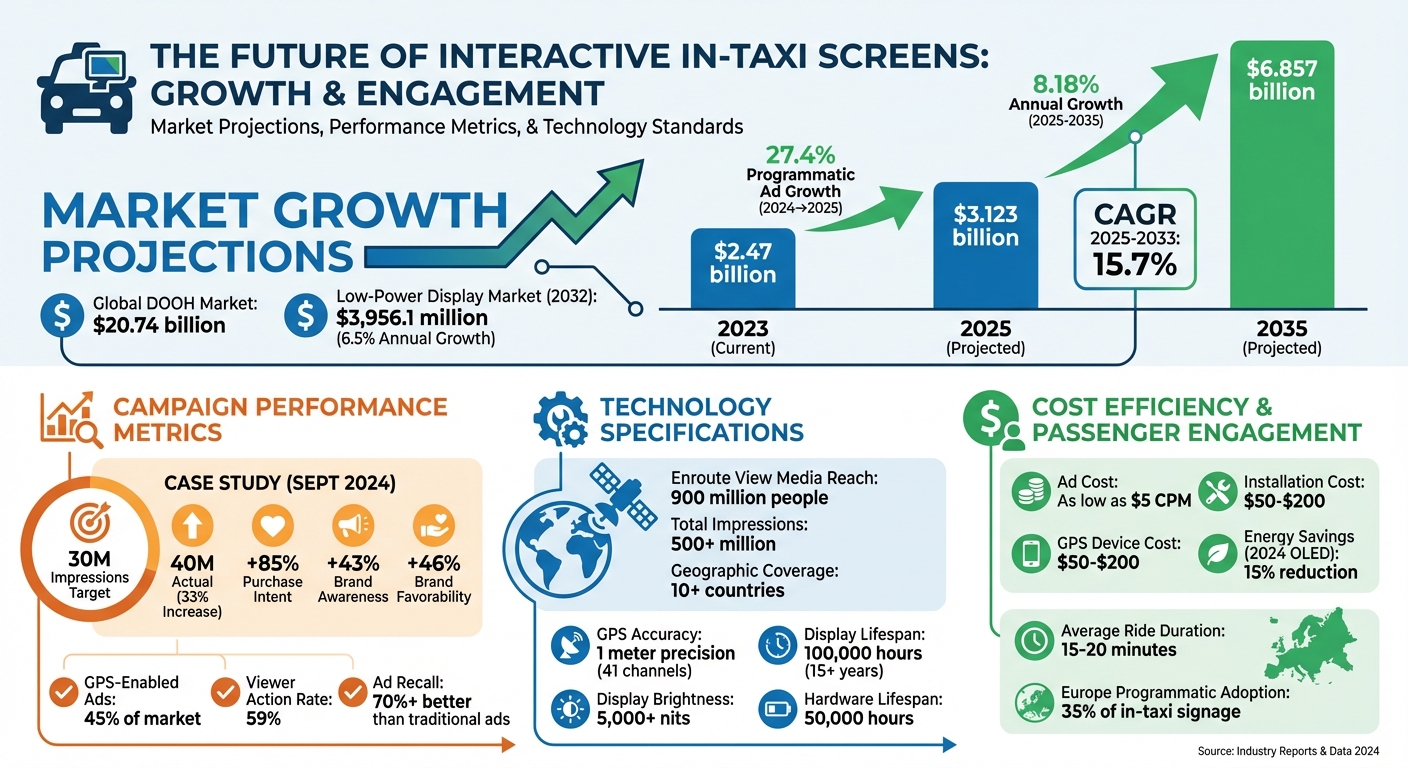
In-Taxi Digital Advertising: Market Growth, Performance Metrics & Technology Stats 2024-2035
Today's in-taxi screens have transformed into advanced advertising platforms, thanks to three key technologies: cloud-based ad management, high-speed connectivity, and cutting-edge AI/AR features. Let’s dive into how cloud systems and location tracking drive these innovations.
Cloud platforms have revolutionized ad management by enabling remote updates, eliminating the need for on-site adjustments. Tools like DigiStreamView allow brands to schedule and control media - whether it’s images, videos, or HTML5 content - across entire taxi fleets from a single dashboard. For instance, a restaurant chain can promote breakfast deals in the morning and seamlessly switch to dinner ads by evening, all without manual intervention.
These systems have propelled in-taxi screens from static displays to dynamic, targeted advertising platforms. One standout feature is Geotargeting-Time with Advertising (GTWA), which combines precise GPS tracking (leveraging up to 41 satellite channels) with time-based ad delivery. This technology can pinpoint locations within 1 meter, triggering ads based on a taxi’s position. For example, when a taxi enters a specific neighborhood or passes a competitor, geo-conquesting enables relevant ads to appear in real time.
In September 2024, a cosmetics brand used Firefly’s digital taxi advertising across cities like Chicago, New York, Los Angeles, and Miami. The campaign, initially aiming for 30 million impressions, surpassed expectations with nearly 40 million impressions - a 33% increase. It also drove an 85% boost in purchase intent, a 43% rise in brand awareness, and a 46% lift in brand favorability.
"Firefly car tops are everywhere we look, the visibility we get is unmatched with any other OOH option in New York."
– Co-Founder, ALB Vodka
Additionally, cloud systems integrate with programmatic ad networks, enabling real-time bidding for screen inventory. Advertisers can track metrics like impressions and engagement through live dashboards, making it easy to tweak campaigns on the go. The hardware behind these systems isn’t overly expensive, with GPS devices costing between $50 and $200, plus $50 to $200 for professional installation.
High-speed 4G and 5G networks are the backbone of modern in-taxi screens. These connections enable high-definition video streaming and allow for remote content updates across fleets without physical intervention. They also support edge computing and localized caching, ensuring smooth playback by reducing network delays.
Real-time analytics further enhance the impact of in-taxi advertising. Screens now account for 45% of GPS-enabled ads and prompt actions from 59% of viewers, contributing to the $20.74 billion digital out-of-home (DOOH) market. This data-driven approach helps advertisers identify the most effective routes and times, enabling dynamic updates that static billboards simply can’t match. Combined with robust connectivity, AI and AR take passenger engagement to the next level.
Artificial intelligence is changing the game by delivering highly personalized ad content. By analyzing passenger preferences and environmental data in real time, AI ensures ads are hyper-relevant. For instance, it might display umbrella ads during a rainstorm or promote iced coffee on a hot day.
Advanced sensors, such as infrared and high-resolution cameras, track audience engagement and exposure with remarkable accuracy. Meanwhile, augmented reality (AR) turns screens into interactive hubs. Capacitive touchscreens support HTML5 media, enabling passengers to engage with games, quizzes, and surveys. Features like QR codes, NFC tags, and short URLs connect the in-taxi experience to mobile commerce, letting passengers instantly claim discounts or shop online.
To ensure reliability, intelligent power monitors shut down screens if the vehicle battery drops below 12 volts, preventing disruptions. This robust design ensures consistent interactivity, regardless of external conditions or weather challenges.
Enroute View Media combines hardware, software, and data into a single platform designed for taxi advertising. Their setup includes 10.1-inch Android tablets and dual-sided P2.5 LED rooftop displays that boast over 5,000 nits brightness and a 100,000-hour lifespan. These displays are built for round-the-clock operation and outperform standard LCD screens in both visibility and durability.
At the core of this system is the DigiStreamView® platform, which uses cloud-based management to simplify operations. Fleet owners can update content across the network in less than a second, schedule campaigns remotely, and even implement automated software updates. Through GTWA technology, the platform utilizes precise 41-satellite GPS tracking to deliver ads tailored to specific locations and times. For example, it can show breakfast promotions near cafés in the morning and switch to dinner ads near restaurants in the evening.
The system also provides real-time analytics, tracking metrics like impressions, dwell times, routes, and engagement using embedded sensors and GPS data. Advertisers can monitor campaign performance live through dashboards, while sensor technology ensures accurate reporting on how many people viewed specific ads. Integration with global programmatic ad networks enables real-time bidding and dynamic CPM pricing based on location, time, and route data. With a reach of 900 million and over 500 million impressions spanning 10+ countries, Enroute View Media has become a scalable solution for modern mobility advertising.
These features are offered through subscription plans designed to fit fleets of all sizes.
Enroute View Media structures its service offerings into three subscription tiers: Basic, Professional, and Enterprise.
"enRoute partnership has helped us scale faster, more efficiently, and cost-effectively."
– Sebastian, CTO of Aceme
The subscription model covers both software and fleet operations, allowing fleet owners to focus on generating revenue rather than worrying about technical maintenance. This approach positions Enroute View Media as a forward-thinking solution, seamlessly blending cutting-edge technology with practical applications to shape the future of mobility advertising.
The programmatic advertising industry is on a fast track, with projections showing growth from $12.33 billion in 2024 to $15.7 billion in 2025, reflecting a 27.4% annual increase. This surge is changing the way advertisers approach in-taxi screens. Instead of relying on fixed-rate ad placements, advertisers now turn to Demand-Side Platforms (DSPs) to automate the process. These platforms allow them to set specific parameters - like targeting certain neighborhoods, times of day, or even weather conditions - that the system executes automatically. With real-time bidding (RTB) and dynamic creative optimization (DCO), ads can adjust instantly to match current conditions. Imagine an umbrella ad popping up the moment it starts raining or a restaurant promotion appearing as a taxi enters a geofenced area. This type of hyper-targeting ensures advertisers only pay for impressions that reach their intended audience.
Dynamic pricing adds another layer of sophistication, adjusting ad costs based on impression value. For instance, during rush hour, costs might spike, while off-peak times see lower CPMs. In Europe, nearly 35% of in-taxi signage already uses programmatic content distribution. These advancements in pricing and targeting are paving the way for more interactive and context-sensitive in-taxi advertising.
Advances in AI and real-time analytics are transforming in-taxi screens into highly interactive platforms. Modern touch interfaces now incorporate QR codes and NFC technology, enabling passengers to complete transactions like redeeming discounts, booking reservations, or making purchases directly during their ride. Studies show that over 70% of consumers remember digital screen ads better than traditional ones, and adding interactive elements further strengthens this recall.
Personalization is another game-changer. AI analyzes passenger demographics and preferences in real time to tailor ads to their needs. For instance, a business traveler might see ads for airport lounges, while a tourist might get recommendations for local attractions. In some markets, advanced features like facial recognition and sentiment analysis are being tested to refine ad relevance, though privacy concerns remain a significant issue.
Contextual triggers are also enhancing ad effectiveness. Dayparting technology, for example, can display breakfast ads near cafés in the morning and shift to dinner or entertainment options later in the day. Integration with ride-hailing apps creates a seamless multi-screen experience, catering to a wide range of passenger needs. With the global in-taxi digital signage market expected to grow from $3.123 billion in 2025 to $6.857 billion by 2035 at an 8.18% annual growth rate, these trends show no signs of slowing down.
The evolution of in-taxi screens isn’t just about content - it’s also about making the hardware more efficient and sustainable. Manufacturers are now opting for OLED and MicroLED technologies, which offer better contrast and use less energy. For example, Samsung Display’s 2024 OLED panels cut energy consumption by up to 15% compared to earlier models. These improvements not only support global climate initiatives but also extend hardware lifespans to over 15 years or 50,000 hours, significantly reducing electronic waste.
Adaptive brightness control is another standard feature. Ambient light sensors with PWM dimming adjust screen brightness to save power and extend battery life. For ultra-low power needs, e-paper technology provides excellent readability in sunlight while consuming minimal energy. The global market for low-power next-generation displays is projected to hit $3,956.1 million by 2032, growing at an annual rate of 6.5%.
"LEDs consume significantly less power than xenon or neon alternatives, reducing operational costs and environmental footprint." – KSS Display
Durability and recyclability are also becoming priorities in hardware design. Aluminum shells improve heat dissipation and prevent rust, while frosted PC plates resist yellowing and degradation over time. With IP65/IP66 ratings, these screens can withstand harsh urban environments. Modular designs further enhance sustainability by allowing component upgrades without the need to replace entire units. Together, these features make in-taxi screens a more efficient and cost-effective advertising solution for the long term.
Interactive in-taxi screens have come a long way, transforming from basic displays into sophisticated advertising tools that connect brands with urban audiences in ways traditional media can't. The global in-taxi digital signage market, valued at $2.47 billion in 2023, is projected to grow at an impressive CAGR of 15.7% between 2025 and 2033. This shift signals a future where every taxi ride becomes a chance for brands to engage with consumers dynamically.
Thanks to advanced connectivity and analytics, advertisers can now deliver highly targeted messages based on factors like location, time of day, or even weather conditions. These campaigns are managed seamlessly through cloud-based platforms, making the process both efficient and scalable.
One standout feature of in-taxi screens is their ability to capture the attention of a captive audience. Passengers typically spend 15 to 20 minutes in a taxi, providing ample time for engagement through touchscreens, QR codes offering discounts, and other interactive elements. The added bonus? Advertisers can track engagement metrics and tweak their campaigns in real time to maximize impact.
As we move forward, advancements in AI-driven personalization, faster 5G networks, and programmatic ad buying are reshaping urban advertising. Companies like Enroute View Media are already raising the bar with platforms that combine precision and efficiency. When paired with upcoming autonomous vehicle technologies and energy-saving hardware, in-taxi advertising is positioned as a cost-effective and eco-friendly way to connect with mobile, urban audiences with pinpoint accuracy.
In-taxi screens rely on GPS, motion sensors, and data analytics to tailor ads in real time. These tools adjust advertisements based on the passenger's location, movements, and interactions, allowing for dynamic, location- and time-specific ad targeting that enhances relevance and keeps passengers engaged.
Advertisers have the ability to monitor crucial metrics like dwell time, interaction rates, ad recall, and real-time engagement data. These insights provide a clear picture of how well a campaign is performing and how effectively it is connecting with the audience.
Passenger privacy and data security are protected through systems like location-based targeting and real-time analytics that prioritize confidentiality. Data collection is limited to aggregated behaviors, such as interaction rates and engagement based on location, steering clear of collecting identifiable personal information. Programmatic advertising further enhances security by automating data exchanges with encryption, reducing the need for manual intervention. These precautions allow for effective and targeted advertising while upholding strong privacy safeguards.
Need pricing details?
EnrouteViewMedia is a Canadian technology company based in Edmonton, Alberta, Canada. The company was founded by a group of media entrepreneurs and engineering executives. Our mission is developing leading-edge digital media display technologies for taxicab rooftops and taxicab interiors advertising market. Through our easy to use ad delivery and management system, we assist our clients in reaching their customers with targeted exposure. EnRouteViewMedia continuously strives to be the global leader in digital geo-time targeted advertising media systems for modern taxi fleets.