
Vehicle programmatic ads use GPS, H3 indexing and time triggers to show dynamic, weather- and event-aware creatives with real-time performance tracking.
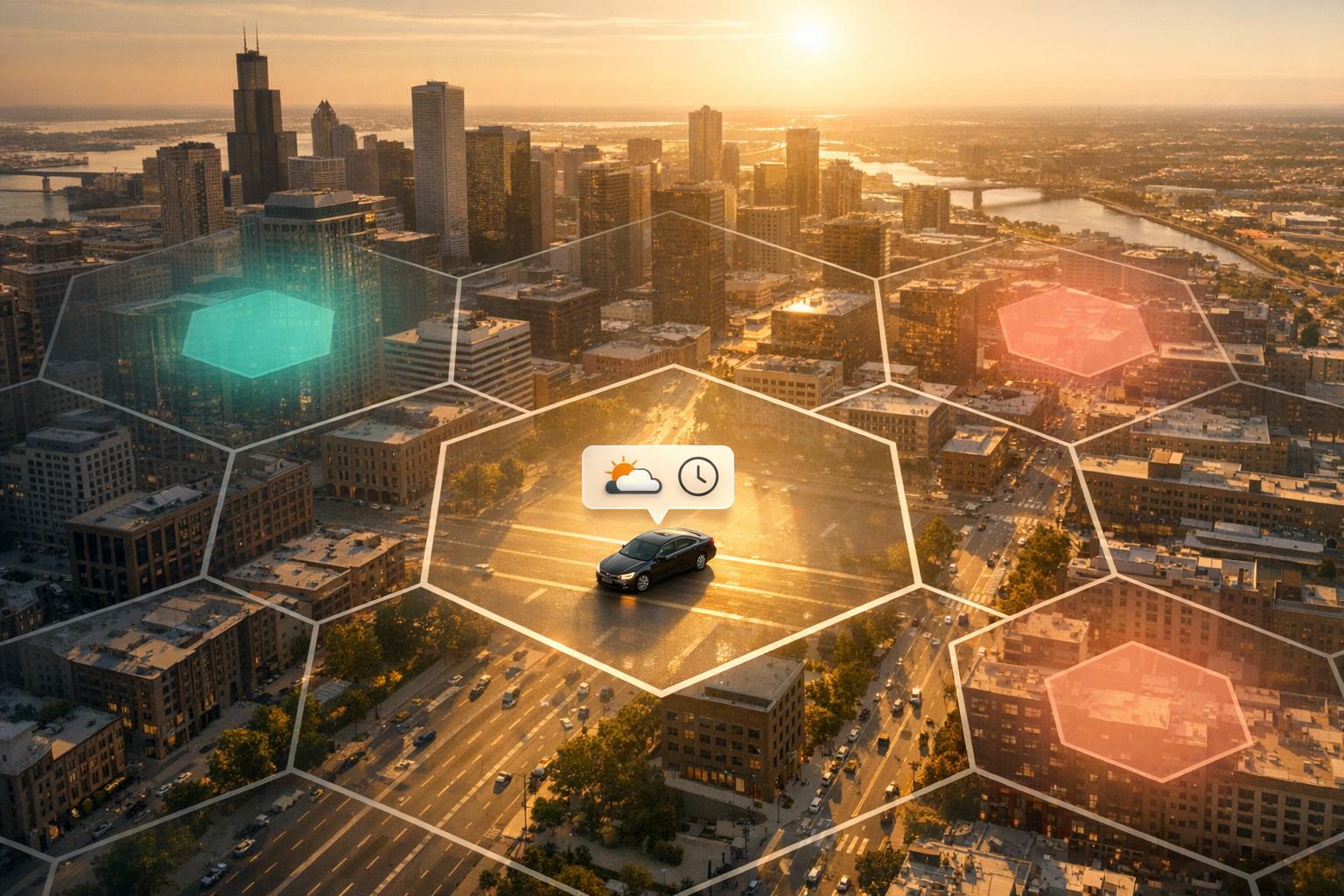
Programmatic advertising uses algorithms to automate ad buying in real time, making ads cheaper and more efficient. Geo-time targeting enhances this by combining location data (like GPS) with time-based triggers to display ads relevant to a person’s environment. For example, ads can adjust based on weather, local events, or the time of day.
Here’s why this matters for vehicle-based campaigns:
Platforms like Enroute View Media make managing these campaigns easier with cloud-based tools that track vehicles, automate geofencing, and deliver real-time performance data. This approach ensures ads reach the right audience at the right time, improving engagement and ROI.

How Geo-Time Targeting Works in Vehicle-Based Programmatic Advertising
Vehicle-mounted screens rely on GPS hardware to update their location every 15 seconds. This ensures that ad content stays relevant as vehicles move through different areas.
To make this work, platforms use H3 hexagonal indexing, which divides cities into small 0.1-mile cells. Each cell acts as its own ad unit. When a vehicle enters one of these cells, the digital screen displays the ad assigned to that specific location. This approach focuses on targeting physical areas rather than tracking individual drivers or passengers, offering a more privacy-conscious alternative to mobile device ID tracking.
"This innovation turns discrete geographic locations, such as zip codes, into ad units, allowing buyers to target and deliver ads on mobility media screens that pass through each location."
The system also integrates POI (Point of Interest) data from tools like Google Maps or SafeGraph. This allows ads to trigger near specific landmarks such as shopping malls, stadiums, or even competitor locations. On the flip side, negative geofencing ensures ads are excluded from sensitive areas like schools, medical facilities, or places of worship.
After location targeting, time-based triggers add another layer of precision by delivering ads at the most effective times.
Time-based triggers let advertisers schedule ads for specific hours when their audience is most likely to engage. Dayparting is a popular strategy that aligns ad delivery with peak commute times, such as mornings or evenings, to reach professionals and city workers. For instance, a breakfast spot might promote deals from 6:00 AM to 9:00 AM, while a restaurant could advertise dinner specials starting at 5:00 PM.
Platforms can also use transit API data to fine-tune ad frequency during rush hours. Event-based triggers take this a step further by activating time-sensitive promotions near venues like concert halls or sports arenas just before or after events.
A great example of time-based targeting comes from the charity Missing People. In 2016, they adopted programmatic out-of-home advertising to issue appeals for missing children. Instead of running one general appeal weekly, they began targeting specific areas and times where children had gone missing. According to Ross Miller, Director of Funding, this strategy boosted their response rate from 50% to 70%.
"People respond to a message that is relevant to either where they live or a location."
- Ross Miller, Director of Funding, Missing People
Building on these scheduled triggers, real-time adjustments take targeting to an entirely new level.
Real-time adjustments complement location and time targeting by allowing campaigns to adapt instantly to changing conditions. Real-Time Bidding (RTB) enables platforms to bid on ad placements within milliseconds as vehicles move between zones. This lets advertisers update campaigns dynamically based on factors like traffic, weather, or emerging opportunities.
Another powerful tool is Dynamic Creative Optimization (DCO), which updates ad content in real time using live data feeds. For example, if it starts raining, the system can switch to displaying umbrella ads. Campaigns using DCO often achieve 20–60% higher click-through rates compared to static ads.
Platforms also calculate impression multipliers by integrating data from mobile measurement companies. These multipliers estimate how many people actually see an ad at a given location and time, factoring in variables like foot traffic, weather, and time of day.
"We deliver to [Reveal Mobile], in real time, our lat-longs for every single vehicle, and they crunch the numbers and estimate the impression multiplier."
- Roey Franco, SVP of Product, Firefly
With platforms like Enroute View Media, these advanced targeting methods come together, enabling taxi and rideshare campaigns to deliver highly relevant and measurable ad experiences.
Geo-time targeting allows ads to align with local interests and immediate needs, making campaigns more effective. For instance, a coffee shop might promote morning specials near office districts during peak hours (6:00 AM to 9:00 AM), while a hotel near an airport could activate ads during flight delays. This strategy focuses on reaching consumers who are ready to act.
By placing ads near stores or shopping centers, brands can connect with people who are in a buying mindset rather than just browsing. It even enables competitive conquesting - targeting customers at competitor locations with time-sensitive offers to sway their decisions.
The results speak volumes. Around 59% of viewers take action after seeing a digital taxi top ad, such as searching for more information or visiting a store. Campaigns that combine relevance with ethical data use can achieve up to 2x higher engagement compared to generic approaches. Retailers leveraging predictive analytics and real-time bidding have reported up to a 30% boost in conversions.
"Programmatic Advertising has generated an effective market channel for communication and develop better campaign that will direct to whom it has to reach, where it has to reach and when it has to reach personally."
- K Uday Kiran and Thangaraja Arumugam, Vellore Institute of Technology
Geo-time targeting ensures ad budgets are spent wisely by focusing on the right audience, at the right moment, and in the right location. Unlike traditional out-of-home advertising, which charges for continuous exposure regardless of its relevance, programmatic DOOH employs a "lighter for longer" approach, stretching budgets while maintaining impact.
The financial benefits go beyond cost savings. Publishers using geospatial models for mobile media have seen revenue more than double compared to fixed-location methods. GPS-enabled digital taxi campaigns often achieve positive ROI within the first quarter.
Take Jack in the Box as an example. Their programmatic DOOH campaign for the Cheddar Loaded Cheeseburger, displayed across taxis and rideshares, generated over 49 million impressions, leading to an 8.8% increase in foot traffic and over 1.3 million store visits. This campaign highlights how precision targeting can drive both efficiency and impact.
"We are thrilled with the results from this campaign and felt that DOOH drove traffic into our locations during a key time period, plus helped us reach key sales objectives."
- Jaime Ogus, Senior Regional Marketing Manager at Jack in the Box
Similarly, UGG used weather-based triggers and proximity targeting for its rain-or-shine collection. Their month-long campaign delivered a 7% lift in brand awareness, a 6% rise in consideration, and a 6% boost in purchase intent. These results showcase how geo-time targeting can produce measurable outcomes.
"Partnering with Vistar Media on our digital out‑of‑home efforts allowed us to leverage both location and weather‑based targeting - ensuring that our Rain campaign was seen by our target audience when they were more likely to be in‑market for rain products."
- Michelle Hernandez, Director of Omni Digital Marketing at UGG
Beyond cost effectiveness, these campaigns also benefit from advanced analytics for precise performance tracking.
Geo-time targeting isn't just about delivering ads; it's about monitoring their performance in real time. GPS tracking on mobile media feeds precise location data into third-party tools, which consider factors like traffic, weather, and time to calculate impression multipliers.
Advertisers can use performance dashboards to adjust geo-fences, reschedule ads for peak traffic times, and tweak creative content based on engagement metrics. Closed-loop attribution connects ad exposure to digital actions and in-store visits, providing clear insights into campaign effectiveness. Brands that integrate their data systems report a 20% to 40% boost in attribution accuracy.
For example, a cosmetics brand used digital taxi tops to target high-value urban ZIP codes in cities like New York and Chicago. Their campaign exceeded its 30 million impression goal by 33%, achieving nearly 40 million impressions. This targeted approach drove an 85% increase in purchase intent, a 43% rise in brand awareness, and a 46% jump in brand favorability.
"The ability to pinpoint a specific location of your intended audience in real‑time gives you a decisive competitive advantage."
Platforms like Enroute View Media make tracking even easier by integrating these capabilities into their cloud-based systems. Advertisers and fleet owners can monitor multiple campaigns across various vehicles in real time, ensuring every dollar spent delivers measurable results.
Cloud-based platforms simplify the intricate process of geo-time targeting by using real-time GPS data and automated decision-making. These systems pull latitude and longitude details from vehicle-mounted GPS devices via APIs. When a vehicle enters a geofenced area, the platform automatically displays the relevant ad content.
With advanced geospatial indexing, these platforms can precisely monitor which screens pass through specific geographic zones, all while safeguarding driver and passenger privacy.
Ad servers use conditional logic, integrating real-time data like weather, time of day, and audience demographics, to determine the most suitable content to display. Administrators can set up dynamic geofences - whether circular, polygonal, or rectangular - that trigger targeted campaigns automatically.
Enroute View Media consolidates these capabilities into a single dashboard, allowing fleet owners and advertisers to manage refresh intervals, location monitoring timeouts, and targeting rules without needing technical expertise. The platform also ensures consistent ad delivery, even when GPS signals are temporarily lost, making it a reliable tool for fleet-wide ad management.
These features collectively enable seamless control over multi-vehicle advertising campaigns.
Centralized dashboards simplify the management of advertising across large fleets, offering single sign-on access to inventory management, programmatic deals, and real-time reporting. This unified system not only streamlines workflows but also supports the scalability needed for expanding vehicle fleets.
Automated optimization takes care of adjusting ad displays based on performance metrics, ensuring premium inventory is allocated to routes or time slots with higher engagement rates. Advertisers can also set frequency caps to avoid overexposure and integrate external APIs, such as live weather or traffic feeds, for more contextually relevant ads.
A notable example of this approach is Firefly's partnership with Place Exchange in November 2022. By shifting from static vehicle locations to real-time GPS tracking that activated ads in specific geofenced hexes, Firefly achieved over twice the revenue lift for Place Exchange campaigns.
Cloud platforms are built to handle the growing demands of larger fleets and programmatic transactions. For instance, some demand-side platforms (DSPs) can manage and filter over 250,000 units on a single map interface, while platforms like PubMatic process more than 1.4 trillion ad bids daily. This scalability ensures smooth operations whether you're managing a fleet of 10 vehicles or 10,000.
White-label solutions offer an additional layer of flexibility. These platforms allow fleet owners and startups to operate under their own branding while benefiting from enterprise-level technology. Enroute View Media’s white-label platform, for example, provides customizable branding, API access, and advanced analytics, enabling businesses to deliver tailored solutions without building infrastructure from scratch. This flexibility supports campaign growth and dynamic programmatic ad optimization.
Additionally, using H3 hexagonal indexing creates a standardized approach to location data across mobility partners like taxis, rideshares, and delivery vehicles, offering advertisers a consistent buying experience. Operators can also implement negative geofencing to exclude sensitive areas, such as schools or religious institutions, ensuring campaigns meet brand safety standards.
Programmatic advertising and geo-time targeting have reshaped how vehicle campaigns operate. Unlike static billboards, advertisers can now deliver messages tailored to real-time factors like location, time of day, weather, and proximity to key landmarks. By moving away from outdated zip code–based strategies to dynamic geospatial targeting methods, such as H3 hexagonal indexing, the results speak for themselves - publishers have seen revenue double after adopting this approach.
Campaigns leveraging these advanced techniques have also reported up to an 85% boost in purchase intent. This shift has turned outdoor advertising into more than just a tool for brand awareness; it’s now a measurable channel for driving performance and outcomes.
Platforms like Enroute View Media's DigiStream GTWA are key to achieving such success. With high-resolution GPS tracking (accurate to less than a meter), automated geofencing, and white-label options, this cloud-based system enables businesses to run campaigns under their own branding while using top-tier technology. Features like intelligent power management and the ability to schedule campaigns in advance ensure smooth, scalable operations for fleets of any size.
By adopting geo-time strategies, advertisers can map customer journeys, pinpoint high-traffic areas where buying decisions happen, and use dynamic creative that adapts to environmental triggers. Starting with pilot campaigns in key markets and incorporating negative geofencing can help ensure brand safety while refining targeting efforts.
As data-driven approaches continue to evolve, advertisers have an opportunity to boost both engagement and revenue. With 59% of viewers taking action after seeing a digital taxi top ad and the global digital out-of-home (DOOH) market projected to hit $20.74 billion in 2024, the potential for geo-time targeting is immense. Now is the moment to embrace these strategies and redefine your advertising game plan.
Geo-time targeting in vehicle advertising uses location and time data to deliver highly relevant ads to moving vehicles, such as taxis or rideshares. By integrating GPS tracking with specific time windows, ads are displayed when vehicles enter designated areas or during key moments. This method ensures ads are timely and relevant, making it a powerful tool for digital out-of-home campaigns. It’s especially effective for connecting with audiences near stores, events, or other high-traffic locations - all while keeping privacy intact.
Geofencing on moving vehicles leverages real-time GPS tracking combined with geospatial indexing to establish dynamic virtual boundaries. When a vehicle enters or exits these zones, ads are triggered automatically. This ensures highly accurate targeting and boosts engagement by delivering messages tailored to a person's location and timing. It's a smart way for advertisers to connect with their audience exactly when and where it matters most.
To measure ROI effectively, focus on real-time engagement metrics such as passenger interactions, dwell time, and conversions. Incorporate GPS tracking and mobile engagement data to assess ad exposure and performance. These insights provide a clear picture of campaign success and help refine future strategies.
Need pricing details?
EnrouteViewMedia is a Canadian technology company based in Edmonton, Alberta, Canada. The company was founded by a group of media entrepreneurs and engineering executives. Our mission is developing leading-edge digital media display technologies for taxicab rooftops and taxicab interiors advertising market. Through our easy to use ad delivery and management system, we assist our clients in reaching their customers with targeted exposure. EnRouteViewMedia continuously strives to be the global leader in digital geo-time targeted advertising media systems for modern taxi fleets.