
Programmatic rooftop LED ads use GPS, cloud CMS and DSP bidding to deliver geo-targeted mobile DOOH that cuts costs, boosts impressions, and measures ROI.
Programmatic advertising on rooftop LED displays is transforming how ads are delivered in busy cities. Mounted on taxis and rideshares, these screens use GPS and cloud-based systems to display targeted ads in real time. Advertisers bid for impressions via demand-side platforms (DSPs), tailoring campaigns by location, time, or weather. Compared to stationary billboards, these mobile screens are more cost-effective and generate higher daily impressions - 50,000 per vehicle versus 18,000 for static billboards.
Key highlights:
Fleet owners and advertisers can leverage this system to monetize urban traffic while delivering dynamic, measurable ad campaigns.
Programmatic Rooftop LED Advertising: Key Performance Metrics and ROI Statistics
Mobile DOOH (Digital Out-of-Home) refers to digital screens mounted on moving vehicles like taxis, rideshares, buses, and delivery trucks. These screens display dynamic content to pedestrians and drivers as the vehicles navigate through city streets. Unlike traditional billboards that stay in one place, these mobile screens travel through various neighborhoods, business districts, and entertainment areas, allowing advertisers to reach a more diverse audience. A key feature of this category is vehicle-mounted rooftop LED displays - double-sided digital panels installed on car roofs. These panels connect to cellular networks, enabling remote programming and real-time updates.
Programmatic rooftop ads take this concept a step further by automating the media buying process. Demand-side platforms (DSPs) bid on ad impressions based on factors like location, time of day, weather, and audience demographics. A content management system (CMS) then triggers the appropriate ad creative as vehicles enter targeted areas. These advanced capabilities are driving the rapid adoption and strong market performance of this advertising format.
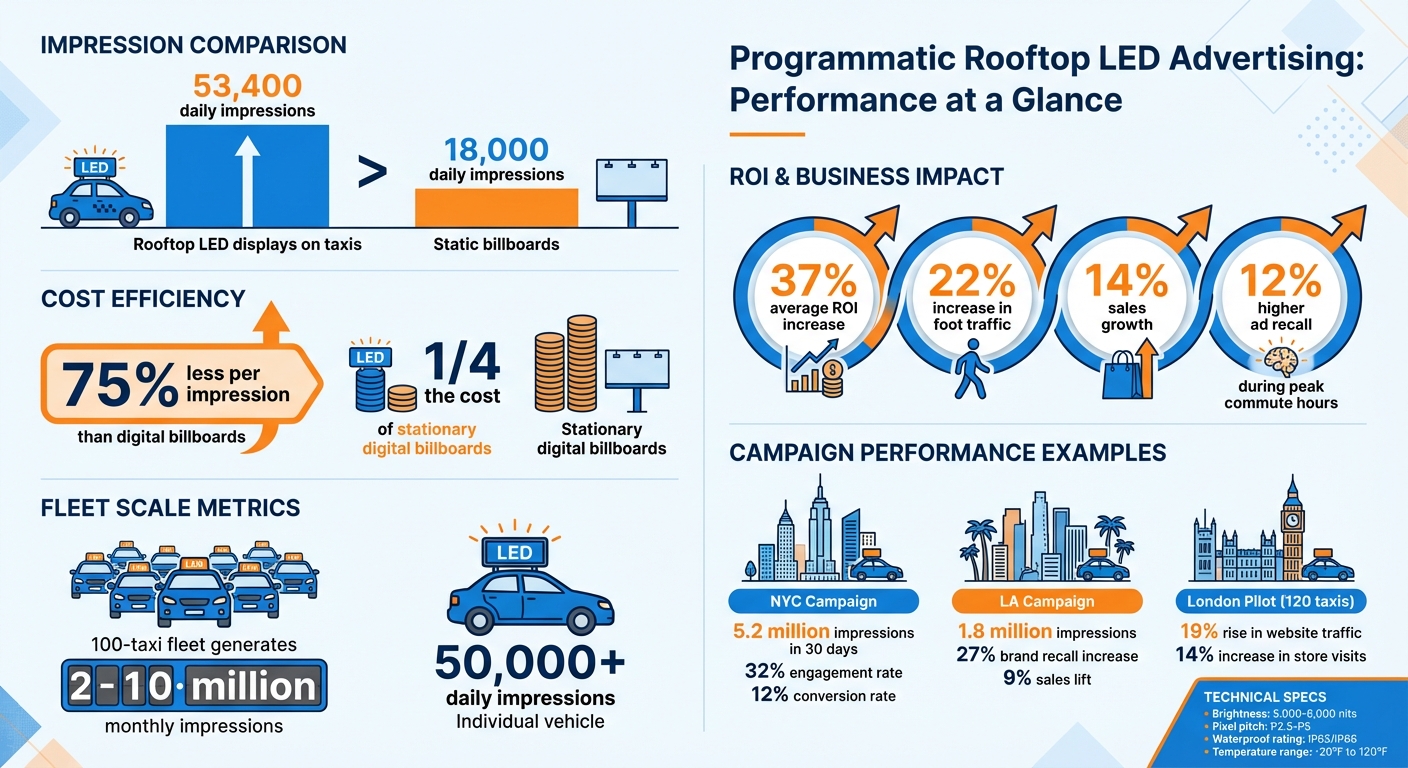
The transition from static to digital vehicle advertising is gaining momentum, especially in major U.S. cities. For example, taxis equipped with rooftop LED displays generate approximately 53,400 daily impressions, and they do so at about one-quarter the cost per impression compared to stationary digital billboards. This cost-effectiveness has encouraged fleet operators to upgrade their vehicles with digital advertising capabilities.
Quick-service restaurants and retail chains are leading the charge in adopting this technology. A 2023 pilot involving 200 taxis demonstrated its effectiveness for local businesses: restaurants using geo-fenced ads near subway stations experienced a 22% increase in foot traffic compared to those relying solely on static billboards. One bakery chain saw a 14% boost in sales after running rush-hour promotions on taxi-roof LEDs. Similarly, a six-month pilot in London with 120 taxis targeting local cafés and retailers showed a 19% uptick in same-day website traffic and a 14% rise in store visits, thanks to strategic routing and geo-fencing near competitors during peak commuting hours. Small and mid-sized businesses using these taxi LED displays reported an average ROI increase of 37% and 12% higher ad recall during peak commute hours compared to previous static campaigns.
These trends highlight the growing appeal of mobile DOOH advertising, with companies like Enroute View Media leading the way in simplifying programmatic rooftop ad solutions.
Enroute View Media equips taxi and rideshare fleets with dual-sided P2.5 LED screens connected to a cloud-based ad management platform. This platform automates geo-targeted ad scheduling, provides real-time analytics, and ensures unsold ad inventory is filled through certified DSP integrations.
Fleet operators benefit from centralized content control across their entire network. They can generate exportable reports and offer API access to advertisers who want to track rooftop ad exposure against key metrics like store visits or app downloads. By offering this streamlined, all-in-one solution, Enroute View Media enables fleet owners and marketing startups to focus on growing their business while turning moving vehicles into measurable and profitable advertising platforms.
Rooftop LED screens designed for vehicles are built to withstand urban environments while maintaining high visibility. These displays operate at brightness levels exceeding 5,000 nits, with some reaching up to 6,000 nits, ensuring they remain clear even under direct sunlight. To prevent nighttime glare and comply with local regulations, automatic brightness sensors adjust the screen’s output based on ambient lighting conditions.
The clarity of these displays is determined by pixel pitch, which affects how sharp images appear at different viewing distances. For instance, pixel pitches ranging from P2.5 to P5 are common. A finer pitch, like P2.5, is ideal for close-range viewing, making it suitable for slower-moving traffic or pedestrians. Enroute View Media’s dual-sided rooftop screens exemplify this specification. On the other hand, coarser pitches, such as P4 or P5, work better for longer viewing distances, like those encountered on highways.
To ensure durability, these screens are built with waterproof ratings of IP65 or IP66. They feature enclosures made of aluminum or steel, paired with tempered glass or polycarbonate covers to protect against weather elements like rain, snow, and dust, as well as the vibrations from moving vehicles. Operating reliably across a wide temperature range - from –20°F to 120°F - these displays are equipped to handle diverse U.S. climates. Lightweight construction (around 35 pounds per panel) and anti-vibration mounts further enhance their stability on vehicles. These robust features support real-time connectivity, which is critical for programmatic advertising campaigns.
The advanced hardware of rooftop LED screens is complemented by powerful connectivity and management systems, making real-time updates and remote control seamless. Using 4G and 5G cellular networks, each display is equipped with a SIM card that enables instant content updates, location tracking, and geofencing. This allows advertisers to deliver location-specific ads as vehicles enter targeted areas.
Fleet operators rely on cloud-based content management systems (CMS) to control their ad networks. Through an online interface, managers can remotely upload new ad creatives, adjust schedules, monitor the health of devices, and resolve technical issues. These platforms also support programmable rules, such as scheduling ads to run during specific times or near particular locations. Additionally, the system alerts managers if a screen goes offline. Enroute View Media’s cloud platform combines these features with real-time analytics, providing insights like impression counts, route heatmaps, and overall campaign performance metrics.
Enroute View Media’s system ties together the hardware and connectivity features to integrate rooftop displays with programmatic ad platforms. This process automates the buying and selling of ad impressions on these displays, creating a direct link between advertisers and vehicles. Through demand-side platforms (DSPs), advertisers can bid on available inventory in real time, while supply-side platforms (SSPs) manage the rooftop LED network. For example, when a vehicle enters a specific area, such as a shopping district during lunchtime, the GPS-connected display sends its location and time data to match with relevant campaigns. The winning ad is then delivered instantly via the 4G/5G connection.
Enroute View Media’s platform works seamlessly with certified DSP partners, offering advertisers detailed parameters like geographic coordinates, time of day, vehicle speed, and audience demographics. Once an ad is selected, the platform formats it for optimal display on a P2.5 LED screen and delivers it to the appropriate vehicle within seconds. Advertisers can access performance data through various channels, including exportable reports, APIs, and white-label portals, which provide insights such as estimated impressions, dwell time, and attribution metrics.
Evaluating programmatic rooftop campaigns hinges on tracking ad exposures and understanding audience behaviors. Key metrics to watch include impressions delivered, ad recall rates, brand awareness growth, and foot traffic increases to targeted locations.
Mobile digital out-of-home (DOOH) ads on rooftop displays achieve 40–60% higher ad recall compared to static formats. Taxi LED displays, especially during peak commuting hours, boast a 12% higher recall rate than non-digital alternatives. When campaigns use geo-targeting, they see a 28% boost in ad recall and an 18% rise in brand awareness versus non-targeted efforts.
Foot traffic measurement offers clear evidence of a campaign's effectiveness. Geo-fenced campaigns aimed at specific store locations typically drive 15–20% more visits, while dynamic ads near office districts increase foot traffic by 22%. For example, a Chicago diner running rooftop ads for lunch deals between 11:00 a.m. and 1:00 p.m. saw 29% more foot traffic in just over a month - outperforming its previous local radio campaigns by a factor of three.
Impression delivery varies based on fleet size, route density, and operating hours. A 100-taxi fleet in a major U.S. city can deliver 2–10 million monthly impressions. In high-traffic urban areas, individual vehicles generate more than 50,000 daily impressions, significantly outpacing the 18,000 daily impressions of stationary digital billboards - and at about one-quarter of the cost. Enroute View Media’s platform tracks these metrics in real time using GPS data, vehicle speed, route density, and dwell time, ensuring accurate exposure counts. These metrics lay the groundwork for real-world case studies that highlight the impact of rooftop ad campaigns.
Real-world examples highlight the measurable success of programmatic rooftop ads across different markets and goals. For instance, a New York City taxi fleet campaign using Enroute View Media’s platform delivered 5.2 million impressions in 30 days, achieving a 32% engagement rate and a 12% conversion rate for store visits.
In Los Angeles, a rideshare rooftop campaign focused on boosting brand awareness and sales. It generated 1.8 million impressions, resulting in a 27% increase in brand recall and a 9% sales lift through multi-channel attribution. By leveraging real-time bidding, the campaign dynamically adjusted ads based on vehicle location and time of day, delivering 20% higher ROI compared to traditional out-of-home formats.
Similarly, a six-month pilot program in London used 120 taxis to display geo-targeted LED rooftop ads. Local cafes and retailers reported a 19% rise in same-day website traffic and a 14% increase in store visits.
Attribution models play a critical role in understanding how rooftop ads fit into the broader marketing mix. These campaigns integrate seamlessly into larger strategies through multi-touch attribution models, which link ad exposure to downstream actions. Geo-fencing technology, for example, creates proximity alerts within 500 feet of impression locations and tracks subsequent store visits. By using anonymous device linking, platforms can connect mobile IDs to ad exposure, mapping the customer journey from rooftop ad view to purchase.
Incrementality testing with control groups reveals that rooftop campaigns typically drive 20–30% higher conversions compared to audiences not exposed to the ads. Mobile location data from vehicle GPS feeds into attribution platforms, which calculate ROI using the formula: (attributed conversions × value) / ad spend. Multi-touch models often credit rooftop ads with 15–25% of the total conversion path in omnichannel campaigns.
Enroute View Media’s platform enhances these multi-touch attribution efforts with robust real-time analytics. It integrates with demand-side platforms like Google DV360, enabling cross-channel attribution across TV, mobile, search, and rooftop inventory. This unified approach allows advertisers to see how rooftop ads influence other touchpoints. For example, combining rooftop ads with social media retargeting delivered a 3.5x ROI, with unified dashboards tracking de-duplicated metrics across channels. When included in a blended media strategy, rooftop campaigns typically account for 10–20% of total revenue growth, bridging the gap between online and offline customer behaviors.
Running programmatic rooftop LED campaigns comes with its share of complexities. A centralized fleet platform is critical for keeping tabs on screen status and ensuring real-time content delivery. This involves leveraging GPS, 4G/5G connectivity, and health sensors to address potential issues like offline screens, brightness malfunctions, or temperature warnings before they escalate.
Route planning is another key piece of the puzzle. Fleet operators need to map out efficient routes through high-traffic areas - think downtown business hubs, entertainment districts, and busy transit zones - while syncing these routes with specific times of day. Movement analytics come into play here, offering insights into vehicle travel patterns, historical heatmaps, daily impression estimates, and proof-of-play logs. These tools not only give advertisers confidence but also help improve CPMs.
Durability is a must for rooftop LED hardware. The units need to withstand vibrations and handle urban weather conditions with ease. High-brightness LEDs (around 6,000 cd/m²) with automatic brightness adjustment ensure visibility in bright sunlight while adhering to city brightness limits at night. Regular upkeep - such as cleaning, hardware inspections, sensor tests, and firmware updates - helps minimize the need for on-site fixes.
Enroute View Media tackles these hurdles with rugged rooftop LED systems equipped with GPS, brightness sensors, and 4G/5G connectivity. Their cloud-based ad and screen management platform simplifies scheduling, health monitoring, and real-time programmatic content delivery. These operational strategies pave the way for managing the intricate regulatory landscape of urban advertising.
In the U.S., vehicle-mounted LED displays are subject to various local ordinances, often falling under digital sign or mobile billboard regulations. These rules typically set maximum brightness levels and mandate automatic dimming at night to reduce glare and minimize driver distractions. Brightness limits usually range from 5,000 to 7,000 nits, with some cities capping daytime brightness at 6,000 cd/m². Additionally, many jurisdictions restrict flashing, strobing, or highly animated content - particularly near intersections, schools, and residential areas - to cut down on light pollution and distractions.
Fleet operators must secure specific permits, such as mobile advertising or peddler licenses, and may need approvals from local transportation or taxi commissions. Some cities limit the number of mobile billboards allowed or require vehicle registration, including license plate details and proof of liability insurance. For fleets operating in multiple cities, staying compliant with each area's unique rules - covering operating hours, approved zones, and safety inspections - is essential.
To meet safety standards, operators often adopt cautious content guidelines. This includes avoiding rapid flashing, misleading traffic-signal colors, or any messaging that might encourage unsafe behavior. Displays are also programmed to dim automatically during low-light conditions, thanks to built-in brightness sensors and software controls. Driver training on when and where to turn off displays - such as in restricted zones - further ensures compliance.
Enroute View Media adheres to these regulations with adaptive brightness controls and rigorous licensing protocols, keeping operations aligned with city standards.
Operational efficiency isn’t the only priority - data privacy and security are equally critical. Location data collected from vehicles should remain anonymized, ensuring that no individual passengers or pedestrians can be identified. Data collection should focus solely on aggregated route paths and impression zones necessary for ad targeting and measurement. Operators must enforce retention limits, secure storage, and strict access controls, ensuring that only authorized personnel or trusted partners have access.
Instead of relying on personal identifiers like names or device IDs, networks can use contextual signals such as location, time of day, weather, traffic, and event schedules to refine targeting. When advanced attribution methods involve mobile IDs or cross-device data, advertisers must comply with privacy laws like the California Consumer Privacy Act (CCPA) by providing clear notices and opt-out options. Contracts with partners should also specify limits on secondary data use.
To safeguard systems, encrypted communication (e.g., TLS) between vehicles, central management systems, and programmatic platforms is essential. Media players should have restricted OS access, and firmware updates must be signed to prevent unauthorized code installations. Network segmentation and VPNs can isolate ad playback systems from other IT assets, reducing vulnerabilities. Strong authentication methods, like multi-factor authentication (MFA), and role-based permissions ensure that only authorized personnel can modify content or settings. Physical security measures, including tamper-evident seals and locked enclosures, further protect the hardware from manipulation.
Enroute View Media simplifies secure data handling through its cloud-based platform. By eliminating the need for dedicated servers, it allows operators to focus on sales and operations while maintaining stringent encryption and access controls. The platform also provides secure, white-label portals for accessing campaign data and analytics, with privacy guidelines clearly outlined in its Privacy Policy and Terms of Service.
Programmatic rooftop LED advertising transforms urban vehicles into dynamic, mobile digital screens, delivering targeted messages in real time. This system uses high-brightness LED displays, 4G/5G connectivity, cloud-based management, and programmatic ad buying to create a seamless advertising experience. Advertisers can tailor messages to specific locations and times - like promoting breakfast deals along commuter routes in the morning, lunch specials in office districts at midday, or entertainment options near stadiums in the evening - all within a single campaign. At the same time, fleet owners can generate recurring revenue by monetizing vehicles in busy urban areas, with platforms handling content delivery, compliance, and performance tracking.
If you’re an advertiser ready to dive in, start by defining geofences around key areas like stores, events, or high-traffic neighborhoods in your target cities. Design ads with bold, clear messaging that aligns with the time and location of delivery. A pilot campaign using 100–200 vehicles over 4–8 weeks can help you measure foot traffic increases and fine-tune your targeting strategy. Early campaigns have already demonstrated noticeable boosts in both foot traffic and sales. Use built-in analytics to track impressions, store visits, and sales uplift, and consider integrating rooftop DOOH with mobile, web, and connected TV campaigns for a unified audience approach.
For fleet owners, begin by identifying vehicles that operate on high-traffic routes in dense urban areas. Check local regulations for rooftop digital signage to ensure compliance, and choose hardware that meets brightness and weatherproofing requirements. Companies like Enroute View Media offer turnkey solutions, including LED screens with GPS, brightness sensors, and 4G/5G connectivity. Their cloud-based platform simplifies ad scheduling, health monitoring, and programmatic content delivery - all without the need for dedicated servers. The platform also manages device groups, ensures brightness compliance, and handles scheduling across multiple cities.
Programmatic integration further boosts revenue potential by connecting to global advertiser demand through certified partners and demand-side platforms (DSPs). This increases fill rates and maximizes earnings.
As Sebastian, CTO of Aceme, shared: "enRoute partnership has helped us scale faster, more efficiently, and cost-effectively".
Real-time analytics dashboards provide detailed insights, including estimated impressions, plays, route coverage, and performance by city or time of day. This data allows for dynamic pricing strategies, such as charging higher CPMs for premium routes in Manhattan compared to suburban areas, and enables performance-based deals.
Whether you’re an advertiser looking to achieve hyperlocal targeting or a fleet owner aiming to monetize unused screen time, programmatic rooftop LED advertising offers a scalable and effective solution. Start with a focused pilot, use cloud-based tools for streamlined management, and leverage GPS and usage data to optimize campaigns and demonstrate ROI as you grow.
Programmatic rooftop LED ads bring a fresh edge to outdoor advertising by leveraging real-time data to deliver dynamic, tailored content. Unlike traditional billboards, which are static and tied to a single location, these ads can shift and adapt based on factors like audience demographics, specific locations, or even the time of day. This means campaigns can feel more relevant and personalized.
Another advantage is their ability to connect with people on the move. By using geo-targeted and time-sensitive messaging, advertisers can craft messages that resonate with specific audiences at just the right moment. This flexibility gives brands a stronger chance to engage effectively, standing out in ways fixed billboards simply can't match.
Programmatic ads on rooftop LED displays bring a whole new level of precision in audience targeting. They allow local businesses to connect with potential customers at just the right moment - based on location, time of day, and even specific demographic details. This means ads appear exactly when and where they’re likely to make the biggest impact.
What’s more, these ads come with real-time analytics. Businesses can monitor performance as it happens and tweak their campaigns on the fly to improve results. This combination of visibility and flexibility helps boost engagement, streamline ad management, and unlock more revenue opportunities.
To install rooftop LED advertising on vehicle fleets, you’ll need sturdy LED screens that can handle high-resolution visuals while withstanding the challenges of outdoor conditions. These screens should be built to endure weather changes, constant vibrations, and the movement of vehicles, all while adhering to strict safety standards.
Equally important is reliable software that allows for smooth ad management. Features like real-time analytics, geo-targeting, and programmatic ad integration are essential. A cloud-based platform can streamline ad scheduling and help optimize revenue, ensuring your campaigns connect with the right audience at the perfect moment.
Need pricing details?
EnrouteViewMedia is a Canadian technology company based in Edmonton, Alberta, Canada. The company was founded by a group of media entrepreneurs and engineering executives. Our mission is developing leading-edge digital media display technologies for taxicab rooftops and taxicab interiors advertising market. Through our easy to use ad delivery and management system, we assist our clients in reaching their customers with targeted exposure. EnRouteViewMedia continuously strives to be the global leader in digital geo-time targeted advertising media systems for modern taxi fleets.