
Pairing mobile ads with DOOH increases engagement and store visits using geotargeting, real-time creative, cross-device retargeting, and measurable analytics.

Combining mobile ads with Digital Out-of-Home (DOOH) advertising creates a powerful synergy that boosts engagement, drives store visits, and improves campaign performance. Here’s why this approach works:
Geo-targeting sets up virtual boundaries, allowing targeted mobile ads to sync with on-screen DOOH content when a device enters a specific area.
For example, systems like H3 hexagonal geospatial indexing divide cities into small zones, roughly 0.1 miles each. When a moving asset, like a taxi with an LED screen, enters one of these zones, real-time bidding (RTB) kicks in. Using live GPS data, advertisers can instantly target ads to that exact location. This method makes DOOH campaigns more dynamic and location-specific.
Geo-targeting ensures ads are delivered at the right time and place, increasing their relevance. Take a restaurant chain, for instance: it can target screens near its locations during lunch or dinner hours to engage customers when they’re most likely to act.
The results speak for themselves. Jack in the Box used proximity targeting around its restaurants and urban panels to promote the Cheddar Loaded Cheeseburger. This campaign led to an 8.8% increase in foot traffic and over 1.3 million store visits. Similarly, Samsung’s programmatic DOOH campaign for the Galaxy S21 in Texas, paired with mobile retargeting, saw a 1.75x boost in in-store visits.
"DOOH drove traffic into our locations during a key time period, plus helped us reach key sales objectives."
– Jaime Ogus, Senior Regional Marketing Manager, Jack in the Box
Another advantage of geo-targeting is its privacy-conscious approach. Instead of focusing on individual users, modern geospatial systems target areas - like neighborhoods near grocery stores or busy downtown zones. This method mirrors contextual targeting seen in online advertising, ensuring consumer trust remains intact. As Nick Bennett, SVP Partnerships at Place Exchange, explains:
"Digital Out of Home media is more trusted by consumers than any other digital channel, and we want to keep it that way".
The impact of geo-targeting is evident in several successful campaigns.
UGG ran a month-long campaign for its "rain-or-shine" collection, using weather-based triggers on taxis, rideshares, and urban panels. Ads launched automatically when the weather matched the product’s theme, leading to a 6% lift in purchase intent, 6% lift in consideration, and 7% lift in brand awareness.
Foodora used location data from DOOH screens in Germany to trigger mobile ads promoting its pick-up option. This multi-channel approach delivered 107,000 ads and reached 1 million impressions.
Boehringer Ingelheim targeted DOOH screens near pet stores and shopping malls to advertise "Frontpro Antiparasitic." These screens included QR codes for immediate mobile interaction, achieving a 105% increase in purchase consideration.
Publishers are also reaping the rewards of geo-targeting. Roey Franco, Senior Vice President of Product at Firefly, shared:
"As a publisher we are seeing more than 2x lift in revenue on Place Exchange campaigns once we shifted to the geospatial model".
Real-time updates have turned static DOOH billboards into dynamic, context-sensitive displays. By leveraging GPS data and geofencing, these systems can instantly update DOOH content based on changing conditions. For example, programmatic DOOH (pDOOH) platforms use live data feeds - like weather updates, traffic conditions, sports scores, or even pollen levels - to automatically adjust the ads displayed on screens.
This is made possible by advanced DOOH ad servers, which operate differently from traditional content management systems. Instead of relying on pre-scheduled ad loops, these servers pull content in real time, guided by live data and predefined rules. This shift to impression-based buying allows advertisers to seize opportunities as they arise.
And the results? Dynamic OOH campaigns have been shown to boost sales by more than 16% compared to static campaigns. When ads align with a consumer's immediate context - like promoting umbrellas during a sudden downpour - people are more likely to engage. This ability to adapt on the fly opens up endless possibilities for creative and impactful campaigns, as highlighted in these examples.
These real-time capabilities make DOOH advertising not just more efficient but also far more engaging for the audience.
Cross-device interactions take DOOH advertising to the next level by bridging the gap between public displays and personal devices. Pairing DOOH with mobile creates a seamless flow, where a message seen on a digital billboard transitions effortlessly to a smartphone, encouraging deeper engagement.
Here’s how it works: Device ID retargeting allows advertisers to identify and reconnect with audiences exposed to a DOOH ad, while sequential messaging delivers follow-up prompts like promo codes or website links to guide them toward a purchase.
Adding tools like QR codes and geofencing makes it easy for users to engage on their phones instantly. For example, scanning a QR code on a DOOH display can unlock exclusive content or offers. It’s a growing trend - over 94 million U.S. consumers used QR scanners on their phones in 2025, with numbers projected to reach 102.6 million by 2026.
The impact is clear: 74% of mobile users take action after seeing a DOOH ad, whether it’s visiting a website, redeeming an offer, or making a purchase. Even better, combining OOH and mobile is 2.5x more effective at driving store traffic compared to using either channel alone.
Real-world campaigns show how these strategies deliver results.
Interactive campaigns using cross-device techniques have proven to drive measurable outcomes.
Take Boehringer Ingelheim, for instance. In January 2025, they ran a programmatic DOOH campaign in Spain to promote their pet antiparasitic product, Frontpro. Partnering with OMD Spain and Broadsign, they displayed dynamic QR codes on screens near pet stores. Scanning the codes gave pet owners access to product details and special offers. The results? A 254% boost in positive brand perception and a 105% increase in purchase consideration.
Similarly, Samsung used a cross-device approach to promote the Galaxy S21 in Texas in February 2025. They combined programmatic DOOH ads with mobile retargeting, serving follow-up ads to those who had seen their billboards. This strategy led to a 1.75x lift in in-store visits.
Another example comes from Virgin Active, a fitness brand that synced mobile retargeting with programmatic OOH ads in May 2021. This campaign resulted in a 2.35% increase in foot traffic to specific gym locations and a 23% year-over-year rise in club walk-ins.
"Consumers are 48% more likely to engage with a mobile ad after encountering the same campaign out of home." - Jay Fenster, Marketing Manager, OUTFRONT
Even earlier, in 2018, the delivery service foodora showcased the potential of cross-device campaigns. They used DOOH screens in Germany to trigger mobile ads for nearby users. This effort delivered 107,000 mobile ads and achieved one million impressions, effectively raising awareness of their pick-up feature.
These examples highlight the power of cross-device interactions - not just for boosting engagement but for driving tangible business outcomes.
Enroute View Media builds on the strengths of geo-targeting and real-time insights by integrating digital out-of-home (DOOH) advertising into taxi and rideshare networks.
Enroute View Media connects mobile and DOOH advertising through a platform tailored specifically for taxi and rideshare vehicles. It features dual-sided LED rooftop screens for outdoor visibility and 10.1-inch touchscreen tablets inside the vehicles for engaging passengers directly. The entire system is powered by DigiStream View, a cloud-based management platform that allows advertisers to manage campaigns remotely through mobile data connectivity.
What makes this platform stand out is its Geotargeting-Time with Advertising (GTWA) technology. By using a 41-satellite GPS channel, the system can establish virtual boundaries around specific locations with an accuracy of less than 3.3 feet (approximately 1 meter). This ensures that ads are triggered precisely when a vehicle enters a targeted zone or passes near a specific location, combining the broad reach of DOOH with the precise targeting usually associated with mobile advertising.
The system is designed to perform reliably under real-world conditions. The LED rooftop screens deliver over 5,000 nits of brightness - more than double the brightness of standard LCD screens - ensuring excellent visibility even in direct sunlight. These screens also offer a 100,000-hour lifespan, far surpassing the 30,000–50,000 hours typical of LCDs, and they are field-serviceable, allowing individual pixels to be replaced without swapping out the entire panel.
Inside the vehicles, the 10.1-inch touchscreen tablets provide an interactive experience for passengers. Users can tap on ads to access websites, redeem offers, or participate in campaigns, bridging the gap between simply viewing an ad and taking immediate action.
DigiStream View enhances campaign management by enabling advertisers to pre-schedule ads, set geo-fences with pinpoint accuracy, and automatically adjust screen brightness based on ambient light. Additionally, the system includes an intelligent power monitor that shuts down displays if the vehicle's battery voltage drops below 12 volts, ensuring the vehicle's performance isn't compromised. This seamless integration highlights DOOH's growing role in dynamic, location-based advertising.
The platform's advanced features deliver tangible results. By combining precise targeting with real-time analytics, advertisers can significantly enhance campaign performance. Data shows that location-based advertising can improve ROI by an average of 68%, while incorporating mobile location data into DOOH campaigns can increase conversion rates by 60%.
The platform also tracks ad exposure across both rooftop screens and in-taxi displays with high accuracy. Using the DigiStream View dashboard, advertisers can monitor their campaigns in real time, including a live map view of all fleet vehicles to confirm ads are running within the intended geo-fenced zones. For campaigns featuring video content, the system monitors data usage per device, helping manage bandwidth costs across LTE, 3G, or 4G networks.
"The ads can be displayed anywhere in the world with a location precision of less than 1 metre from the intended target." - Enroute View Media
This level of precision and control enables advertisers to target specific locations effectively, trigger ads as vehicles approach high-foot-traffic areas like shopping districts, and adjust campaigns dynamically based on performance data.
To determine whether your mobile and DOOH (Digital Out-of-Home) strategy is working, you need to track the right metrics. Start with verified exposure. Modern DOOH technology can detect mobile devices near a screen during ad delivery, giving you a clear picture of who’s in the vicinity. Since DOOH broadcasts to multiple people at once, media owners use impression multipliers to estimate the total number of viewers.
For campaigns aimed at building brand awareness, focus on brand health metrics. These include brand lift studies that compare exposed audiences to control groups, measuring factors like awareness, ad recall, consideration, favorability, and purchase intent. If your campaign is designed for direct engagement, track engagement metrics such as QR code scans, app downloads, social shares, or touchscreen interactions.
To tie ad exposure directly to outcomes, attribution metrics are key. These measure website visits (web lift), in-app actions, physical store visits (using footfall attribution), and sales lift compared to a baseline. Advanced campaigns may also use device ID passback, which provides anonymized IDs of exposed users for retargeting across mobile, social, and connected TV platforms. Research shows that consumers are 48% more likely to engage with mobile ads after seeing the same campaign on a DOOH screen, and this combination drives store traffic 2.5× more effectively than using either channel alone.
By tracking these metrics, you not only measure success but also gain insights that help fine-tune your campaign for better results.
Once you’ve identified your key performance indicators, analytics allow you to make real-time adjustments to improve outcomes. With tools like Programmatic DOOH (pDOOH), you can automate data collection and centralize reporting, achieving precision similar to online advertising. For deeper insights, use control groups to conduct brand or sales lift studies. Comparing an "exposed" group with a "control" group reveals the actual impact of your campaign.
Another powerful tool is Dynamic Creative Optimization (DCO), which adjusts ad content based on real-time factors like weather, time of day, or local events. A great example comes from the 2023 holiday season when MOBSTA and StackAdapt ran a Michael Kors Jewelry campaign in Hamburg and Berlin. The campaign achieved over 14 million impressions on DOOH screens, with brand lift studies showing a 13% increase in awareness in Hamburg and a 39% boost in Berlin. Dynamic QR codes were also used to provide instant access to deals while collecting live engagement data. Programmatic dashboards further allowed real-time tweaks to location, timing, and creative based on performance data.
This constant stream of data-driven adjustments highlights how combining mobile and DOOH can deliver better results.
| Metric Category | Key KPIs to Track | Method |
|---|---|---|
| Exposure | Impressions, Reach, Frequency, CPM | Multipliers, GPS data, sensors |
| Engagement | QR Scans, App Downloads, Social Shares | Interaction tracking, mobile analytics |
| Physical Impact | Footfall/Walk-in Rate, Store Visits | Mobile location data, geofencing |
| Digital Impact | Web Conversions, App Lift, Online Sales | Tracking pixels, SDKs |
| Brand Impact | Awareness, Recall, Intent, Favorability | Pre- and post-campaign surveys |
| Financial Impact | Sales Lift, ROI, ROAS | Sales data comparison, attribution modeling |
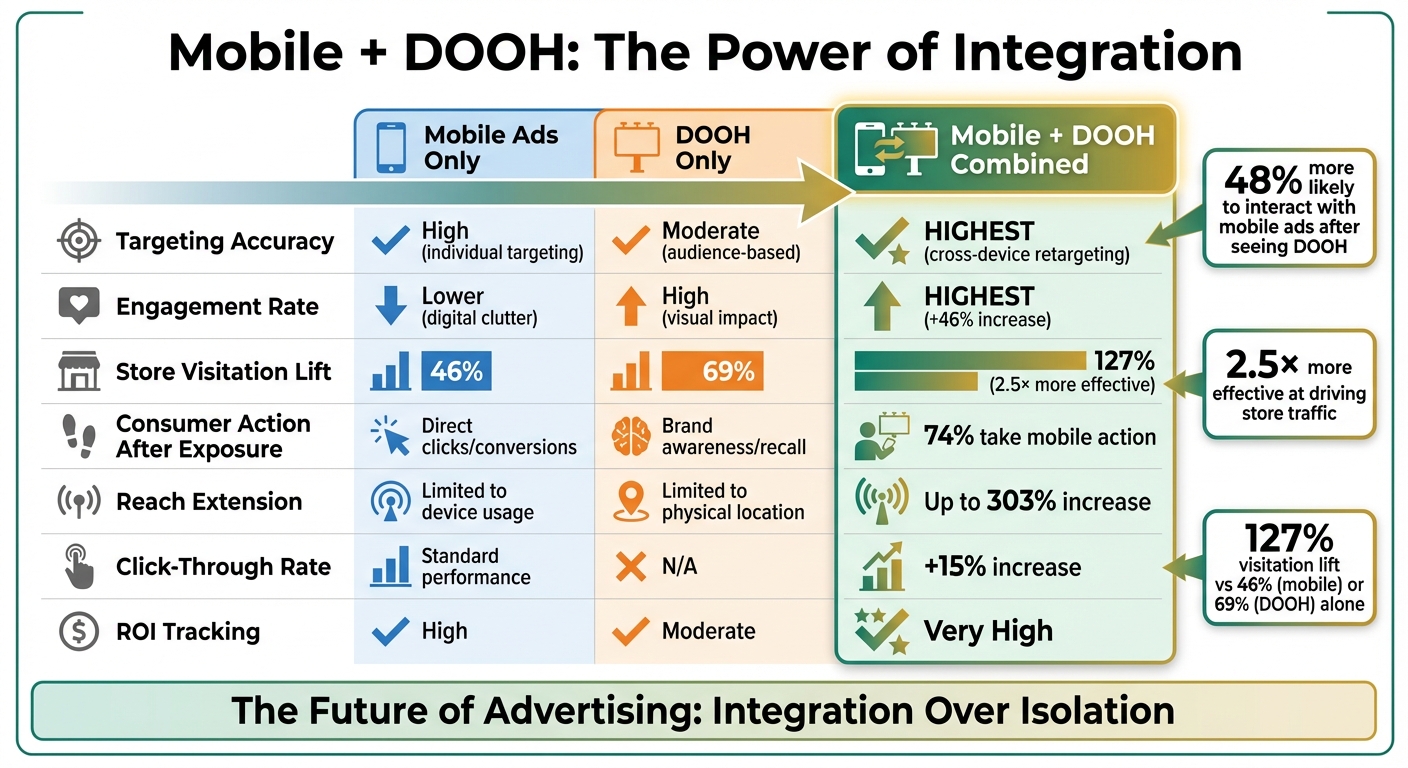
Mobile Ads vs DOOH vs Combined Approach Performance Comparison
Allocating your advertising budget means understanding how each channel plays to its strengths. Mobile advertising is great for reaching individuals with personalized messages, offering direct and tailored interactions. The downside? It often gets lost in the endless stream of digital ads, with many users turning to ad blockers to avoid the clutter.
Standalone DOOH (Digital Out-of-Home) advertising, on the other hand, shines in public spaces like shopping areas or transit hubs. Its bold visuals grab attention, but it has traditionally lacked the precise tracking and attribution that digital platforms offer.
The magic happens when these two approaches join forces. By combining DOOH’s broad reach and visual impact with mobile’s precision targeting, advertisers can create a seamless experience. DOOH builds brand awareness in public spaces, while mobile ads follow up with personalized messaging. This synergy not only bridges gaps in engagement but also drives results - store traffic can increase 2.5× more effectively with the combined approach than with either channel alone.
"When comparing different approaches, using both Facebook and OOH ads worked best." - Danone
The numbers back this up. For example, a gaming console campaign saw a 46% visitation lift with mobile ads alone and 69% with DOOH alone. But when both were used together, the lift soared to 127%. Similarly, a major auto brand reported a 217% increase in visitation rates by combining OOH and mobile compared to using OOH alone - and an incredible 382% increase compared to mobile alone.
Here’s a quick breakdown of how these methods stack up:
| Metric | Mobile Ads (Standalone) | Standalone DOOH | Combined Approach |
|---|---|---|---|
| Targeting Accuracy | High (individual targeting) | Moderate (audience-based) | Highest (cross-device retargeting) |
| Engagement Rate | Lower (due to digital clutter) | High (bold visual impact) | Highest (46% increase over standalone) |
| Store Visitation Lift | 46% (baseline) | 69% (moderate) | 127% (2.5× more effective) |
| Consumer Action | Direct clicks and conversions | Brand awareness and recall | 74% take mobile action after DOOH exposure |
| Reach Extension | Limited to device usage | Limited to physical location | Up to 303% increase |
| Click-Through Rate (CTR) | Standard performance | N/A | Up to 15% increase when supported by OOH |
| ROI Tracking | High (clicks, sales) | Moderate (footfall data) | Very high (cross-channel attribution) |
This comparison highlights how blending mobile and DOOH strategies can deliver unmatched results, paving the way for even deeper insights in the next section.
Pairing mobile and DOOH ads creates a dynamic combination that amplifies advertising results. While DOOH grabs attention with bold visuals in high-traffic areas, mobile ads deliver precise, actionable messages, forming a seamless blend of awareness and engagement.
In fact, consumers are 48% more likely to interact with a mobile ad after seeing the same campaign on a DOOH screen. This "priming effect" turns passive viewers into active participants, boosting spontaneous brand recall by 21% when both formats are used together.
To make the most of this synergy, think of DOOH and mobile as two sides of the same coin. Use DOOH to make a splash and capture attention, then follow up with mobile's targeting capabilities for personalized calls-to-action. Techniques like geofencing and device ID passback ensure timely messages reach the right audience, while cohesive creative elements strengthen brand recognition.
By incorporating tools like geo-targeting and real-time analytics, advertisers can take this integration to the next level. Platforms such as Enroute View Media simplify campaign management, enabling smoother coordination across channels. The result? A stronger connection between the physical and digital worlds, turning brief moments of attention into measurable actions and lasting consumer relationships.
The takeaway is clear: the future of advertising lies in combining channels, not choosing between them. When mobile and DOOH work in harmony, they meet consumers where they are and guide them effortlessly toward conversion.
To set up geofencing for a DOOH (Digital Out-of-Home) and mobile campaign, start by using real-time GPS tracking to establish virtual boundaries around targeted areas - think neighborhoods, shopping centers, or specific business locations. Once these zones are defined, you can set up triggers that activate certain actions, like sending push notifications or displaying ads, whenever a device enters or leaves the designated area.
For the best results, integrate geofencing with your programmatic ad platform. This ensures your mobile and DOOH messaging works together seamlessly, delivering location-specific campaigns that feel timely and relevant.
Real-time DOOH (Digital Out-of-Home) creative updates rely on location-based data like GPS, Wi-Fi signals, mobile towers, and geofencing. These technologies allow ads to adapt dynamically, activating as vehicles or people enter specific zones. This ensures ads reach the right audience at the right moment, making the engagement feel timely and relevant.
To track store visits driven by DOOH and mobile advertising, rely on cross-channel tools that connect ad exposure to actual foot traffic. These tools use real-time location data and attribution models to link ad impressions across platforms like mobile and DOOH with physical store visits. This approach helps marketers assess campaign performance, calculate ROI, and gain insights into how these combined strategies influence in-store traffic.
Need pricing details?
EnrouteViewMedia is a Canadian technology company based in Edmonton, Alberta, Canada. The company was founded by a group of media entrepreneurs and engineering executives. Our mission is developing leading-edge digital media display technologies for taxicab rooftops and taxicab interiors advertising market. Through our easy to use ad delivery and management system, we assist our clients in reaching their customers with targeted exposure. EnRouteViewMedia continuously strives to be the global leader in digital geo-time targeted advertising media systems for modern taxi fleets.