
How static, programmatic dynamic, and vehicle-based DOOH compare for targeting, measurement, and ROI.
If you want reach, static DOOH still works. If you want better timing, tighter targeting, and clearer ROI, dynamic programmatic DOOH usually wins.
I’d sum it up like this: static screens are best for broad awareness, dynamic programmatic screens are better for timing-based and location-based campaigns, and vehicle-based DOOH goes one step further with route-level delivery, GPS-verified playback, and in-car interaction. The article also points to a 48% higher response rate when people who saw a DOOH ad were later retargeted on mobile, plus a 30% lift in engagement from real-time schedule changes in vehicle-based setups.
Here’s the short version:
Quick Comparison
| Format | Best For | Targeting | Measurement | Main Limitation |
|---|---|---|---|---|
| Static DOOH | Broad local awareness | Location and schedule | Basic impression and exposure logs | Same message stays in place |
| Dynamic Programmatic DOOH | Store visits, timed offers, local response | Time, weather, traffic, audience, geofencing | Logged plays, attribution, mobile retargeting | More platform and data setup |
| Vehicle-Based Programmatic DOOH | Hyperlocal reach and in-ride engagement | Route, zone, stop, live location | GPS-verified playback, interaction logs, audience sensing | Depends on fleet uptime, power, and connectivity |
If I were choosing by goal, I’d keep it simple: static for awareness, dynamic for response, and vehicle-based for hyperlocal campaigns that need location proof and stronger audience action.
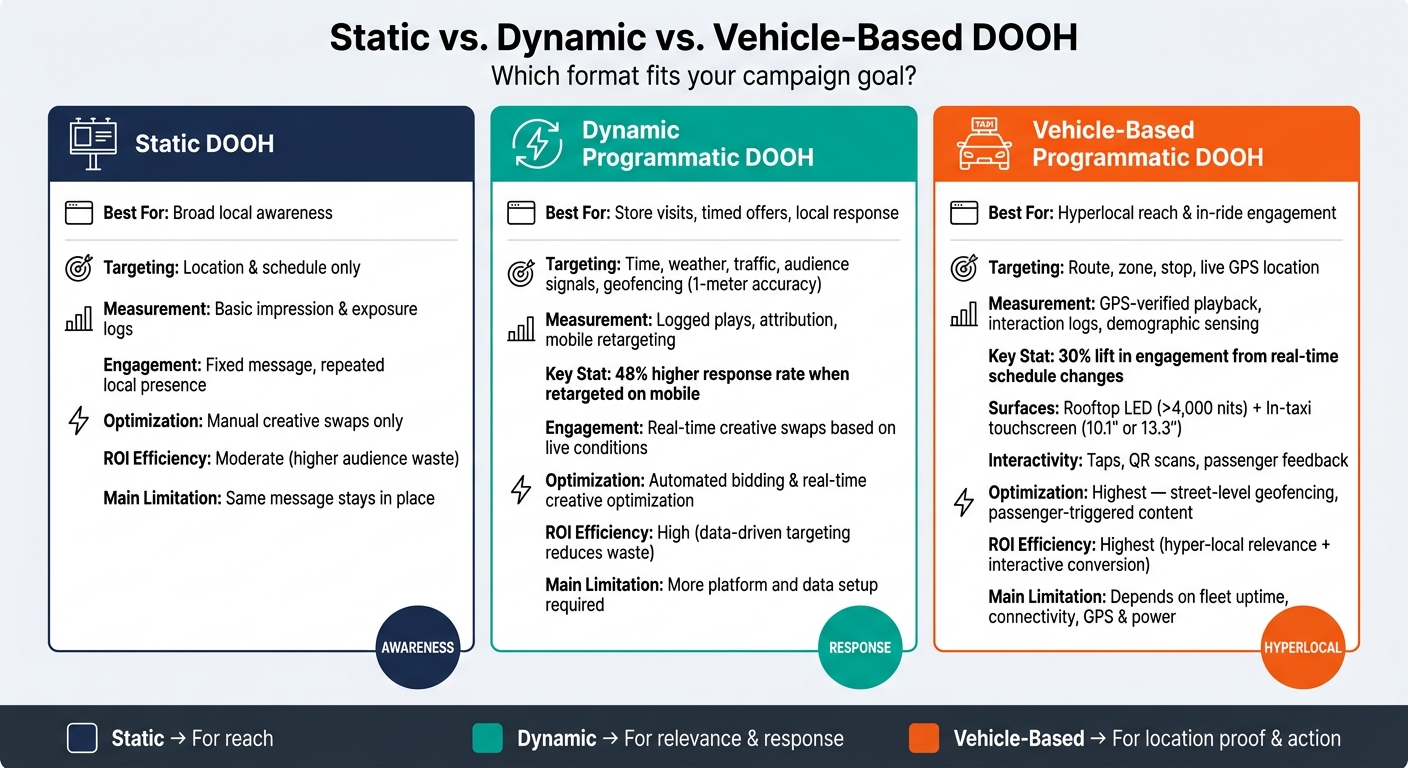
Static vs. Dynamic vs. Vehicle-Based DOOH: Full Format Comparison
Static DOOH runs the same ad on a set rotation. Because each placement has a short moment to make an impression, the image and copy need to be instant and easy to grasp.
Static ads help brands stay familiar by showing up again and again in the same area. That repeated local presence matters.
But static ads don’t react to what’s happening right now. Once the schedule is locked in, the creative stays the same. So static works well for reach, though it’s less suited for message changes tied to context.
Measurement is one of static DOOH’s strong points, even if it leans more toward exposure than live action. Cloud systems record each play with a timestamp and GPS data, and static OOH still drives search, social activity, and website visits.
You can also connect offline views to digital action with simple add-ons like:
Static DOOH can be scheduled by location and time, but the ad itself stays fixed. It doesn’t shift with weather, traffic, events, or other live signals.
Programmatic dynamic DOOH starts with those same scheduling inputs, then swaps creative in real time.
Static DOOH is run through cloud-based content systems. Teams upload creative files, schedule them, and send them to screens remotely.
That fixed setup creates the starting point for dynamic programmatic ads, which can change mid-flight.
Static DOOH stays the same. Dynamic programmatic DOOH changes on its own.
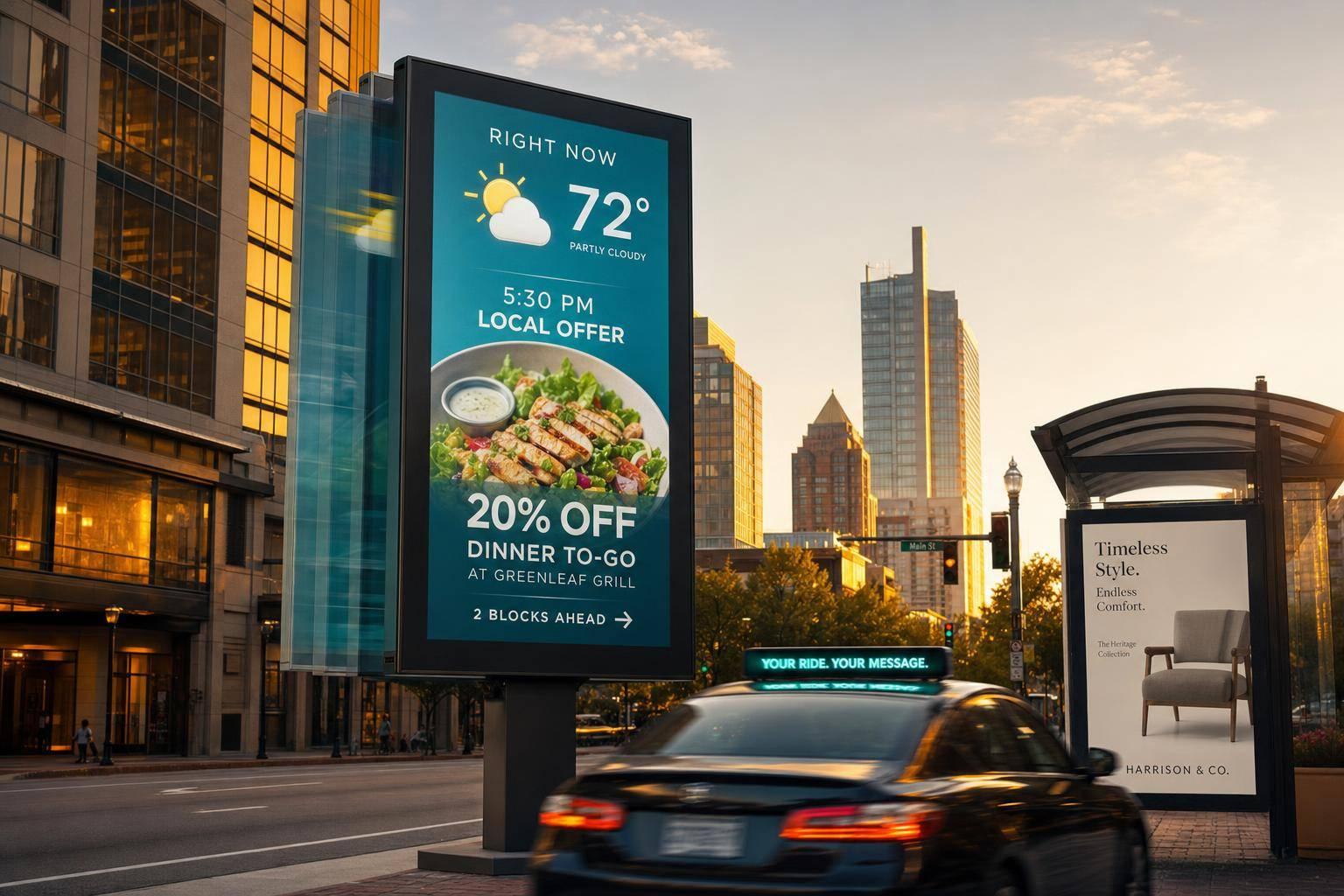
That means an ad shown during the morning commute can be totally different from the one shown at noon. The change can happen based on time, location, weather, or event schedules. That’s the big advantage: the message fits the moment, which makes it more relevant and easier to measure.
Dynamic creative works best when it lines up with the audience, the place, and the timing. Static ads can’t do that. Dynamic ads can.
Some platforms use anonymous audience-detection cameras to estimate audience profiles in real time, then switch the creative to fit who’s there. It’s a simple idea, but it changes the game: the screen doesn’t just display an ad, it reacts to the setting around it.
Interactive formats add even more pull. Touch-screen feedback and AR features can make the experience feel less like a billboard and more like something people want to try, especially for Gen Z and Gen Alpha audiences.
This is where dynamic programmatic DOOH stands out. When measurement and tuning matter, it has a clear edge.
Every ad play is logged with a precise timestamp, GPS location, and duration of exposure, all verified automatically through cloud-based systems. Those logs make live optimization possible and support closed-loop attribution across the funnel, from brand awareness to store visits to online sales lift.
There’s also a strong link with mobile retargeting. Audiences who see a DOOH ad and are later retargeted on mobile show a 48% higher response rate.
Put simply, dynamic DOOH can improve ROI because it adjusts fast, tracks each play with precision, and lets teams act on performance data without waiting around.
Programmatic DOOH gives advertisers much more control over when and where creative appears.
It can support geofencing accurate to within one meter, along with time-based triggers and live signals from the surrounding environment. So if the temperature climbs, a campaign can switch to warm-weather creative. If screens are near a store during peak shopping hours, the message can shift to match that traffic window.
Creative updates sync to screens within minutes through cloud-based content management, with no manual intervention needed. That speed matters. If static creative is like printing a poster and hoping for the best, dynamic DOOH is more like adjusting the message mid-conversation.
Of course, this setup needs more behind the scenes than static DOOH.
Dynamic programmatic DOOH depends on constant connectivity, GPS for location tracking, and a cloud CMS that can swap creative remotely and verify playback. That extra setup is what makes real-time switching and verification possible in the first place.
Self-service dashboards usually handle the day-to-day work, including creative uploads, media buying, and live playback checks. So while the system is more involved, it also gives teams much tighter control once it’s up and running.
Those same dynamic rules become even more useful in moving fleets, where time and location keep changing.
"The flexibility of programmatic buying, the auction-based model, granular media decisioning, and optimization – these things are not coming down the pike. They're available today, and they're doable." - Wade Rifkin, EVP/GM Programmatic, Clear Channel
Moving vehicles can put ads in places fixed screens simply can't. The big difference is motion: the screen travels through the city, and the targeting can change with it. In a fleet setup, those same tools can control where an ad shows while the audience is also on the move.
Vehicle-based DOOH reaches two separate groups: people outside the vehicle and people inside it.
Rooftop LED screens can reach pedestrians and other drivers at more than 4,000 nits for sunlight visibility. At the same time, in-taxi touch-screen tablets in 10.1-inch or 13.3-inch formats reach passengers during the ride, which creates a captive audience.
That split matters. A rooftop screen is built for visibility at a glance. An in-car screen can go further, with taps, QR scans, and feedback built into the ad experience.
Timing also plays a part. Real-time schedule changes during peak hours increased engagement by 30%.
Reach is one thing. Proving where an impression happened is the part that makes the model useful.
On a vehicle-based platform like Enroute View Media, every ad play uses GPS timestamps and cloud verification to connect impressions to an exact time and place along a moving route. That gives advertisers a clearer read on delivery instead of treating the route like a black box.
Some setups also use front-facing cameras to detect anonymized audience demographics, such as age and gender, in real time. That helps tighten exposure measurement without tying the data to a person's identity.
This format gives advertisers a lot of control over location and timing. Geo-time targeting can trigger ads by route, zone, or stop.
In plain English, that means a campaign can run near a certain business, close to a competitor, or in high-value zones like airports. And because the content is managed digitally, updates move with the vehicle. There's no need for physical installation each time the message changes.
All of that control comes with hardware demands fixed screens don't have to deal with.
These devices need LTE/4G connectivity, GPS, vibration resistance, and a power management module that shuts the screen down if battery voltage drops below 12V to protect the vehicle's electrical system. For in-vehicle screens, kiosk mode keeps passengers inside the intended ad experience.
There are also two different surfaces in play, and each one behaves a bit differently:
| Feature | Rooftop LED Screen | In-Taxi Touch-Screen Tablet |
|---|---|---|
| Primary Audience | Pedestrians & other drivers | Passengers |
| Brightness | >4,000 nits | 10.1" or 13.3" display |
| Interactivity | None | Taps, QR scans, feedback |
| Targeting | Geo-time, route-based triggers | Demographics, passenger detection |
| Key Operational Need | Vibration resistance | Kiosk mode, power protection |
Static DOOH can put a message in front of a lot of people. But it shows the same ad to everyone, no matter who they are or what’s happening around them. Dynamic programmatic DOOH changes that. It can swap creative based on live conditions, which cuts down on wasted impressions. That shift matters even more when the goal moves from simple exposure to actual response.
When the message fits the moment, people are more likely to notice it, remember it, and do something after seeing it. And as advertisers get more control, they also get a clearer view of what drove that response.
Vehicle-based dynamic DOOH pushes this a step further. Because it moves through routes and neighborhoods, it can deliver route-level relevance that fixed screens just can’t match.
Measurement gets tighter at each stage. Static DOOH mainly measures reach. Dynamic DOOH adds response signals. Vehicle-based platforms add verified location data and interaction data.
Here’s the difference by format:
| Format | Engagement Outcome | Attribution Depth | Optimization Potential | ROI Efficiency |
|---|---|---|---|---|
| Static DOOH | Broad awareness; limited contextual relevance | Low; general traffic counts and basic impressions | Low; requires manual creative swaps | Moderate; higher waste on non-target audiences |
| Dynamic Programmatic DOOH | Higher attention and recall via live triggers | Medium; foot traffic lift, website visits, brand lift | High; automated bidding and real-time creative optimization | High; reduced waste through data-driven targeting |
| Vehicle-Based Programmatic DOOH | Highest local impact; captive in-vehicle audience and moving neighborhood-level exposure | Highest; GPS-verified playback, demographic sensing, interaction logs | Highest; street-level geofencing and passenger-triggered content | Highest; hyper-local relevance and interactive conversion |
Of course, those gains also bring more cost and more moving parts, which the next section weighs against the upside.
Every format has tradeoffs. The best pick comes down to what you want the campaign to do, how much setup and coordination your team can handle, and how much measurement you need. That’s the catch: as relevance goes up, the work behind the scenes usually goes up too.
Static DOOH is the easiest to make and budget for, but it can’t change in real time. Its upside is simple execution. Its downside is stiffness. It’s built for reach, not response. Measurement is limited, and both buying and reporting give you less room to adjust.
Programmatic DOOH moves things a step forward. It allows real-time updates and tighter control over where ads appear. It also improves measurement and optimization, which can cut waste and help ROI. The tradeoff is more setup and more moving parts.
Vehicle-based programmatic DOOH, like the solutions offered by Enroute View Media, goes even further with route-level targeting and format-specific creative. In-vehicle screens add interaction and a captive audience, which can make local messaging more relevant and increase response potential. But this format depends on fleet uptime, connectivity, GPS, and power management. For example, screens should shut off if battery voltage drops below 12V so the vehicle’s battery doesn’t get drained.
The table below sums up the main tradeoff in each format.
| Format | Main Advantages | Main Tradeoffs |
|---|---|---|
| Static DOOH | Simple production; predictable costs; no tech stack needed | No live updates; weak attribution; manual swaps |
| Programmatic DOOH | Real-time triggers; stronger measurability; auction buying flexibility | More creative and tech complexity; requires platform integration |
| Vehicle-Based Programmatic DOOH | Geo-time targeting; captive in-vehicle audience; interactive touchscreens; real-time GPS tracking | Dependent on fleet coverage, connectivity, power, and hardware uptime |
That leads to the real choice: which format lines up with the campaign goal, budget, and measurement need.
Dynamic content in programmatic DOOH drives stronger engagement and more measurable ROI than static ads when timing and location matter most. You see that gap most clearly in mobile, hyperlocal settings. Static DOOH still has its place for fixed-message awareness campaigns on tighter budgets, but it doesn't change in real time.
Vehicle-based programmatic DOOH pushes that edge even further because the screen moves with the audience. In dense U.S. urban markets, vehicle-based programmatic DOOH stands out by pairing geo-time targeting with rooftop LED screens and in-taxi tablets through platforms like Enroute View Media.
For broad awareness, static still works. For relevance and measurable response, dynamic content wins.
Choose dynamic DOOH over static ads when you want more relevance and stronger audience response through real-time targeting.
It gives you the option to tailor messages based on location, time of day, weather, and passenger demographics. With Enroute View Media, campaigns can be updated in under a second, which helps keep content timely, current, and impactful.
ROI in programmatic DOOH comes down to one thing: did the campaign move a business goal? That can mean more brand awareness, more foot traffic to a store, or a lift in online and offline sales. With advanced measurement, advertisers can tie those results back to ad exposure instead of guessing what worked.
For fleet operators, the focus is more day-to-day and performance-based. Enroute View Media’s platform tracks live campaign data such as screen uptime, impressions, and revenue reports, so operators can see how their screens are performing as campaigns run.
Vehicle-based DOOH works especially well at the local level because it uses real-time location data to reach people where they live, work, and spend time.
With geotargeting and time-based delivery, Enroute View Media helps fleet operators show ads only in the areas that matter, like airports or business districts. It also lets them change messaging based on location or time of day, which makes each ad feel more timely and relevant.
Need pricing details?
EnrouteViewMedia is a Canadian technology company based in Edmonton, Alberta, Canada. The company was founded by a group of media entrepreneurs and engineering executives. Our mission is developing leading-edge digital media display technologies for taxicab rooftops and taxicab interiors advertising market. Through our easy to use ad delivery and management system, we assist our clients in reaching their customers with targeted exposure. EnRouteViewMedia continuously strives to be the global leader in digital geo-time targeted advertising media systems for modern taxi fleets.