
Compare static OOH, fixed DOOH, and vehicle-based DOOH to choose the right format by reach, targeting, update speed, and measurement.
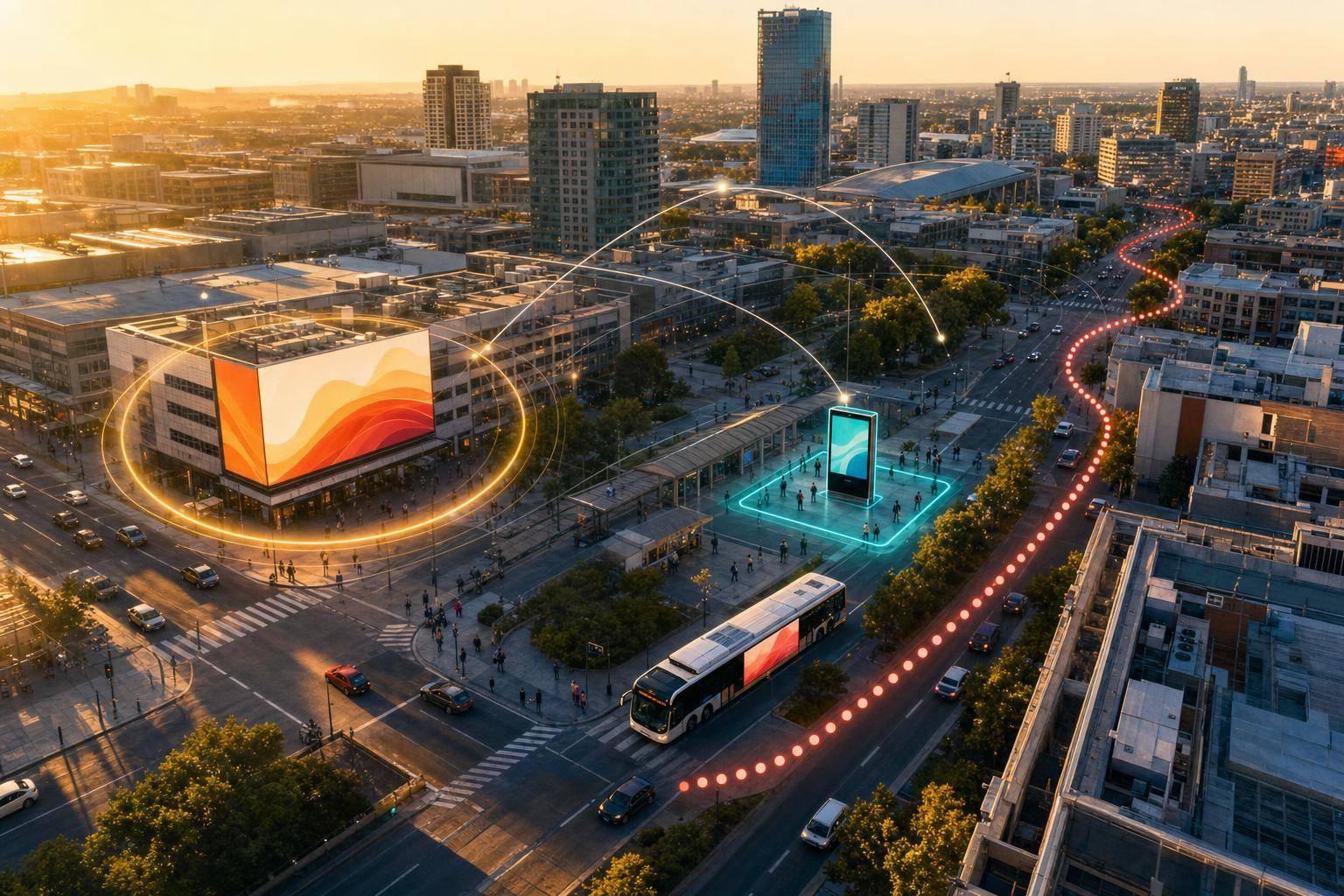
If you need broad reach, use static OOH. If you need time-based message changes, use fixed-location DOOH. If you need route-based delivery with location data and proof of play, vehicle-based DOOH is the best fit.
I’d sum it up this way: the whole choice comes down to where the screen is, how fast the message can change, and how well you can track delivery. Static boards stay fixed and rely on placement alone. Fixed DOOH stays in one venue but can swap ads by time, weather, or nearby activity. Vehicle-based DOOH adds movement, GPS, and route-based control.
A few numbers make the point fast:
So if I were choosing between these formats, I’d look at four things first:
Quick comparison
| Format | Best for | Targeting | Message updates | Measurement |
|---|---|---|---|---|
| Static OOH | Broad awareness | Location only | Manual | Estimated impressions |
| Fixed-location DOOH | Venue-based, time-based campaigns | Place + time of day + nearby context | Remote | Playback logs + audience estimates |
| Vehicle-based DOOH | Route-based campaigns across a city | GPS + geofences + time windows | Remote | GPS/time-stamped delivery logs |
In short, I see it like this: static = reach, fixed DOOH = dwell and timing, vehicle DOOH = movement and verified delivery. The rest of the article breaks down how those tradeoffs affect campaign planning in U.S. city markets.
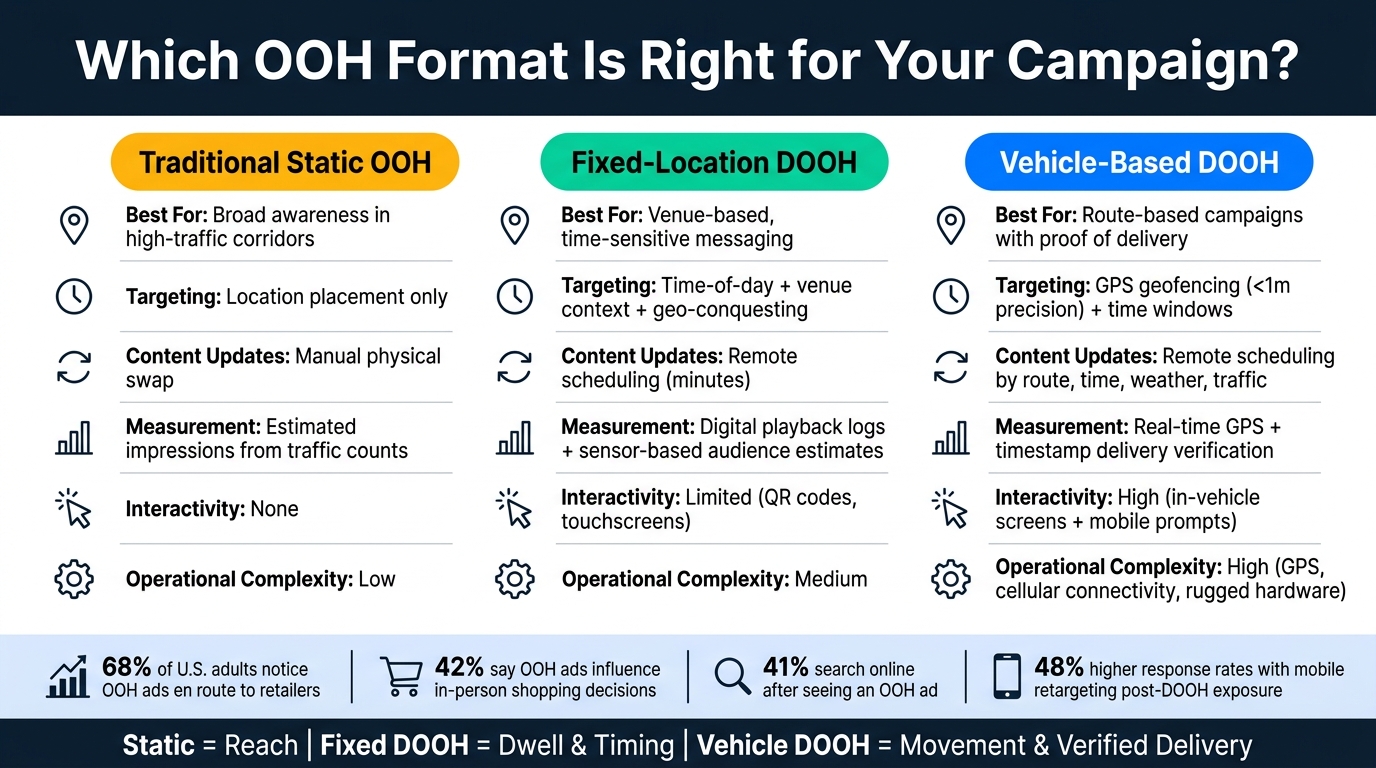
Static OOH vs Fixed DOOH vs Vehicle DOOH: Format Comparison Guide
Static OOH relies on fixed placement, not live location intelligence. It still works for one simple reason: it sits close to how people move through the world.
Static OOH targets by where the ad is placed. A billboard near a grocery store or on a highway heading to a shopping center reaches people on a route you can usually predict. But that’s about as far as the targeting goes. There’s no time-based scheduling, no live-triggered swap, and no audience filtering beyond the people passing by.
68% of U.S. adults notice OOH ads while en route to retailers. That’s solid reach. But it comes from geographic placement, not live location data.
Once a billboard is installed, the message stays put until someone replaces it by hand. For awareness campaigns, that can be fine. If the goal is to react to what’s happening right now, though, static OOH can’t move fast enough.
Impression estimates usually come from traffic counts and projected reach. That gives you a useful snapshot, but only to a point. There’s no verified playback, no movement logs, and no live audience data. So you get a rough sense of how many people may have seen the ad, not the verified exposure detail that digital screens can offer.
The next difference isn’t about where the ad appears. It’s about how the screen itself can change.
Static OOH is good at broad awareness, but it can’t respond to live location signals. That fixed setup is the baseline that fixed-location DOOH builds on next.
The screen stays in one place, like a mall entrance, a transit hub, or inside a grocery store. But the message on that screen can change in real time. That's what sets fixed DOOH apart: it mixes a set physical location with live control over what people see.
Fixed DOOH adds venue context and dayparting on top of plain geographic placement. A screen at a retail entrance reaches shoppers who are already close to making a purchase. Dayparting lets advertisers swap the message by time of day, such as a coffee promotion at 8 a.m. and a lunch deal at noon.
Proximity targeting adds one more option. A brand can place ads on a screen near a competitor's store, a tactic known as geo-conquesting.
With a cloud-based CMS, advertisers can update screens remotely, often in just minutes. That means a brand can react to a weather shift, a local event, or changes in who is nearby without going anywhere near the display.
Programmatic DOOH (pDOOH) pushes this further by swapping creative based on inputs like weather, traffic, or events. Some fixed displays also support QR codes and interactive features that can push people to act on mobile right away. So while the screen itself doesn't move, the message can keep pace with what's happening around it.
This is where fixed DOOH gets past static formats. Sensing tech, including cameras and motion sensors, can detect anonymized audience data like estimated age and gender in real time, without storing identifiable footage. In plain English, that gives advertisers exposure data instead of rough traffic estimates.
The effect after exposure can also be tracked. 41% of consumers exposed to OOH ads used a search engine afterward, 33% searched social media, and 28% visited a website. And when brands retarget that same audience on mobile after they have seen a fixed DOOH ad, response rates are 48% higher than for non-retargeted audiences.
The tradeoff is simple: the screen can't follow the audience. It only reaches people who pass that one location, which puts a ceiling on geographic coverage when a campaign needs to span more of a city. If the goal is to move with the audience, vehicle-based DOOH is the next step.
If fixed-location DOOH reacts to place, vehicle-based DOOH adds motion. That changes the game a bit. Instead of tying targeting to one screen in one spot, brands can target a live route. The screen moves through the audience’s day-to-day surroundings, so ads can line up with routes, zones, and time windows instead of just sitting there and waiting for foot traffic.
Vehicle-based systems rely on geo-time targeting. In plain English, that means they combine exact GPS data with time fences so an ad shows up in the right place at the right moment. With GPS precision under 1 meter, campaigns can trigger creative as soon as a vehicle enters a geofenced zone. That gives advertisers room to run exterior creative for people on the street and interior creative for passengers at the same time.
That same geo-time control also means the creative can shift as the route changes.
Content can update across vehicle screens within minutes. Advertisers can schedule ads by route, time, weather, or traffic. For vehicle screens, shorter usually works better: keep video to 20 seconds and static creative to 10 seconds.
Each play is logged with GPS and time stamps, which gives delivery reports showing exactly where and when the ad ran. In-taxi tablets can also detect estimated age and gender anonymously.
So this isn’t just about showing an ad and hoping for the best. It gives advertisers clearer proof of delivery while also extending campaign reach across more parts of a city.
The big edge here is mobility. Fixed screens stay put. Vehicles don’t. A moving vehicle can reach several audience clusters without any screen relocation. In one shift, a single vehicle can pass through multiple neighborhoods, retail corridors, and business districts.
68% of U.S. adults notice OOH ads while en route to retailers, which makes moving vehicles a strong match for path-to-purchase campaigns.
Each format solves a different job.
Static OOH is built for broad awareness. Fixed-location DOOH adds time-based control. Vehicle-based DOOH goes a step further with route-level precision and delivery proof. The core difference comes down to how each one uses location data: static placement, fixed venue context, or live route data.
That changes the tradeoffs around reach, targeting, measurement, and setup.
| Feature | Traditional Static OOH | Fixed-Location DOOH | Vehicle-Based DOOH |
|---|---|---|---|
| Reach | High, but fixed to one location | High, but fixed to one location | Mobile; reaches multiple corridors and neighborhoods |
| Targeting | Broad/demographic only | Time-of-day, basic location | Hyper-local geofencing and time windows |
| Content Updates | Manual/physical swap | Remote scheduling and updates | Remote scheduling and updates |
| Measurement | Estimated impressions | Digital playback logs and sensor-based audience estimates | Real-time GPS verification and anonymized demographic sensing |
| Interactivity | None | Limited (touchscreens) | Higher, via in-vehicle screens and mobile prompts |
| Operational Complexity | Low | Medium | High (GPS, cellular connectivity, rugged hardware) |
Here’s the plain-English version.
Traditional static OOH works best when the goal is simple, broad awareness in high-traffic corridors. It’s straightforward and easier to run, but you give up timing control and detailed measurement.
Fixed-location DOOH fits time-based messaging in high-dwell settings. Think places where people wait, look around, and have a moment to notice the screen. You get remote updates and better reporting than static placements, though the audience is still tied to one venue.
Vehicle-based DOOH is the best fit for mobile, route-aware campaigns that need proof of delivery. It can follow movement patterns, hit set time windows, and verify where the ad ran. That edge matters most when movement, timing, and delivery verification are part of the media plan. SaaS licensing for these systems can range from $5.99 to $19.99 per device per month, with industrial-grade in-taxi tablets priced around $190 per unit and advanced targeting integrations reaching $15,000 to $20,000 per year.
The right DOOH format comes down to the goal of the campaign.
Static OOH works best for broad awareness. Fixed-location DOOH makes more sense for venue-based, time-sensitive messaging.
Once movement becomes part of the media plan, vehicle-based DOOH is the better fit. When geo-time precision and proof of delivery matter, Enroute View Media fits that use case well. It supports geo-time targeting, route-based delivery, and playback verification. That makes it the strongest fit when route, timing, and proof of delivery matter most.
In short: use static for reach, fixed-location for dwell, and vehicle-based DOOH for movement, timing, and verified delivery.
Choose based on whether you need mobility and real-time location targeting.
Location intelligence helps improve delivery accuracy. It does that by showing the right ad to the right people in the right place at the right time, using geofencing, geotargeting, and, when needed, demographic targeting.
It also improves measurement. You can see where and when ads ran through timestamps and GPS-based location data, which makes location- and time-based optimization much easier.
Vehicle-based DOOH can deliver results you can track with location data and live analytics. Advertisers and fleet owners can monitor ad exposure and review campaign performance as it happens through secure portals, reports, or APIs.
It can also confirm playback with timestamps, GPS location, duration, and impression counts. If cameras are installed, systems may also collect anonymized audience data, such as age and gender.
Need pricing details?
EnrouteViewMedia is a Canadian technology company based in Edmonton, Alberta, Canada. The company was founded by a group of media entrepreneurs and engineering executives. Our mission is developing leading-edge digital media display technologies for taxicab rooftops and taxicab interiors advertising market. Through our easy to use ad delivery and management system, we assist our clients in reaching their customers with targeted exposure. EnRouteViewMedia continuously strives to be the global leader in digital geo-time targeted advertising media systems for modern taxi fleets.