
How geo-targeted vehicle DOOH cuts waste, improves local reach, tightens timing, and provides GPS-backed reporting.
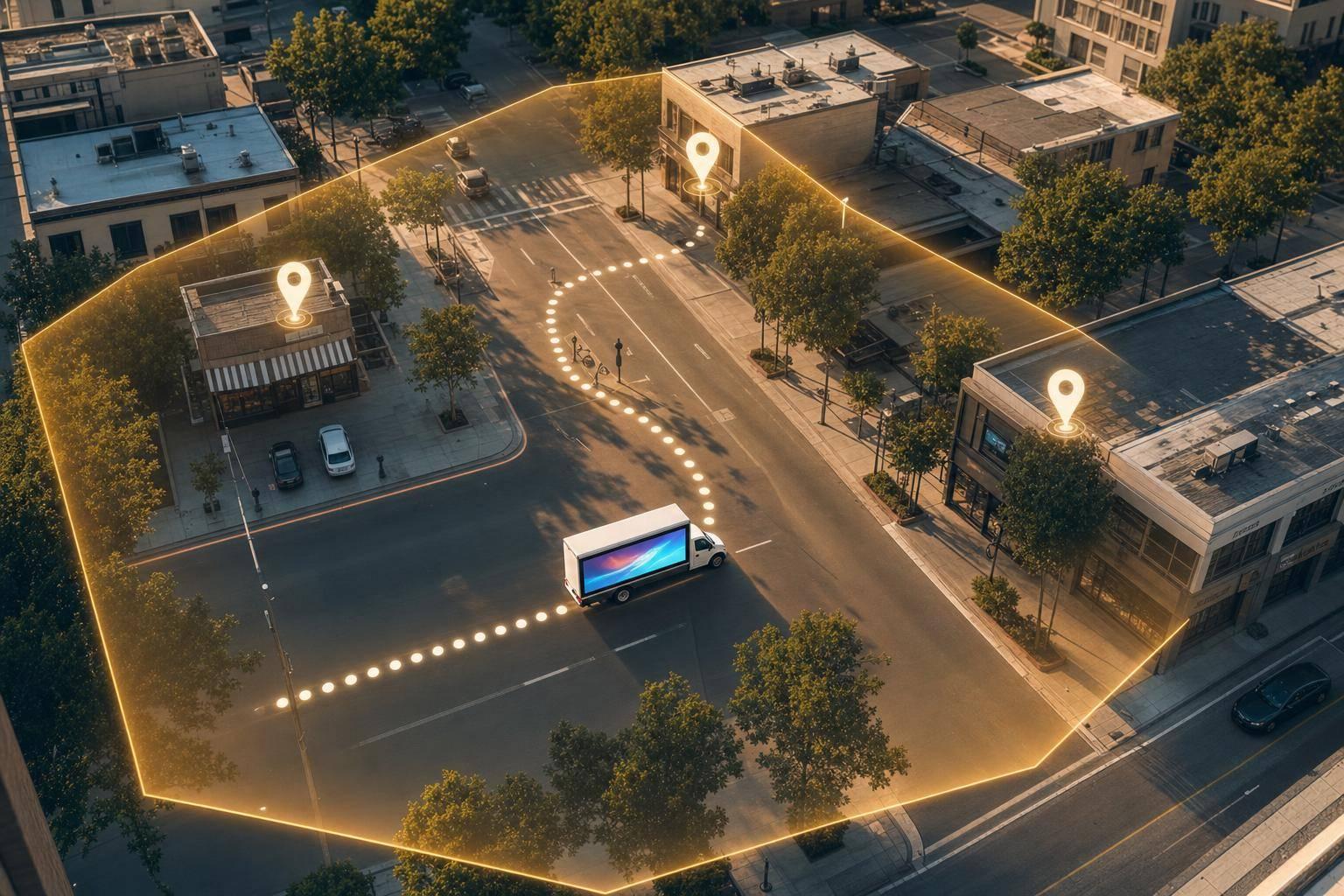
Geo-targeted vehicle DOOH helps you show the right ad in the right area at the right time. That means less wasted spend, better local fit, sharper timing, more useful reach, and cleaner reporting.
If I had to sum it up in one line, it would be this: a moving screen works harder when the message changes by location and time instead of running the same ad everywhere.
Here’s the short version:
The article also points to a few hard numbers that matter:
| Area | Geo-Targeted DOOH | Broad Delivery |
|---|---|---|
| Local fit | Ads change by zone | Same ad runs everywhere |
| Waste | Lower | Higher |
| Timing | Location + schedule | Fixed loop |
| Reach | More focused | More general |
| Reporting | GPS- and time-stamped | Broader estimates |
Bottom line: if you want a campaign to work by place, time, and audience, geo-targeted vehicle DOOH gives you more control than broad delivery.
Vehicle-based DOOH stands out for a simple reason: the screen changes with the route instead of running the same loop all day.
A taxi or rideshare vehicle might pass through a business district, a residential neighborhood, and an airport zone in one day. That means location and timing can work together, so ads show only when the vehicle is in the right place at the right time.
That level of precision matters because it turns location and timing into triggers you can actually use. Modern GPS systems can reach less than 1 meter of precision, which makes it possible to set tight geofences around districts, airports, and event zones. Content can also sync across the fleet through a cloud CMS, so messaging stays current even as routes shift.
A fixed billboard shows the same creative all day. A geo-targeted vehicle screen changes with the route. Static campaigns don't.
| Feature | Static/Broad DOOH | Geo-Targeted Vehicle DOOH |
|---|---|---|
| Location | Fixed or non-specific | Dynamic, shifts with vehicle movement |
| Precision | General area | Less than 1 meter |
| Content Trigger | Time-loop only | Location + time + context |
That flexibility leads directly to the five benefits below.
Geo-targeting’s biggest edge is pretty simple: each impression lines up with the exact place the vehicle is moving through. But that only works when location targeting is tight.
With high-precision GPS, advertisers can target specific blocks, entrances, or terminals. That level of accuracy also lets brands match messages to the time of day, not just the place.
In practice, geo-targeting can blend location and dayparting, so ads shift based on where the vehicle is and when people are most likely to pay attention.
Geo-conquesting takes that a step further by placing ads near a competitor’s location to pull in nearby demand. The same idea works in live campaigns, where ad delivery changes as conditions change.
A New York taxi fleet used real-time GPS scheduling to shift ad delivery during peak hours, resulting in a 30% increase in audience engagement. That’s the difference between messaging that feels timely and messaging that feels generic.
In vehicle-based DOOH, waste drops when content shifts with a vehicle’s live location. Geo-targeted DOOH helps by showing ads only when a vehicle is in the right zone and moving along the right route.
Passenger detection can trigger ads only when a passenger is physically present, preventing ads from playing to an empty cabin. In plain English, playback starts only when someone is actually there to see it.
Dayparting cuts waste by running each offer only during the hours that matter most. That means scheduling creative for the lunch rush, commute hours, or evening entertainment windows so ad spend goes where attention is highest.
Here’s how each feature helps trim waste:
| Feature | How It Reduces Waste |
|---|---|
| Geofencing | Limits ad delivery to specific high-value zones or competitor locations |
| Dayparting | Ensures time-sensitive offers only run during relevant hours |
| Passenger Detection | Prevents ad playback when the vehicle is empty |
| Real-Time GPS | Enables immediate adjustments based on actual vehicle location |
Enroute View Media brings geofencing, passenger sensing, and dayparting into one cloud platform, helping campaigns stay efficient.
When waste goes down, the same budget can deliver more useful impressions across the fleet.
Cutting waste is only half the job. The next win is reach: more of the right people see the ad in the right place.
Tight geofences help taxi and rideshare screens show ads only in high-value zones, like business districts and event areas.
Exterior rooftop screens reach pedestrians and nearby drivers. In-car screens keep passengers’ attention for 10 to 30 minutes. As vehicles move, they spread exposure across neighborhoods, travel corridors, and event zones in a single day.
That’s where timing starts to matter. A New York taxi fleet reported a 30% lift in engagement after matching ad delivery to peak hours with real-time GPS data.
Location-based delivery tends to work best when it lines up with route patterns and where people are at a given moment. Add daypart scheduling to the mix, and that reach gets sharper.
Dayparting and geo-targeting are a strong pair in vehicle-based DOOH. The route handles where the ad appears, and the schedule handles when it shows up. Because taxis and rideshare vehicles pass through many zones in a single shift, one screen can move from commuter-focused ads to evening offers without swapping out the campaign.
Cities have a rhythm, and smart campaigns follow it. In the morning, commuters pack business districts and transit hubs. Around lunch, people head to office parks and food corridors. By evening, traffic moves toward malls, entertainment areas, and restaurant rows.
A taxi or rideshare screen can track that flow. A coffee brand ad might run near a transit hub in the morning, then later switch to a dinner offer near a restaurant district. Same screen, different moment, better fit.
| Daypart | Location Trigger | Ad Content That Works |
|---|---|---|
| Morning Commute | Transit hubs, business districts | Coffee, news, financial services, B2B |
| Lunch Hour | Office parks, commercial centers | Food delivery, quick-service restaurants, local restaurants |
| Evening | Shopping malls, retail corridors | Fashion, electronics, drive-to-store offers |
| Late Night | Entertainment zones, nightlife districts | Dining, events, ride-sharing, late-night dining |
Platforms can pre-schedule campaigns well ahead of time. That makes it simpler to match ads with holiday promos, local events, and high-traffic periods.
It doesn't stop there. Live signals like traffic, weather, or passenger presence can also trigger content changes. Enroute View Media's cloud-based platform supports geo-time targeted advertising and real-time analytics, which gives operators room to adjust schedules as conditions shift.
That tighter timing also makes performance easier to measure in the next section.
Geo-targeted DOOH makes campaign measurement much easier to check. Each ad play is linked to a specific place, time, and device status. That means advertisers can verify performance by zone, time slot, and audience instead of relying on rough estimates.
Every ad play is logged with a GPS-based location, timestamp, duration, and impression count, so you can confirm exactly where and when each creative ran. Enroute View Media's platform uses 41-satellite channel GPS, with location precision of less than 1 meter from the intended target.
Offline screens can drain budget in any DOOH campaign. Cloud-based dashboards show device status right away, so operators can catch a dead screen and fix it before more impressions disappear. Live status data flags offline screens before impressions are lost.
Integrated cameras and sensors can track anonymized demographics such as age and gender in real time, without storing identifiable data. That gives advertisers a much clearer view of who actually saw an ad, not just where the vehicle was.
Programmatic integration can use real-time location and audience data to support dynamic CPMs and automated bidding. Those logs also make it simple to compare results by zone, route, and hour.
| Measurement Feature | Data Provided | Benefit for Advertisers |
|---|---|---|
| GPS Playback Logs | Exact coordinates and timestamps | Verifies ad delivery in specific local neighborhoods |
| Audience Sensing | Anonymized age, gender, and presence | Measures reach and demographic alignment |
| Real-Time Monitoring | Online status and live screenshots | Reduces media waste by identifying offline screens immediately |
| Geofencing Analytics | Performance by city zone | Allows for location-based ROI comparison |
That proof point leads directly into the next comparison with broad delivery.
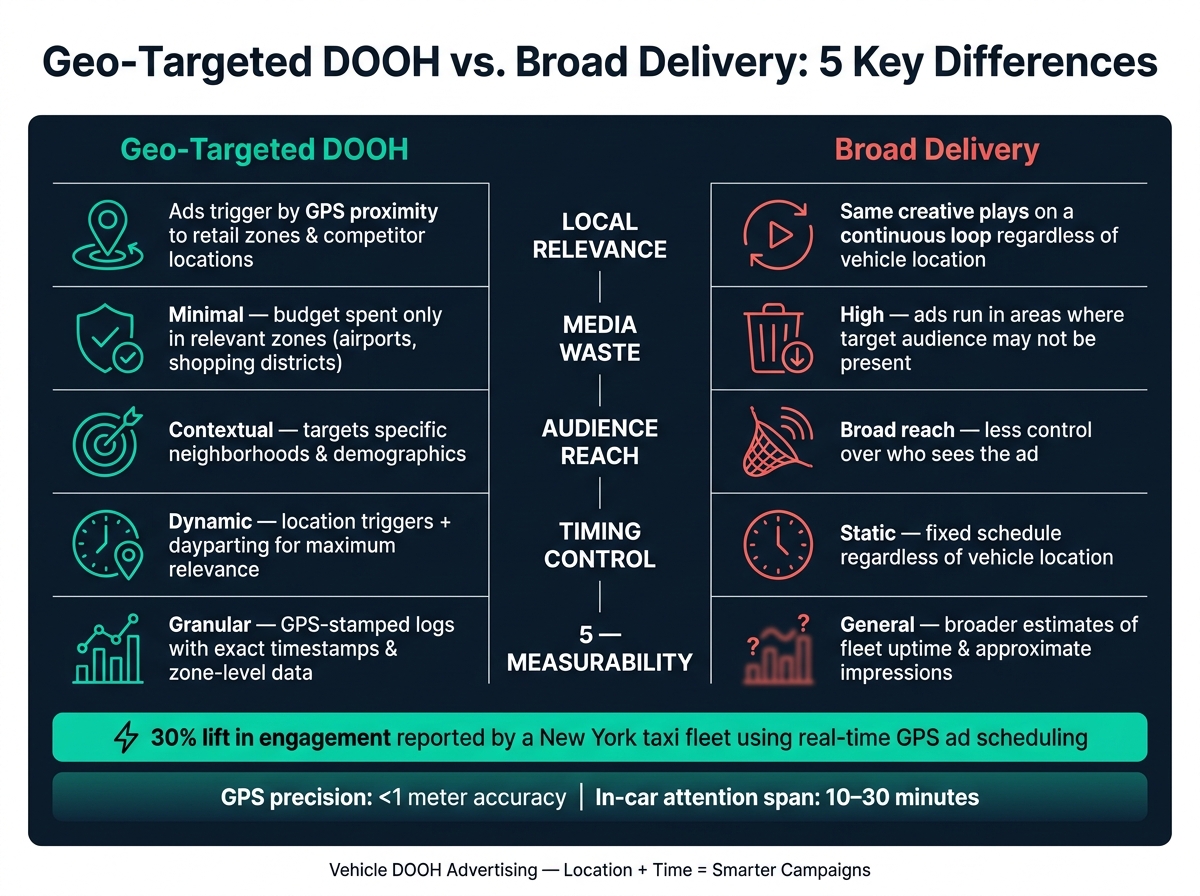
Geo-Targeted DOOH vs. Broad Delivery: 5 Key Differences
Geo-targeted vehicle DOOH works off location and time. Broad delivery does not. It runs the same ad loop everywhere the vehicle goes.
That one difference changes a lot. It affects local relevance, wasted spend, reach, timing, and how closely you can track performance. The table below puts those five areas side by side, so the contrast is easy to scan.
| Area | Geo-Targeted DOOH | Broad Delivery (Untargeted) |
|---|---|---|
| Local Relevance | High; ads trigger based on GPS proximity to specific retail locations or competitor locations | Low; the same creative plays on a continuous loop regardless of where the vehicle is |
| Media Waste | Minimal; budget is spent only in relevant geographic zones such as airports or shopping districts | High; ads run in areas where the target audience may not be present |
| Audience Reach | Contextual; targets specific neighborhoods and demographics | Broad reach; reaches more people, with less control over who sees the ad |
| Timing Control | Dynamic; combines location triggers with dayparting so ads run at the most relevant moments | Static; follows a fixed schedule regardless of location |
| Measurability | Granular; GPS-stamped playback logs provide exact timestamps and location-specific performance data | General; relies on broader estimates of fleet uptime and approximate impressions |
Put simply, geo-targeting gives advertisers more control over where an ad appears and when it shows up. Broad delivery casts a much bigger net, but it also gives up precision. If a campaign needs tight local focus, that tradeoff matters.
The conclusion pulls those differences together.
Geo-targeted vehicle DOOH is pretty simple: it puts the right message in the right place at the right time.
Those five benefits come from one main edge: more control over where and when ads appear. In moving vehicles, that kind of precision turns screen time into targeted exposure. A campaign that runs only when a vehicle enters a high-value zone, and only during the hours when the target audience is most likely to act, will often beat a fixed, all-day loop.
For vehicle-based DOOH, location targeting and dayparting work best together as one plan. That’s the edge of geo-targeted DOOH in motion.
Geo-targeting in moving vehicles uses GPS to track a vehicle’s location in real time. Enroute View Media puts that data to work through the DigiStream GTWA platform, which sets up virtual boundaries, or geofences, around specific areas.
When a vehicle enters one of those zones, the system serves ads matched to that place, day, and time. That keeps the message relevant and helps it land at the right moment.
Geo-targeted DOOH is a strong fit for businesses selling time- and location-sensitive products or services. That’s especially true for local brands that want to reach people in specific neighborhoods, during peak hours, or near major events.
It also works well for mobility-based advertisers and taxi or rideshare fleet operators. They can reach people on the move and adjust ads based on location. On top of that, real-time analytics and precise location matching can help improve ad delivery and boost revenue.
Performance is tracked through campaign reporting and verification. The platform records ad plays with timestamps, GPS-based location data to confirm delivery inside the planned geofences, and impression counts, including repeat views during a single ride.
Advertisers also get real-time device monitoring. That includes:
That means you’re not left guessing whether a campaign ran as planned. You can check delivery data, see device status as it happens, and review reports in the format that fits your workflow.
Need pricing details?
EnrouteViewMedia is a Canadian technology company based in Edmonton, Alberta, Canada. The company was founded by a group of media entrepreneurs and engineering executives. Our mission is developing leading-edge digital media display technologies for taxicab rooftops and taxicab interiors advertising market. Through our easy to use ad delivery and management system, we assist our clients in reaching their customers with targeted exposure. EnRouteViewMedia continuously strives to be the global leader in digital geo-time targeted advertising media systems for modern taxi fleets.