
White-label geo-targeting platforms let businesses rebrand location-based ad tech, run precise time-and-location campaigns, and track real-world conversions.

White-label platforms for geo-targeted advertising let businesses rebrand advanced ad tech as their own. These platforms are widely used for location-based campaigns, leveraging tools like geofencing and real-time GPS data to deliver highly targeted ads. They simplify backend operations, allowing companies to focus on scaling their services without developing technology from scratch. Key features include:
These solutions help businesses cut costs, improve ROI, and streamline operations - all while maintaining their brand identity.
A white-label platform designed for geo-targeted campaigns needs to deliver precise targeting, clear performance tracking, and efficient automation. The best platforms combine precise location controls, time-based scheduling, and automated bidding engines to ensure ads reach the right audience at the ideal moment.
Multi-signal location technology uses data from sources like IP addresses, GPS, WiFi, Bluetooth, and cell towers to achieve varying degrees of precision. This layered approach enables targeting by country, state, city, ZIP code, Designated Market Areas (DMAs), or even a specific radius around a building. The results speak for themselves: 89% of marketers reported higher sales, while 84% noted increased engagement, and 78% saw improved response rates after adopting location-based marketing.
In addition to targeting, these platforms often include custom domains and branded dashboards. These features build client trust and help agencies increase profit retention, with some reporting 25–40% higher profits. Advertisers can also reduce 30–50% of tech fees by using white-label solutions.
Effective geo-targeting depends on the ability to schedule ads based on both where a user is and when they’re there. Platforms must support dayparting, which allows ads to run during specific hours or days to align with local audience habits. For instance, a restaurant chain might promote breakfast deals from 6:00 AM to 10:00 AM within a two-mile radius, then switch to lunch offers at 11:00 AM.
A real-time bidding (RTB) engine evaluates ad impressions instantly, using location and time data to guide spending decisions. This ensures that budgets are allocated to the most relevant opportunities. Advertisers can also use location bid adjustments to increase bids in high-performing areas while excluding regions outside their service zone, minimizing wasted spend.
Exclusionary targeting is another crucial feature, preventing ads from appearing in areas where a business doesn’t operate. This approach maximizes ROI by ensuring every impression has the potential to convert. Additionally, frequency caps help avoid ad fatigue in smaller areas by limiting how often the same person sees an ad.
Real-time dashboards provide 24/7 access to campaign performance data, enabling advertisers to make immediate adjustments. Whether it’s fine-tuning targeting, removing underperforming domains, or updating creative assets, these tools are essential for dynamic campaigns like vehicle-based advertising, where routes and audience exposure shift throughout the day.
One standout feature is online-to-offline attribution, which measures how many users visit a physical location after seeing a geo-targeted ad. By tracking "Conversion Zones", advertisers can connect digital impressions to real-world actions, offering clear proof of ROI.
"The question that we're answering now is, is it worth our investment? And we're able to get to the data to prove that out".
Platforms also include automated filtering of General Invalid Traffic (GIVT) and Sophisticated Invalid Traffic (SIVT), ensuring that performance metrics are accurate and free from bot interference. Some advanced systems even use machine learning to offer predictive performance insights, forecasting outcomes across mobile, desktop, and Connected TV (CTV) campaigns.
For example, a nine-week hyper-targeted geofencing test led to a 28% sales increase for an outside sales team. Meanwhile, a consumer brand achieved a 134% Return on Ad Spend (ROAS) for a top-of-funnel campaign. These analytics also integrate seamlessly into programmatic platforms, streamlining campaign management.
Programmatic integration automates the buying of digital ad inventory across exchanges. This opens access to massive networks - over 600,000 apps and hundreds of publishers - ensuring ads reach audiences wherever they are.
Beyond ad placement, these platforms combine geofencing with more than 1,500 demographic and psychographic variables to refine targeting. For example, a luxury car dealership might target households within a specific income range who recently visited a competitor’s showroom, blending location data with behavioral insights for maximum impact.
"White label programmatic platforms... allow ad networks the ability to scale in sophistication, scope and effectiveness, without the need to develop expensive technology, knowledge and tools in-house." - Limelight Inc
For agencies and fleet operators, programmatic integration offers a way to provide advanced advertising services under their own brand - without the time and cost of developing in-house technology. In fact, 83.5% of U.S. companies now use programmatic technologies to automate ad campaign planning, optimization, and analysis. The efficiency gains are notable: dynamic digital out-of-home (DOOH) platforms can cut costs by up to 90% compared to manual methods.
These platforms also support multi-channel coordination, enabling unified management of ads across display, video, mobile, and Connected TV.
Enroute View Media offers a cloud-based white-label platform tailored for geo-targeted advertising on taxis and rideshare vehicles. Their DigiStreamView system eliminates the need for local servers, enabling fleet owners and marketing startups to rebrand and utilize the technology as their own. This setup allows businesses to skip the complexities of custom development and focus on growing their client base and boosting revenue. As the industry shifts toward dynamic white-label solutions, this platform represents a forward-thinking approach to vehicle-based DOOH (Digital Out-of-Home) advertising.
Since its launch in 2015, the platform has reached 900 million people and logged over 500 million impressions across more than 10 countries. Advertisers can update campaigns across entire fleets instantly, adapting in real time as vehicles travel through different neighborhoods. With geo-targeting and analytics at its core, Enroute View Media offers vehicle-specific features that integrate seamlessly into broader DOOH strategies. Let’s take a closer look at its hardware and operational innovations.
The platform’s hardware lineup is designed for high-impact visibility and efficiency. On the exterior, dual-sided rooftop LED screens boast a P2.5 pixel pitch, over 5,000 nits of brightness, and a lifespan of 100,000 hours - ensuring clear visibility even in direct sunlight. These screens can be installed using non-invasive roof racks or direct mounting and are powered by the vehicle's 12V battery.
Inside the vehicle, 10.1-inch Android touch-screen tablets (1280 x 800 resolution) engage passengers with interactive digital content. These tablets are equipped with motion sensors that activate content only when passengers are present, minimizing wasted impressions. Rooftop units use AI-powered computer vision to count viewers, providing precise impression data for mobile campaigns.
The platform’s geo-time targeting feature dynamically serves ads based on the vehicle’s location and schedule, with analytics tracking impressions and foot traffic increases. Using a 41-satellite GPS system, it achieves location precision within 1 meter. An intelligent power monitor ensures the displays shut off if the battery voltage drops below 12 volts, preventing battery drain. Together, these advanced hardware features and operational tools simplify fleet management and boost revenue opportunities.
Enroute View Media provides specialized modules to cater to the needs of both fleet owners and marketing startups. Fleet owners can access live maps showing vehicle locations, performance metrics, and driver earnings, while drivers have their own portal to track income and update profiles.
Fleet owners can set custom CPM rates, automate invoicing, and accept secure online payments in multiple currencies. Unsold ad inventory is automatically filled through programmatic integration with certified global ad networks, ensuring steady revenue without manual sales efforts. By combining white-label branding with streamlined operations, the platform minimizes administrative burdens while maximizing earnings per vehicle.
"enRoute partnership has helped us scale faster, more efficiently, and cost‑effectively." - Sebastian, CTO, Aceme
For marketing startups, the platform offers an opportunity to launch a media business without the expense of software development. The white-label portal allows startups to provide professional campaign management tools under their own brand. Features like real-time analytics and geo-heatmaps help advertisers see clear ROI, while the cloud-based architecture eliminates the need for private server infrastructure. This allows startups to focus entirely on acquiring fleets and driving sales, making it an ideal solution for scaling quickly and efficiently.
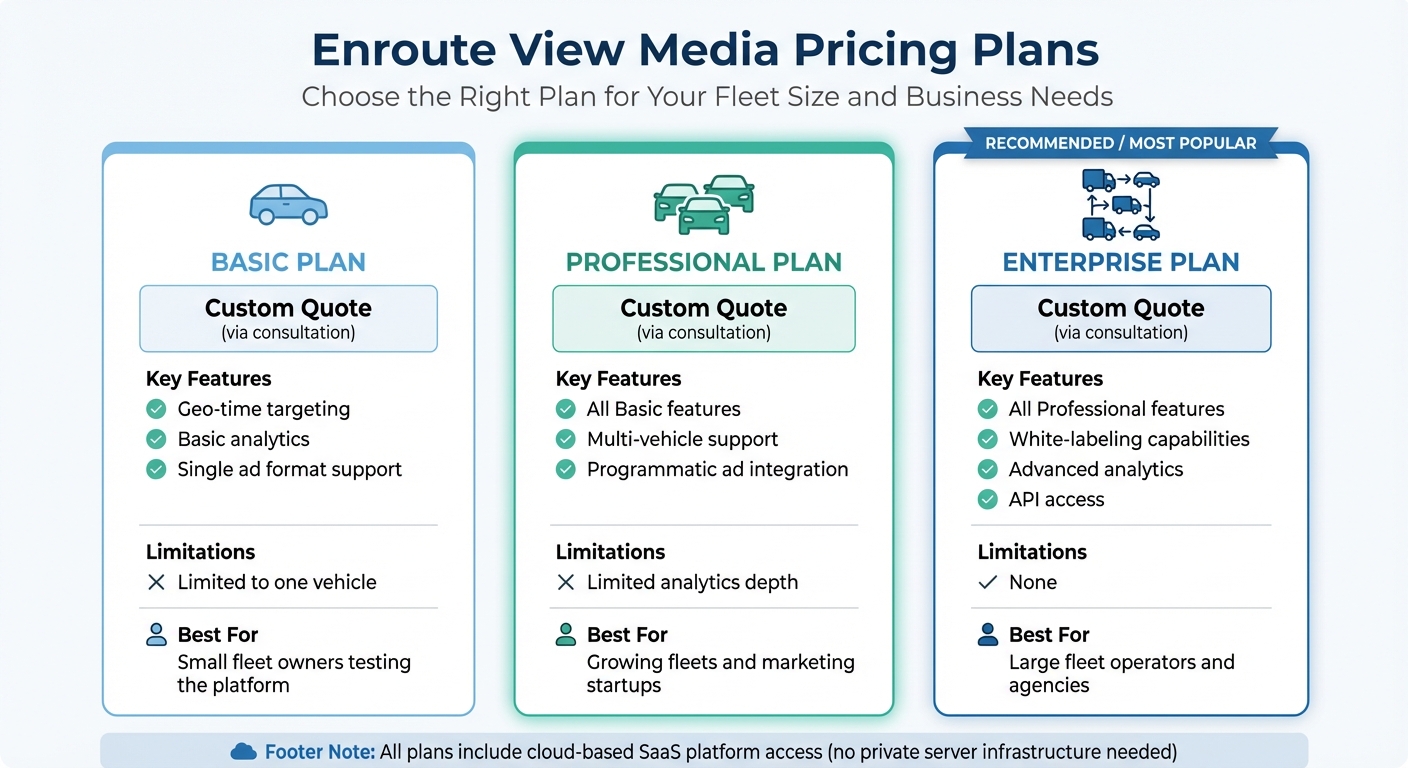
Enroute View Media Pricing Plans Comparison: Basic vs Professional vs Enterprise
Enroute View Media offers flexible pricing options designed to adapt to different fleet sizes and business needs, making it a versatile choice for companies aiming to scale their operations effectively.
The platform operates on a subscription model, with monthly or annual commitments. Pricing specifics for the DigiStream View ad management software are provided through direct consultations. This approach ensures tailored packages that account for factors like fleet size, hardware needs, and module configurations.
The pricing is divided into three tiers - Basic, Professional, and Enterprise - each including access to the cloud-based SaaS platform. This eliminates the need for businesses to invest in private server infrastructure. However, it's important to note that the system does not support generic third-party LED taxi toppers.
"The ad software management (DigiStream View) is a subscription-based software. The pricing model is a payment structure that allows a customer to subscribe to enRoute View Media Inc. services for a specific period of time for a set price." – Enroute View Media
Additional operational factors should be considered. Video advertisements consume more bandwidth, and LED units in electric fleets may require more frequent charging. Additionally, built-in metrics help monitor SIM card data usage.
Here’s a breakdown of the three pricing tiers, tailored to meet diverse operational needs:
| Plan | Pricing Details (via consultation) | Key Features | Limitations |
|---|---|---|---|
| Basic | Custom quote | Geo-time targeting, basic analytics, single ad format support | Limited to one vehicle |
| Professional | Custom quote | All Basic features, multi-vehicle support, programmatic ad integration | Limited analytics depth |
| Enterprise | Custom quote | All Professional features, white-labeling, advanced analytics, API access | None |
The platform’s modular design allows businesses to customize features based on their specific roles - whether they are Agencies, Advertisers, Fleets, or Drivers. This ensures companies only pay for the tools they need, with the flexibility to expand as their operations grow.
These pricing plans make geo-targeted advertising accessible, offering advanced features without adding unnecessary costs for fleet owners and marketing startups.
Enroute View Media gives fleet owners and advertisers the tools to fine-tune their ad campaigns with precision. Advertisers can adjust CPM rates, which range from $5 to $20 per 1,000 impressions, depending on factors like location density and campaign size. Ads are triggered by motion sensors only when vehicles move or enter specific geo-fenced areas. For example, a restaurant chain could display lunch special ads within a 500-foot radius from 11:00 AM to 2:00 PM, reducing wasted impressions by as much as 40%.
The platform also provides real-time analytics that refresh every five minutes. This allows advertisers to pause campaigns during low-traffic hours (like 2:00 AM to 5:00 AM) and amplify efforts during peak times. Features such as ZIP-code heatmaps and A/B testing have been shown to improve click-through rates by 15–20%.
These advanced targeting capabilities are backed by a system designed to make campaign setup and management as smooth as possible.
Operational efficiency is a cornerstone of Enroute View Media’s approach to geo-targeted advertising. The platform automates critical tasks like content syncing, geo-fence management, hardware monitoring, and payment processing in USD, all while adhering to regulations such as FCC brightness limits. For example, a fleet owner in Miami reported a 35% revenue increase over six months by automating in-taxi tablet ads that promoted geo-targeted offers like beachfront hotel deals within a one-mile radius. Impressively, the system maintained a 99.9% uptime during this period.
Additionally, the platform makes it easy for marketing startups to launch vehicle-based campaigns. With drag-and-drop geo-fence creation, pre-built templates, and built-in revenue calculators, campaigns can be set up in hours instead of days, giving businesses a faster path to potential earnings.
White-label platforms for geo-targeted advertising simplify complex technology while ensuring brands maintain their identity. With cloud-based systems handling server management, fleet owners and marketing startups can channel their energy into growing revenue - all while showcasing the technology under their own branding. This streamlined approach enhances audience engagement like never before.
By blending GPS precision (accurate within 3 feet), time-based scheduling, and real-time traffic insights, these platforms achieve results that static ads simply can't match. For instance, research highlights that 59% of viewers take action after seeing digital taxi-top ads, with campaigns boosting brand awareness by 43% and purchase intent by an impressive 85%.
Enroute View Media stands out by addressing the unique needs of vehicle-based advertising businesses. Their platform has reached over 900 million people and delivered more than 500 million impressions across 10+ countries.
"enRoute partnership has helped us scale faster, more efficiently, and cost-effectively." - Sebastian, CTO, Aceme
From automation to programmatic integration and white-label adaptability, these tools offer a solid path for businesses looking to achieve sustainable growth.
Geo-targeting becomes incredibly precise when advanced tools like real-time GPS and layered strategies come into play. A great example of this is vehicle-based digital out-of-home (DOOH) advertising, such as ads displayed on taxi screens. These campaigns use geo-targeting to dynamically activate ads in specific areas, making them more relevant and increasing revenue opportunities.
That said, challenges like inaccurate data or poorly set geofences can sometimes get in the way. To counter this, hyperlocal targeting - focusing on very small, specific zones - can dramatically boost precision and audience engagement.
In-store or foot-traffic lift from geo-ads is tracked by using location data and attribution methods to see if people exposed to ads end up visiting specific locations. This process often involves geofences, which are virtual boundaries set around areas like stores. When a person who has seen an ad enters the geofenced area, their visit is linked to the campaign. This helps marketers understand how well their ads are working to drive foot traffic.
To get started with a taxi or rideshare ad fleet, you’ll need a few essentials. First, invest in digital advertising hardware - this could include rooftop LED screens or in-vehicle tablets. Next, secure a content management platform that allows you to handle tasks like geo-targeting and analytics. Don’t forget to prepare eye-catching ad content and set up modules for managing your fleet and drivers to keep operations running smoothly.
For a hassle-free setup, consider teaming up with a provider that offers an all-in-one solution, combining hardware, software, and ongoing support. This approach simplifies the process and keeps everything under one roof.
Need pricing details?
EnrouteViewMedia is a Canadian technology company based in Edmonton, Alberta, Canada. The company was founded by a group of media entrepreneurs and engineering executives. Our mission is developing leading-edge digital media display technologies for taxicab rooftops and taxicab interiors advertising market. Through our easy to use ad delivery and management system, we assist our clients in reaching their customers with targeted exposure. EnRouteViewMedia continuously strives to be the global leader in digital geo-time targeted advertising media systems for modern taxi fleets.