
Real-time weather data makes DOOH ads timely and relevant, increasing engagement, recall, and ROI with geo-targeting, triggers, and dynamic creatives.
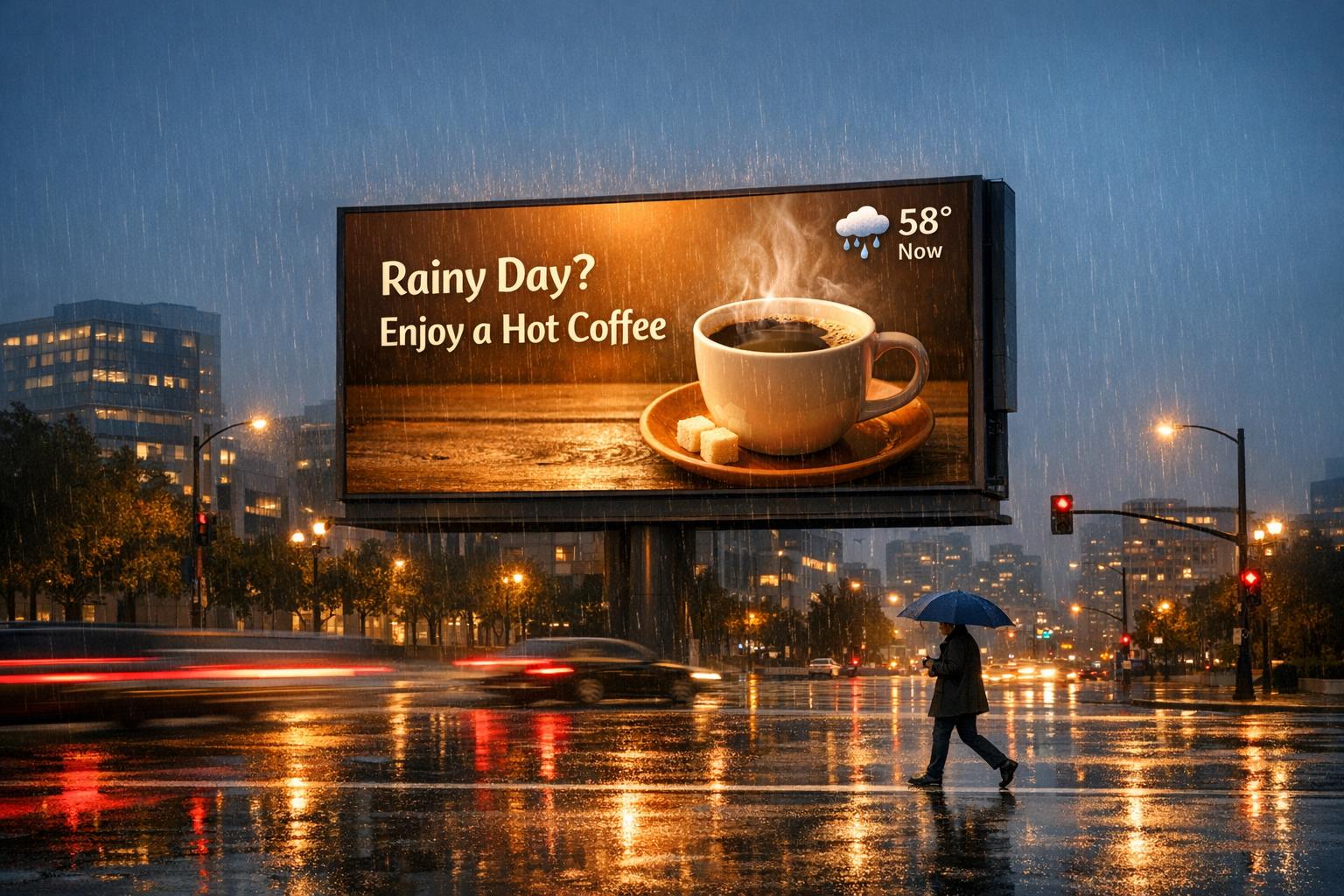
Weather data is transforming digital out-of-home (DOOH) advertising into a powerful tool for engaging consumers. By using real-time weather information, brands can deliver ads that feel timely and relevant, driving higher engagement and better results. Here’s why it works:
From promoting iced coffee on hot days to raincoats during storms, weather-responsive ads turn everyday conditions into opportunities. With tools like weather APIs and geo-targeting, brands can deliver the right message at the right time, creating stronger connections and measurable outcomes.
Weather has a profound impact on how people think, feel, and make decisions. Studies reveal that different weather conditions can create specific neurological states, influencing how consumers process brand messages. Recognizing these patterns is key to designing impactful DOOH (Digital Out-of-Home) advertisements that resonate with audiences. These neurological shifts pave the way for weather-specific emotional responses in advertising.
Weather serves as a strong emotional cue, shaping how viewers perceive and react to ads. There are three primary "weather mindsets" that influence consumer behavior:
When ads are tailored to align with these weather-driven emotional states, they are not only noticed but also remembered and acted upon. This alignment can boost ROI by 10% to 18%, making the timing and emotional tone of DOOH ads critical to their success.
By syncing ad timing and tone with weather conditions, brands can significantly improve ad relevance. Ads that reflect what’s happening outside tend to elicit stronger and faster responses. For example, mobile promotions during sunny weather see a 20% higher response rate and 73% faster reactions compared to cloudy days. On the flip side, rainy weather results in a 10% drop in response rates and 59% slower engagement.
The tone of the message also plays a pivotal role. Research shows that "prevention-tone" messaging - focusing on safety or solving problems - performs better on rainy days. Meanwhile, neutral or upbeat tones are more effective when the sun is shining. This strategic approach ensures that ads feel timely and relevant.
Real-world examples back up these findings. For instance, 49% of consumers are more likely to order food delivery during bad weather. Similarly, website traffic for home, furniture, and clothing retailers jumps by 12% on cold or rainy days. DOOH campaigns that tap into these behaviors - like promoting hot beverages during a snowstorm or refreshing drinks on a warm day - feel more like helpful suggestions than interruptions. This strategy can lead to a 65–82% increase in conversion rates for weather-triggered campaigns.
Examples from real campaigns demonstrate how weather-triggered DOOH ads can boost sales, improve cost efficiency, and enhance consumer engagement by syncing ad delivery with live weather conditions.
In August 2019, Stella Artois launched a weather-triggered DOOH campaign to promote its Cidre product. Through historical sales analysis, the brand identified a direct link: a mere 2°F rise above the monthly average led to increased sales. With the help of Capture, a marketing agency, Stella Artois rolled out digital posters near grocery stores. These ads were programmed to activate only when the temperature exceeded the 2°F threshold, running exclusively during peak heat periods.
"Stella discovered a two-degree temperature rise above the monthly norm triggered a sales rise." - Matt Lee, Managing Director at Capture
By avoiding impressions during cooler weather, the campaign achieved a 65.6% year-over-year sales increase and slashed costs by up to 50%. This approach highlights how weather-triggered advertising can precisely target conditions that influence consumer behavior, rather than just reacting to extreme weather.
La Redoute took a different approach, using addressable DOOH and audience targeting to connect with urban consumers and families, even with limited weather-specific data. The campaign employed Audience Reach Percentage (ARP) technology to dynamically adjust placements and timing, ensuring maximum visibility. By combining weather insights with audience data, La Redoute demonstrated how personalized messaging can effectively capture attention and drive engagement.

Weather-Triggered DOOH vs Standard DOOH Campaign Performance Metrics
After reviewing the case studies, the next step is measuring performance. Focus on metrics like upper- and mid-funnel indicators (brand awareness, consideration, purchase intent), engagement metrics (dwell time, click-through rates, social mentions), and conversion data tied to weather-triggered campaigns.
One standout insight: exposure to weather-triggered DOOH screens has a ripple effect, significantly enhancing mobile retargeting click-through rates. This cross-channel synergy means you should evaluate not just the direct performance of DOOH campaigns but also how they amplify results across your broader marketing efforts.
The data makes it clear - weather-responsive campaigns consistently outperform traditional approaches. For example, weather-driven ads deliver 89% higher click likelihood and 50% more brand mentions compared to generic campaigns. They’re also cost-efficient, reducing waste by up to 50% by running only during optimal conditions.
| Metric | Weather-Triggered DOOH | Standard DOOH |
|---|---|---|
| Cost Efficiency | Up to 50% higher (reduced waste) | Baseline |
| Link Click Likelihood | 89% higher | Baseline |
| Brand Awareness Uplift | +25 to +34 points | Standard market growth |
| Sales Impact | 17% to 65.6% increase | Baseline |
| Mobile Retargeting CTR | 90% above industry benchmark | Industry average |
| Cost-Per-Click (Retargeting) | 67% lower | Standard rates |
These results highlight the strategic advantage of weather-informed advertising strategies.
Take Columbia’s campaign, for instance. By targeting five European markets with ads that appeared only when temperatures dropped below 46°F, they generated 71.4 million impressions and achieved a +25 point brand awareness uplift. Audible’s "Not-Rainy" trigger campaign in France led to a +34 point boost in brand awareness and a +15 point increase in purchase consideration by activating ads exclusively during dry conditions. Norse Atlantic Airways witnessed a 40% rise in searches and bookings, along with an 11% increase in brand awareness, by leveraging weather-reactive DOOH triggered by rain and clouds in the UK during January and February 2024.
"Working with Impression Digital in collaboration with StackAdapt has assisted us to create impactful and innovative campaigns that resonate with our audience, driving greater awareness and consideration for our airline." - Helen Astroulakis, Digital Campaign Manager, Norse Atlantic Airways
Weather-driven DOOH ads have already shown their effectiveness. To make them work for your campaigns, focus on real-time data integration, precise targeting, and creative flexibility.
Start by linking your DOOH platform to a trusted real-time weather API. Some popular options include OpenWeatherMap, AccuWeather, and Visual Crossing. These services provide a range of data, from temperature and precipitation to UV index and wind speed, all tailored to specific geographic areas.
Most weather APIs operate on a per-call pricing model or a subscription plan. Costs depend on how often you need updates and how many locations you’re tracking. Typically, data refreshes every 15 to 30 minutes. The accuracy of the meteorological data is crucial - your ads depend on it to trigger at the right moments.
Once your weather data feed is connected, establish clear rules for when and where your ads should activate. For example, you might set a rule to display an iced coffee ad when the temperature in ZIP code 10001 exceeds 75°F. Using AND/OR logic, you can combine multiple conditions, such as "Temperature above 80°F AND humidity over 60%" - perfect for promoting air conditioners.
Precise targeting is key. Focus on ZIP codes or GPS coordinates to account for microclimates. Platforms like Enroute View Media enable geo-time targeting, allowing you to combine weather triggers with specific time frames and location radii. For instance, you could target ads on taxi rooftop screens only when they’re within about 0.93 miles of your store during peak shopping hours.
To avoid overloading your audience, set minimum activation durations and cooldown intervals between ad displays. Always prepare fallback content for when weather triggers aren’t met, ensuring your screens remain relevant and engaging.
With these triggers in place, you’re ready to fine-tune your creative content.
Before launching your campaign, create a library of ad variations tailored to different weather scenarios. Prepare content for sunny, rainy, snowy, hot, and cold conditions, so your ads can switch instantly when triggers are activated. Modular templates with interchangeable elements - like headlines, images, and calls-to-action - allow your platform to dynamically adjust content based on live weather data.
One great example: In May 2025, McDonald's Qatar ran a weather-responsive campaign for their Summer Coolers. Using the Splicky DSP and Broadsign platform, custom ads triggered between 95°F and 113°F, resulting in a 7% sales boost.
A/B testing is essential for refining your campaign. Experiment with trigger thresholds to see what performs best - for instance, does "hot" resonate more at 75°F or 80°F? You can also test whether rain triggers work better when paired with humidity thresholds. Aim to test 3–5 creative variations per trigger and refresh them every 3–6 months to avoid creative fatigue. Platforms like Enroute View Media provide real-time analytics, helping you track which weather conditions drive the most engagement and adjust your strategy accordingly.
Integrating weather data into DOOH campaigns turns static ads into dynamic, responsive experiences that resonate with audiences. The numbers speak for themselves: weather-activated ads achieve 90% recall rates, compared to 65% for standard static creatives. They also deliver 40% stronger brand awareness and boost consumer consideration by 42%. With 72% of consumers more likely to buy when ads align with current weather conditions, the value of weather-driven campaigns is undeniable.
The financial benefits are just as compelling. By activating ads only in optimal conditions, brands can cut wasted impressions and improve cost efficiency by up to 50% compared to traditional DOOH buys. Weather-tailored creatives can slash Cost-Per-Click rates by as much as 67% while driving higher engagement. A prime example? Stella Artois saw a 65.6% year-over-year sales increase during their weather-responsive campaign.
"Data targeting helps you focus media spend on who, where and when it will have the biggest impact. It maximizes ROI by eliminating wasted impressions and concentrating directly in the moments and locations that matter most." - Vistar Media
Beyond performance metrics, weather-based campaigns foster deeper consumer trust. Messaging tied to environmental context can increase brand trust by 35%, a crucial advantage as marketers navigate a world without third-party cookies. Weather-triggered ads rely on environmental signals rather than personal data, offering a privacy-conscious way to deliver relevant content.
For businesses ready to embrace weather-responsive advertising, platforms like Enroute View Media provide the tools to make it happen. With features like geo-time targeting, real-time analytics, and the ability to combine weather triggers with proximity data, these platforms ensure ads reach audiences at the exact moment they’re most likely to engage. It’s a smarter, more impactful way to connect with consumers.
The best weather triggers for DOOH ads are tied to real-time conditions such as temperature, precipitation, and forecasts. These triggers allow brands to craft timely and relevant messages that resonate with what consumers are experiencing at the moment. By connecting with their immediate needs and emotions, these ads can boost engagement and improve campaign results.
Measuring ROI from weather-triggered DOOH campaigns involves analyzing metrics like brand awareness, purchase intent, and sales or bookings during weather-specific promotions. Additionally, tracking app downloads, website visits, or in-store traffic can provide valuable insights into campaign performance.
For instance, some brands have observed notable increases in purchase intent, store visits, and bookings, showcasing how weather-reactive advertising can deliver tangible results.
To make your digital out-of-home (DOOH) ads more relevant and engaging, you can integrate real-time weather data. By connecting weather data APIs to your ad platform, you can automatically adjust your content based on current conditions.
For instance, imagine promoting hot coffee on chilly days or featuring raincoats and umbrellas during a storm. Pairing this weather-driven approach with geo-location targeting ensures your ads reach the right audience in areas experiencing those specific weather patterns. The result? Ads that feel timely and resonate with viewers.
Need pricing details?
EnrouteViewMedia is a Canadian technology company based in Edmonton, Alberta, Canada. The company was founded by a group of media entrepreneurs and engineering executives. Our mission is developing leading-edge digital media display technologies for taxicab rooftops and taxicab interiors advertising market. Through our easy to use ad delivery and management system, we assist our clients in reaching their customers with targeted exposure. EnRouteViewMedia continuously strives to be the global leader in digital geo-time targeted advertising media systems for modern taxi fleets.