
BAT token powers privacy-first programmatic DOOH in vehicles with verifiable attention metrics, token rewards, ZKP privacy, and wallet/integration basics.
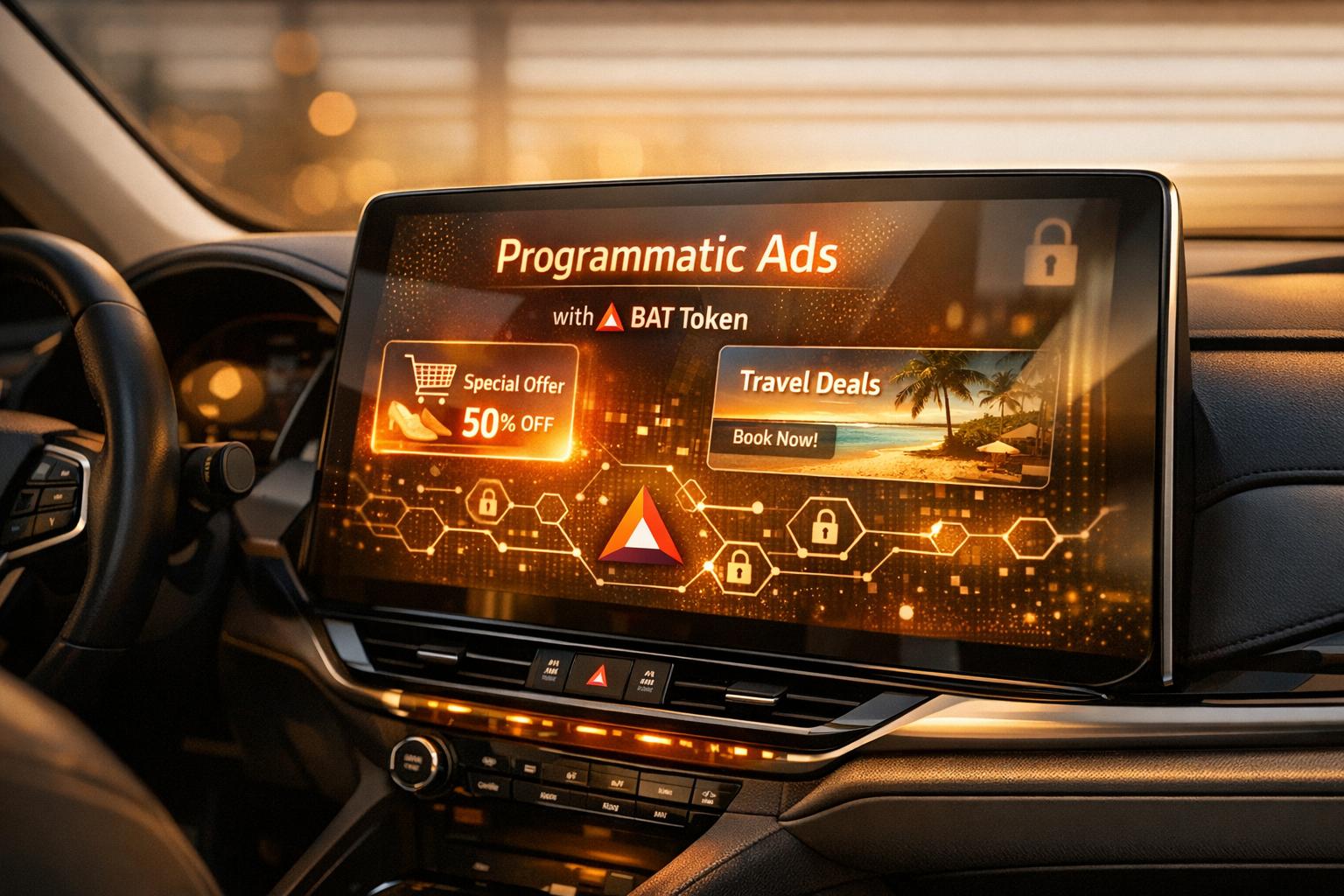
Programmatic ads using the Basic Attention Token (BAT) are changing how brands advertise, especially in vehicle-based digital out-of-home (DOOH) campaigns. Here's what you need to know:
BAT's privacy-first approach and user incentives set it apart, making it a powerful tool for advertisers looking to maximize ROI while respecting user privacy.
The BAT token operates on a pay-for-attention model, ensuring advertisers only pay for genuine engagement. For an impression to count, an ad must be displayed on-screen for at least one second, while a visit requires five seconds of active interaction.
The Verifiable Ad Conversions (VAC) feature adds an extra layer of transparency. Advertisers can independently verify encrypted Conversion IDs by generating public-private key pairs within their accounts. This allows them to decrypt and confirm that specific conversions are directly tied to their campaigns. By cutting out third-party reports, which often include bot traffic, advertisers gain a clearer picture of their return on investment.
For vehicle-based DOOH campaigns, like ads on in-taxi touchscreens or rooftop displays, this means every dollar spent is tied to real human attention. BAT's Basic Attention Metrics (BAM) system ensures this by using on-device matching and anonymous confirmation of ad events. This reduces opportunities for fraud, a common issue in traditional programmatic advertising.
In addition to verifying engagement, BAT prioritizes user privacy throughout the ad process.
BAT’s platform is built with privacy at its core, eliminating third-party trackers entirely. Ads are matched directly on the user’s device, ensuring data never leaves their control while maintaining precise targeting. By default, BAT blocks third-party tracking scripts, cookies, and analytics tools like Google Analytics and Adobe Analytics.
"Unlike ads from Big Tech companies, Brave Ads are private and never profile you. Your browsing data never leaves your device." - Brave
Because BAT integrates both the browser and ad server, it measures conversions directly at the browser level. This eliminates the need for advertisers to add tracking tags or scripts to their websites. For vehicle-based DOOH campaigns, this means passengers interacting with in-taxi ads can do so without concerns about being tracked across the web. The result is a more trustworthy and privacy-respecting advertising experience.
BAT introduces a revenue-sharing model that directly rewards users with 70% of advertising revenue in BAT tokens. This creates a tangible incentive for engagement, especially effective in environments like in-taxi touchscreens.
The system tracks "Billable Events", which include instances of ad viewing or interaction. Users also have the ability to upvote or downvote ads they’ve seen, providing valuable feedback that advertisers can use to fine-tune their campaigns. This feedback loop helps identify which creative approaches resonate most with the audience.
With over 107.4 million monthly active users and 46.9 million daily active users in its ecosystem, BAT’s token reward system has proven its ability to drive meaningful engagement. For advertisers in the vehicle-based DOOH space, this incentive structure transforms commute time into an opportunity for interactive and mutually rewarding advertising experiences.
BAT functions as an ERC-20 token on the Ethereum blockchain and an SPL token on the Solana network. To manage and transact BAT, advertisers need an Ethereum-compatible wallet, such as Brave Wallet, Ledger, or any wallet that supports ERC-20 or SPL tokens.
The programmatic infrastructure must accommodate OpenRTB protocols in either JSON or Protobuf formats for handling bid requests and responses. Ad server integration requires key-value targeting capabilities, like hb_pb for price buckets, which can be implemented through platforms such as Google Ad Manager (GAM) or header bidding solutions like Prebid Server. For GAM setups, tools like the Prebid Line Item Manager can simplify the creation of the numerous line items needed for programmatic campaigns.
To maintain user privacy while verifying attention and engagement, integrate Zero-Knowledge Proof (ZKP) protocols. Use impression_tracking_url fields in bid responses to gather impression-level data and minimize billing discrepancies. Additionally, ensure click macros are in place to collect click metrics for both advertisers and publishers.
Advertisers can monitor campaign performance through the Brave Ads Manager dashboard, which provides hourly updates and detailed insights for Notification ads, New Tab Takeovers, and Search ads. However, standard third-party tracking tools like Google Analytics or Adobe Analytics are blocked by default unless hosted on a first-party subdomain that matches the landing page domain.
Browser-based conversion tracking eliminates the need for cookies, tags, or tracking scripts on your site. Conversion URLs should include wildcard variables (e.g., https://store.com/checkout/thank-you*) to account for unique order IDs or query parameters. The Verifiable Ad Conversions (VAC) feature allows advertisers to audit encrypted Conversion IDs with a public-private key pair, ensuring accurate return on ad spend (ROAS) calculations without compromising user privacy.
For U.S. financial reporting, advertisers are responsible for determining, withholding, and reporting applicable taxes related to BAT transactions. Conversion attribution windows can be set to 1, 7, or 30 days, and Conversion IDs must adhere to specific alphanumeric regular expressions, with lengths between 1 and 30 characters.
Finally, review compliance standards to ensure all campaign practices are legal and transparent.
Once your technical and data setups are ready, confirm that your campaign adheres to legal and regulatory standards. In the U.S., BAT is classified as a utility token built on Ethereum technology and is not considered a digital currency, security, or commodity. Advertisers must handle all tax obligations, including determining, withholding, collecting, reporting, and remitting applicable taxes like VAT/GST, as Brave does not manage these responsibilities . Consult a tax advisor for guidance on the tax implications of BAT transactions and campaigns.
Ensure that your advertisements comply with regional laws, including those in the U.S., California, and the Cayman Islands. Advertisers are prohibited from attempting to identify users through scripts, data scraping, or bypassing content-limiting measures. Brave’s platform uses anonymous accounting and Zero-Knowledge Proof protocols to provide attribution and confirmation without exposing individual browsing habits or preferences .
Advertisers must also avoid operating in countries under U.S. government embargoes or those designated as "terrorist supporting." Additionally, they cannot appear on U.S. government prohibited party lists. Regularly review Brave’s ad policies, as updates may occur and are treated as confidential information.

How to Set Up a BAT-Enabled Programmatic DOOH Campaign: 3-Step Process
Start by outlining your campaign's main objectives. Are you aiming for brand awareness, app downloads, or in-store visits? Each goal requires specific metrics to track success. For instance:
To make your tracking more precise, align your objectives with BAT's verifiable Basic Attention Metrics (BAM). This not only minimizes fraud but also provides reliable data on actual user engagement, helping you measure progress effectively.
Once your goals are clear, it’s time to allocate your budget and resources wisely. Decide between two service options:
Next, choose a pricing model based on your campaign type:
BAT supports multiple payment methods, including credit cards and cryptocurrency, giving you flexibility. If you want to reward user engagement, consider setting aside a token pool. The BAT User Growth Pool (UGP) can provide tokens to incentivize verified attention, complementing your media budget.
With your budget in place, focus on integrating and testing your campaign for smooth execution. Use your DSP to configure targeting parameters such as geo-location, time of day, and device type. The automated bidding happens in around 100 milliseconds, ensuring ads are displayed efficiently as vehicles move through geo-fenced areas.
Leverage Key-Value Pairs (KVPs) in your ad server to pass vehicle-specific data like current location, route patterns, and time-based triggers. This allows you to fine-tune targeting for maximum impact. For those using Google Ad Manager, header bidding solutions can help manage line items and external integrations. Make sure to adjust price granularity settings to align with your budget and desired impression volume.
Before launching, conduct pilot tests to ensure everything runs smoothly. Create test "Orders" and "Line Items" in your ad server to confirm that creatives display correctly on vehicle screens. Experiment with different creative formats at various times and traffic conditions. Use centralized dashboards to monitor real-time performance and adjust your budget allocation daily based on what’s working. A good starting strategy is the "lighter for longer" approach - spreading your budget over a longer period ensures consistent exposure and provides better data for optimization.
Enroute View Media's DigiStreamView® system is the backbone for running BAT-enabled programmatic campaigns on vehicle-based digital screens. Designed specifically for taxi and rideshare fleets, this web-based platform handles everything from ad delivery to management, with built-in support for programmatic ad integration. Its geo-time targeting feature pairs perfectly with BAT's attention-based model, ensuring ads display at the right time and place - whether triggered by a vehicle entering a specific zone or during certain times of day. This ensures ads are timely and reward passenger engagement.
The platform supports essential protocols like OpenRTB, VAST, and XML, enabling seamless BAT-enabled programmatic buying. Locally-run machine learning ensures ads align with passenger interests without transmitting personal data to external servers. For transparency, the system uses a Zero Knowledge Proof (ZKP) ledger, which provides a decentralized and privacy-preserving audit trail to confirm ad delivery. With a reach of 900 million and over 500 million impressions delivered across more than 10 countries, Enroute View Media offers the scale needed for impactful BAT campaigns. These features make it a powerful tool for advertisers looking to optimize their campaigns.
By integrating BAT's engagement-focused metrics, Enroute View Media delivers real-time analytics and precise geo-fencing to boost campaign performance. The platform's dashboard updates hourly, letting advertisers track metrics like impressions (counted after one second on screen), clicks, site visits, and both post-view and post-click conversions. BAT integration also provides access to Verifiable Ad Conversions (VAC), offering a secure way to audit encrypted conversion IDs and verify ROI - all while safeguarding passenger privacy. BAT-enabled campaigns on this platform achieve an impressive 9% average click-through rate, far surpassing the industry standard of 2%.
Geo-fencing capabilities allow BAT-enabled ads to launch precisely when vehicles enter high-traffic or commercially relevant areas, ensuring maximum local impact. Additionally, wildcard variables in conversion URLs make it easy to track performance across different vehicle routes. Payment options are flexible, including BAT, USD, USDC, and USDT, with a 50% discount on your first campaign when using BAT. Self-serve campaigns require a minimum monthly spend of $1,000 USD, with pricing available on flat rate, CPM, or CPC models.
For fleet owners and marketing startups, BAT's attention economy opens up new revenue streams by monetizing taxi rooftops and digital screens. The DigiStreamView® system simplifies DOOH advertising by centralizing control and automatically filling unsold inventory, ensuring steady revenue generation. This incentive-driven model creates a more engaging and efficient marketplace for both advertisers and fleet operators.
With the programmatic DOOH market expected to grow from approximately $900 million in 2023 to over $6 billion by 2030 - an annual growth rate exceeding 31% - BAT integration offers fleet owners a chance to ride this wave of expansion. Moreover, the Brave ecosystem's 107.4 million monthly active users and 46.9 million daily active users as of early 2026 provide a massive audience pool for monetization efforts.
The BAT Token is transforming vehicle programmatic advertising by eliminating intermediaries that typically claim 73% of ad budgets and tackling the $7.2 billion lost annually to bot fraud. By focusing on genuine engagement rather than superficial impressions, advertisers see better returns on investment, while fleet owners enjoy increased revenue streams.
With its privacy-first approach and verified attention metrics, BAT is redefining digital out-of-home (DOOH) advertising on platforms like Enroute View Media. It ensures compliance with privacy regulations while maintaining precise, on-device targeting. As Brendan Eich, Founder & CEO of Brave, puts it:
"With the right talent engaged and working well together, I am confident we can build and scale this system to have complete user control and much better economics than the failing ad-tech ecosystem upon which the Web relies today."
This vision is already taking shape, with 107.4 million monthly active users and 1.8 million verified creators participating in the BAT ecosystem as of early 2026. This growth signals measurable benefits for fleet owners who adopt BAT-enabled campaigns.
BAT's focus on verified metrics and privacy-driven design has already proven its value in improving DOOH advertising. With the rollout of BAT 3.0, its capabilities are expanding further. Fleet owners who embrace BAT-enabled campaigns gain access to blockchain-backed transparency, reduced fraud risks, and incentivized user engagement that drives higher conversion rates. As BAT 3.0 incorporates multi-chain settlement options and AI-driven features, its utility is set to grow beyond ad rewards, branching into subscription models and e-commerce applications. For vehicle-based DOOH campaigns, BAT offers a clear path to efficiency, transparency, and profitability.
Brave Ads, powered by BAT, takes a firm stand on user privacy in the world of vehicle-based digital advertising. It blocks all third-party trackers and steers clear of collecting personally identifiable information. Instead, it offers a privacy-first solution by rewarding users with anonymous, blockchain-based BAT tokens for their attention.
Advertisers also benefit from this system. Campaign performance data is aggregated and anonymized, ensuring individual users remain unidentifiable. At the same time, advertisers still gain access to meaningful insights. This method strikes a balance between respecting user privacy and delivering effective, ethical advertising.
To kick off a programmatic ad campaign using BAT tokens, you'll need to have three essential elements in place:
Once these are in place, you can define your campaign settings - like budget, targeting, and creative assets - and start running BAT-powered ads to reach your audience effectively.
Advertisers using BAT (Basic Attention Token) can cut down on expenses tied to fraud prevention and privacy compliance, which ultimately boosts their return on investment (ROI). With its user-opt-in, attention-focused approach, the platform ensures ads are shown only to users who are actively engaged. This leads to stronger performance indicators, such as higher click-through rates and improved view rates.
By prioritizing user attention and maintaining transparency, BAT offers a more efficient advertising system that meets today’s privacy expectations while enhancing audience interaction.
Need pricing details?
EnrouteViewMedia is a Canadian technology company based in Edmonton, Alberta, Canada. The company was founded by a group of media entrepreneurs and engineering executives. Our mission is developing leading-edge digital media display technologies for taxicab rooftops and taxicab interiors advertising market. Through our easy to use ad delivery and management system, we assist our clients in reaching their customers with targeted exposure. EnRouteViewMedia continuously strives to be the global leader in digital geo-time targeted advertising media systems for modern taxi fleets.