
Calculate and compare mobile billboard CPM fast. See cost per 1,000 impressions, spot efficiency gaps, and plan smarter ad campaigns.
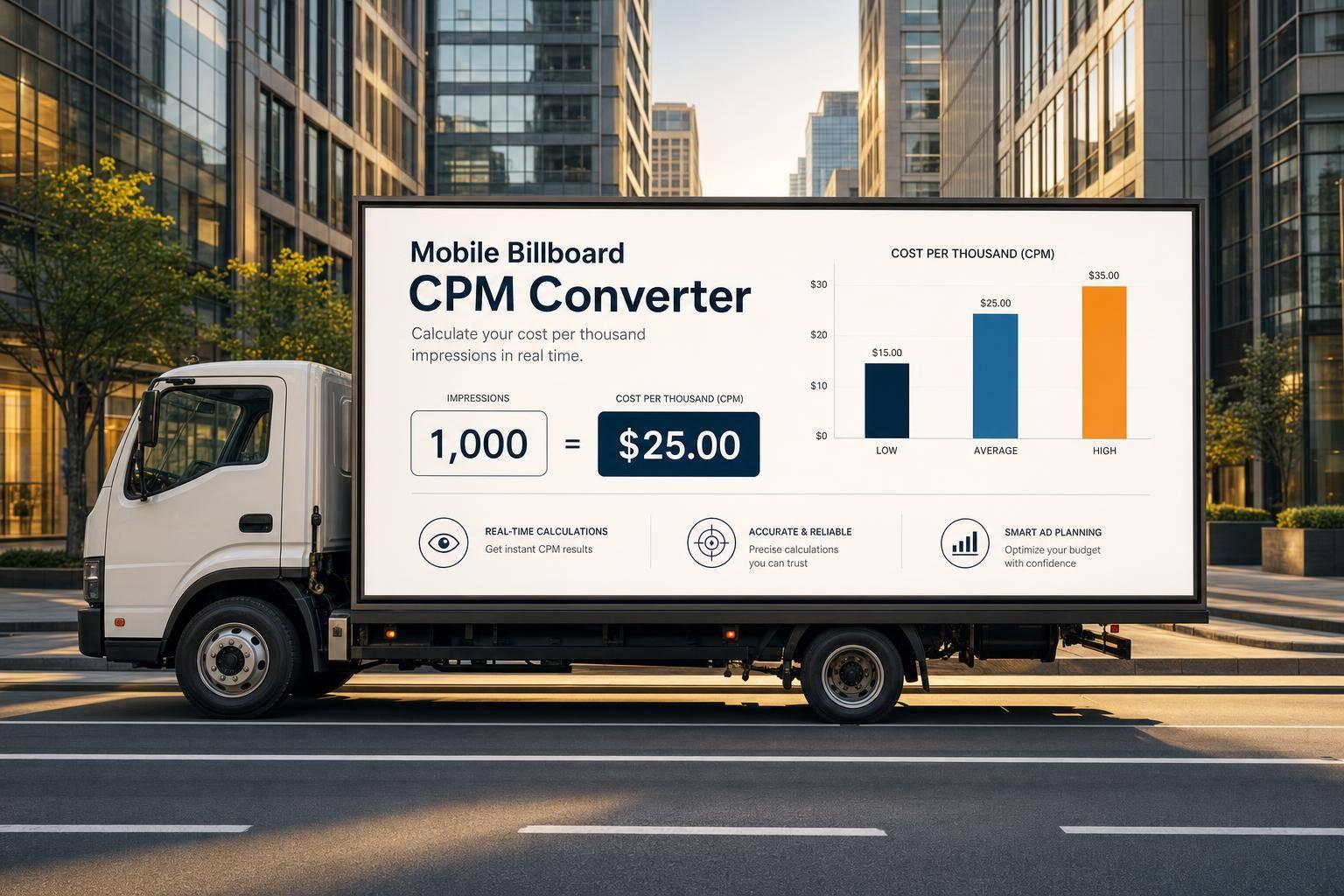
When you're evaluating out-of-home media, cost alone doesn't tell the full story. A campaign with a higher price tag may actually be more efficient if it delivers substantially more exposure. That's where a Mobile Billboard CPM Converter becomes useful. It helps you translate campaign spend and estimated impressions into a clean, comparable metric: cost per thousand impressions.
For advertisers, agencies, and media buyers, CPM is one of the quickest ways to assess value. Instead of guessing whether one route, vendor, or campaign duration is worth the investment, you can compare how much each option costs to generate 1,000 impressions. That makes budget decisions easier and more defensible.
This Mobile Billboard CPM Converter is especially helpful when you're weighing two campaign options side by side. You can enter cost and impression estimates for each one and instantly see which placement is more efficient on a CPM basis. It's a simple way to support planning, negotiations, and post-campaign review.
Whether you're building a proposal or pressure-testing a quote, a reliable CPM calculator gives you a faster read on campaign efficiency without the spreadsheet hassle.
CPM stands for cost per thousand impressions. In mobile billboard advertising, it tells you how much you're paying to reach 1,000 estimated views. It's a simple way to compare campaign efficiency, especially when budgets, routes, and impression totals vary from one campaign to another.
Comparing CPM helps you see which campaign is delivering audience exposure at a lower cost. That doesn't automatically make the lower CPM option the better buy, since targeting, geography, timing, and creative quality still matter. But it's a very useful benchmark when you're deciding where to put budget or how to evaluate competing proposals.
A CPM calculation only makes sense when both cost and impressions are real, positive values. If impressions are zero, you'd be dividing by zero, which breaks the math. Negative costs or negative impressions also aren't valid for normal campaign planning, so the tool flags them to prevent misleading results.
Need pricing details?
EnrouteViewMedia is a Canadian technology company based in Edmonton, Alberta, Canada. The company was founded by a group of media entrepreneurs and engineering executives. Our mission is developing leading-edge digital media display technologies for taxicab rooftops and taxicab interiors advertising market. Through our easy to use ad delivery and management system, we assist our clients in reaching their customers with targeted exposure. EnRouteViewMedia continuously strives to be the global leader in digital geo-time targeted advertising media systems for modern taxi fleets.