
Meta lets eligible advertisers fund ad accounts with USDC; here’s how it works, who benefits, and the risks.
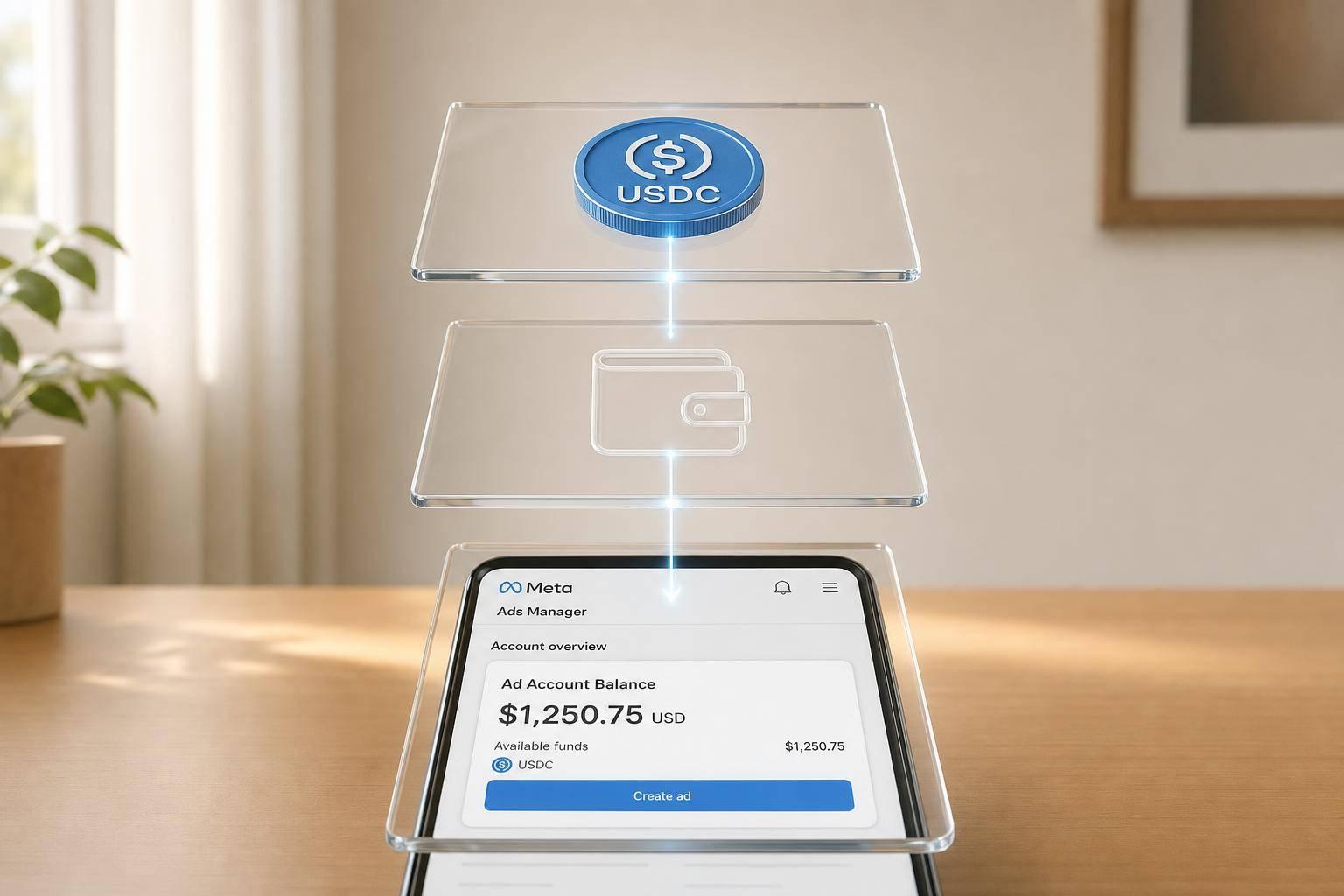
Meta has introduced a USDC payment option for eligible advertisers in selected countries, giving some businesses a new way to add money to prepaid ad balances. The move opens a funding route for advertisers that already hold the dollar-pegged stablecoin, particularly those operating across borders, while leaving Meta’s ad pricing and account balances in conventional currency.
According to Meta’s official help page, advertisers who qualify can choose the stablecoin option when funding an ad account and send USDC from a crypto wallet to a third-party payment partner. That provider then converts the USDC into the advertiser’s selected local currency and settles the payment with Meta.
The credited funds appear as a prepaid balance inside the ad account. Campaign spending and balances continue to show in standard currency in Ads Manager, rather than in crypto.
Meta says it does not hold, transmit, or process the stablecoin itself. Instead, USDC functions only as the funding rail before the third party converts it into local currency. Meta also says it does not charge its own fee for using the option, though wallet providers, exchanges, and blockchain networks may still impose charges.
The company also warns that small exchange-rate movements during conversion can affect the final amount credited to an account.
The option may be most useful for cross-border agencies, crypto-native brands, and regional or performance teams that already use USDC. For advertisers that already have dependable access to cards, bank transfers, or invoicing, the source article says the benefit may be limited.
The article states that banking delays, card limits, and currency conversions can slow media spending for teams funding campaigns across markets, making USDC potentially more practical for some eligible advertisers.
Meta’s new payment option does not remove financial or operational risks. Blockchain transfers are generally irreversible, and the company says advertisers are responsible for the security of the wallet used to make the payment.
Meta says funds sent to the wrong address or through an unsupported network cannot be recovered or refunded. The article also notes that eligible refunds of unused balance follow Meta’s standard billing rules and return as ad credit, not as USDC back to the original wallet.
That means advertisers should treat a stablecoin transfer as a conversion into platform credit rather than a reversible crypto deposit.
The source article says finance teams will need records covering the USDC acquisition cost, network charges, conversion value, and the amount credited to the ad account. That can be especially relevant when agencies fund accounts for clients or divide one balance across several campaigns.
It adds that faster funding creates more work around controls, including setting wallet permissions, approval thresholds, and transaction checks before a media buyer is asked to fund an account.
The article says the payment method should not change how campaigns are measured. It describes the USDC feature as affecting how funds reach an ad account, not how marketers should evaluate reach, attribution, or return on ad spend.
In that sense, Meta’s update is presented as a payments change with strategic implications for some advertisers, rather than a broader overhaul of digital advertising. For businesses already familiar with wallets, stablecoins, and treasury controls, the option could be useful. For others, cards and bank payments may still be simpler.
Need pricing details?
EnrouteViewMedia is a Canadian technology company based in Edmonton, Alberta, Canada. The company was founded by a group of media entrepreneurs and engineering executives. Our mission is developing leading-edge digital media display technologies for taxicab rooftops and taxicab interiors advertising market. Through our easy to use ad delivery and management system, we assist our clients in reaching their customers with targeted exposure. EnRouteViewMedia continuously strives to be the global leader in digital geo-time targeted advertising media systems for modern taxi fleets.