
BLE beacons enable precise in-store and in-vehicle ads, improve offline attribution, and help fleet owners monetize rides while protecting user privacy.

Proximity targeting with beacons allows businesses to send highly personalized messages to users based on their exact location. Using Bluetooth Low Energy (BLE), beacons transmit signals to nearby devices like smartphones, triggering specific actions through apps. This technology is especially effective in precise, in-store marketing compared to geofencing, which covers larger areas using GPS or Wi-Fi.
Key highlights:
For advertisers, this means better targeting and measurable outcomes. For fleet operators, it’s a way to turn vehicles into revenue-generating platforms. Beacon technology bridges digital marketing with physical interactions, offering precise, location-based solutions for modern advertising.
Beacon technology has opened up exciting possibilities in mobile advertising, especially when integrated into vehicles. By using beacons in taxis and rideshare vehicles, advertisers can create hyperlocal campaigns that adapt to real-time locations. These vehicles essentially become moving billboards, with ads displayed on rooftop and in-taxi screens targeting both pedestrians and passengers.
Setting up beacons in vehicles is a simple process. These small, battery-powered devices can be mounted inside the car or integrated directly with digital screens. Once installed, they can operate for 2 to 5 years without needing a battery replacement, depending on how often they transmit signals and the power settings used.
Beacon signals typically cover a range of 10–30 meters indoors and up to 100 meters outdoors. However, their performance can vary based on obstacles or interference. Fleet operators can tweak the transmission power and signal intervals to customize the coverage area, ensuring campaigns are tailored to specific advertising goals.
Beacons work seamlessly with both rooftop LED displays and in-taxi touchscreens to deliver coordinated ad experiences. Here's how it works: when a smartphone with an SDK-enabled app detects a beacon signal, it sends the beacon's unique ID to a backend system. This triggers specific actions across multiple screens. For instance, rooftop displays might show ads aimed at nearby pedestrians, while in-taxi screens deliver complementary messages to passengers. The content displayed is determined by the vehicle's location and the proximity of potential customers, allowing for highly targeted and synchronized advertising.
Cloud platforms play a key role in managing beacon-enabled campaigns for vehicles. When a Bluetooth-enabled device picks up a beacon's signal, it sends the unique ID to a cloud server. Designed specifically for mobile environments, these cloud systems optimize ad delivery by analyzing real-time data, such as the vehicle's location and nearby audience movement. The platform uses this information to apply campaign rules and deliver ads tailored to the current context.
"Now, all beacons can be monitored by a single authority through this platform".
This centralized system offers advertisers the ability to segment audiences based on their proximity to specific vehicles. It also allows campaigns to be adjusted in real time. Additionally, the integration with tools like Google Ads enables tracking offline attribution, helping advertisers measure how digital interactions lead to physical visits.
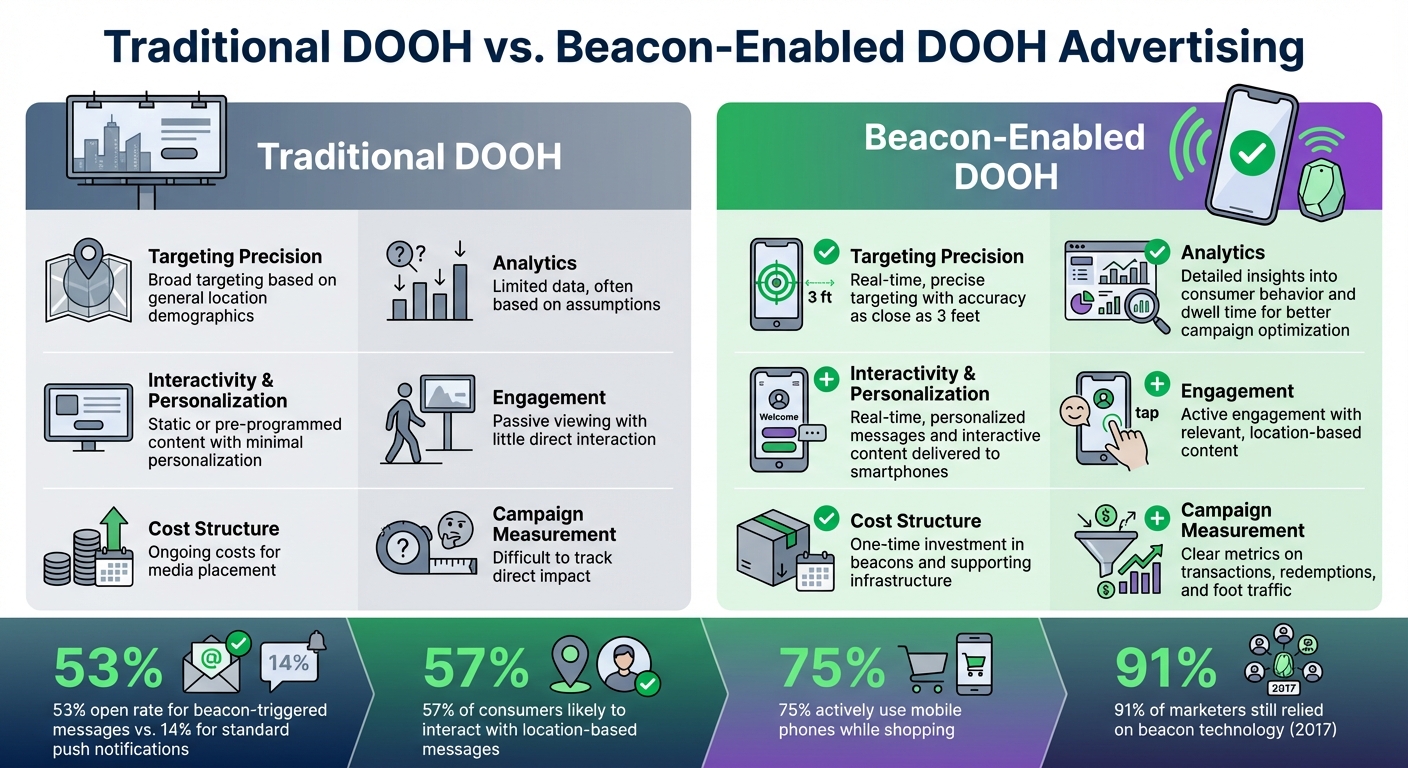
Traditional DOOH vs Beacon-Enabled DOOH Advertising Comparison
Integrating beacons into vehicles has opened up new opportunities for more precise advertising and increased revenue. Beacon-triggered messages boast a 53% open rate compared to just 14% for standard push notifications, making them a powerful tool for advertisers and fleet owners alike.
Beacons offer advertisers unmatched micro-location accuracy, far surpassing GPS or Wi-Fi. For instance, when McDonald's used beacons in 15 Istanbul cafés to promote new coffee beverages through the Shopping Genie loyalty app, 30% of users received proximity-triggered discount coupons, and 20% of them redeemed the offer. Similarly, Carrefour's deployment of beacons across 28 hypermarkets in Romania led to a 400% increase in app engagement and a nearly 600% rise in total app users within seven months.
This technology bridges the gap between digital engagement and real-world action. At Levi's Stadium during the Super Bowl, approximately 2,000 beacons allowed fans to order food and drinks via the stadium app, resulting in a 67% increase in orders compared to previous records. Advertisers can also use beacon data to track offline attribution, gaining insights into how digital interactions drive in-person visits and purchases.
Fleet operators can also capitalize on this technology to boost their revenue streams.
Fleet owners can monetize transit time by delivering targeted in-ride ads and enabling in-app purchases. In the UK, taxi operators have successfully increased revenue during typical 20-minute rides using beacon-triggered advertising. The global beacon technology market is expected to hit $45.2 billion by 2026, with an impressive compound annual growth rate of 75.4%.
Beacons also enhance operational efficiency. By improving vehicle monitoring, transport management, and logistics tracking, fleet owners can streamline operations. Additionally, data collected through beacons provides insights into passenger behavior, allowing for better ad placement timing and making vehicle-based advertising more appealing to marketers.
When comparing traditional digital out-of-home (DOOH) advertising with beacon-enabled DOOH, the advantages of beacon technology become evident:
| Feature | Traditional DOOH | Beacon‑Enabled DOOH |
|---|---|---|
| Targeting Precision | Broad targeting based on general location demographics | Real-time, precise targeting with accuracy as close as 3 feet |
| Analytics | Limited data, often based on assumptions | Detailed insights into consumer behavior and dwell time for better campaign optimization |
| Interactivity & Personalization | Static or pre-programmed content with minimal personalization | Real-time, personalized messages and interactive content delivered to smartphones |
| Engagement | Passive viewing with little direct interaction | Active engagement with relevant, location-based content |
| Cost Structure | Ongoing costs for media placement | One-time investment in beacons and supporting infrastructure |
| Campaign Measurement | Difficult to track direct impact | Clear metrics on transactions, redemptions, and foot traffic |
Beacon-enabled DOOH stands out for its precision and ability to engage consumers directly. Over 57% of consumers are likely to interact with location-based messages, and 75% actively use their mobile phones while shopping. A 2017 report revealed that 91% of marketers still relied on beacon technology, reflecting its continued effectiveness.
To run beacon campaigns in vehicles, you need three key components working seamlessly. First, Bluetooth Low Energy (BLE) beacons must be installed in vehicles. These devices, equipped with a CPU, radio, and batteries, broadcast signals. Second, passengers must have mobile devices with Bluetooth enabled to pick up these signals. Third, if you're using the iBeacon protocol, the receiving device must have a mobile app with an integrated SDK (such as the Gimbal SDK).
Proper configuration is critical for these systems to perform well. Adjust the transmit power and advertising interval to find the right balance between responsiveness and battery life. Placement matters too - beacons should be positioned above shoulder height to maintain a clear line of sight. Avoid installing them near metal or liquid, as these materials can interfere with signal strength. To ensure everything is set up correctly, on-site testing is a must.
Once the technical setup is complete, the focus shifts to respecting user privacy and obtaining consent.
User opt-in is a requirement for beacon interactions. Mobile operating systems require users to enable Bluetooth and grant permission for apps to detect beacon signals. Importantly, the beacons themselves don't store any personal data - they simply broadcast signals that compatible apps can detect.
For campaigns in the United States, compliance with regulations like the California Consumer Privacy Act (CCPA) is essential when handling location data. Frost Prioleau, CEO and co-founder of Simpli.fi, emphasizes this point:
"When initiating location-based marketing, advertisers should use platforms that are compliant with GDPR and other privacy standards, and focused on using data which has been collected based on these standards."
Building trust with users involves being transparent about data practices, encrypting data, securely storing it, and rotating BLE advertising identifiers to minimize tracking risks.
After addressing technical and privacy concerns, the next step is optimizing your campaign for better engagement. Timing is everything - send notifications when a passenger enters a target zone or nears a specific location to avoid overwhelming them with alerts. A great example of this strategy in action is K-supermarket, which achieved a 25% conversion rate in 2024 by sending timely, targeted messages through BLE beacons.
Personalization also plays a big role. Segment your audience based on their behavior and craft messages specifically for each group. Running A/B tests on different message formats, visuals, and calls to action can help identify what works best, allowing you to fine-tune future campaigns. Additionally, mapping beacon IDs to app or user IDs on the server side and filtering outliers in analytics can lead to more accurate insights into passenger behavior and dwell time.
Enroute View Media's DigiStreamView platform marries beacon technology with geo-time targeting to deliver ads precisely when and where they’re most impactful. When vehicles enter geo-fenced zones or mobile devices approach a beacon, the system instantly triggers relevant ads on dual-sided P2.5 LED rooftop screens and 10.1-inch in-taxi touch-screen Android tablets. This cloud-based setup removes the hassle of server management, allowing advertisers to focus entirely on campaign performance.
The platform also tracks ad exposure in real time, offering precise impression data as vehicles move through neighborhoods and busy commercial areas. This integration highlights the platform’s effectiveness in modernizing vehicle-based advertising.
The platform’s advanced signal tracking is complemented by tools tailored for U.S. advertisers and fleet owners. Through a secure, white-label portal, users gain access to real-time campaign statistics, providing immediate insights into ad performance. Features like report exporting, API integrations for custom solutions, and demographic data analysis let advertisers fine-tune their targeting strategies. Additionally, the platform connects with certified programmatic ad networks, broadening ad inventory while streamlining fleet operations.
"enRoute partnership has helped us scale faster, more efficiently, and cost-effectively".
The white-label option allows businesses to customize the platform with their branding, ensuring a seamless identity for their clients while benefiting from Enroute View Media’s powerful infrastructure.
Fleet owners can easily add Bluetooth transmitters to monetize their existing vehicles. By leveraging the pinpoint accuracy of beacon technology, the platform provides detailed ROI tracking, which helps validate higher advertising rates. It also supports mobile device retargeting, offering tools that demonstrate value to advertisers and justify premium CPM pricing. This makes it a win-win for both fleet operators and advertisers looking for measurable results.
Beacon targeting is changing the game for advertisers by connecting them with audiences in a whole new way. By delivering highly personalized, location-specific messages via low-energy Bluetooth, it encourages instant purchases and real-time engagement with nearby smart devices. For campaigns involving vehicles, this technology creates a seamless link between digital impressions and tangible offline actions.
Here’s the big takeaway: advertisers gain precise offline tracking paired with actionable insights, while fleet owners unlock a new revenue stream by turning rides into advertising opportunities.
Enroute View Media’s cloud-based ad management platform takes these benefits to the next level. Designed specifically for the U.S. market, it combines beacon technology with dual-sided LED rooftop screens and in-taxi tablets. This setup allows for campaigns targeted by location and time, supported by real-time analytics and integration with programmatic ad networks. Fleet owners can even customize their white-label portal with their own branding, all while keeping technical management simple and straightforward.
The move toward beacon-enabled vehicle advertising is proving to be a major step up from traditional digital out-of-home (DOOH) advertising. By tracking mobile interactions, delivering ads tailored to specific contexts, and gathering detailed performance data, advertisers can better connect outdoor campaigns to real business results. For fleet operators, it means transforming vehicles into profit-generating platforms without the hassle of complex tech management. This blend of advanced technology and precise targeting is shaping the future of vehicle-based advertising.
Beacons work by using Bluetooth Low Energy (BLE) signals to pinpoint a device's location with impressive accuracy - often narrowing it down to just a few meters. This precision makes them an excellent choice for indoor spaces, where GPS signals often fall short in providing consistent and reliable data.
On the other hand, geofencing relies on GPS and cellular networks to create larger virtual boundaries. While useful for broader targeting, it can struggle with accuracy, particularly in crowded urban areas or inside buildings. Beacons, with their ability to deliver highly localized and context-aware messages, allow advertisers to boost engagement and make campaigns more effective.
When it comes to using beacon technology in taxis, rideshares, or other vehicles, privacy is a critical concern. Beacons work by sending out Bluetooth Low Energy (BLE) signals, which can be picked up by apps - but only with the user's permission. This allows for location-based interactions, but explicit opt-in consent is a must before any location or behavioral data is collected. Companies also need to provide clear, easy-to-use opt-out options. If consent isn't given, the system should remain inactive, as beacons themselves only transmit identifiers and don't gather data.
Privacy risks associated with beacons primarily involve unauthorized tracking and unwanted targeted ads. To address these risks, businesses should stick to best practices, such as:
Adhering to regulations like the California Consumer Privacy Act (CCPA) ensures users are informed and maintain control over their data.
Enroute View Media takes privacy seriously by requiring passengers to opt in via in-vehicle tablets or apps before showing them beacon-triggered content. All location data is encrypted, stored only for the length of specific campaigns, and managed through real-time dashboards. This system balances effective advertising with passenger privacy and regulatory compliance.
Fleet owners have the option to equip their vehicles with BLE (Bluetooth Low Energy) beacons, enabling them to send targeted ads and promotions directly to passengers' smartphones. These ads can be customized based on factors like location and time, ensuring they connect with the right audience at the most relevant moments.
This technology offers a dual benefit: it allows fleet owners to generate revenue from ad impressions or clicks, while also providing access to real-time analytics that track passenger engagement. This not only creates a more engaging advertising experience but also offers an efficient way to turn vehicles into revenue-generating platforms.
Need pricing details?
EnrouteViewMedia is a Canadian technology company based in Edmonton, Alberta, Canada. The company was founded by a group of media entrepreneurs and engineering executives. Our mission is developing leading-edge digital media display technologies for taxicab rooftops and taxicab interiors advertising market. Through our easy to use ad delivery and management system, we assist our clients in reaching their customers with targeted exposure. EnRouteViewMedia continuously strives to be the global leader in digital geo-time targeted advertising media systems for modern taxi fleets.