
Set and manage frequency caps for rideshare ads to prevent ad fatigue, protect brand perception, and improve CTR using segmentation, rotation, and automation.

Ad frequency caps are essential in rideshare advertising to prevent overexposure, which can lead to ad fatigue and harm your brand. Passengers in rideshare vehicles are a captive audience, spending an average of 24 minutes per ride. This makes frequency management critical, as repeated ads can quickly become irritating.
Key takeaways:
To manage this, advertisers should:
Effective frequency management ensures your ads reach passengers without overwhelming them, optimizing campaign performance while preserving brand reputation.
Setting the right frequency caps for rideshare ads is no walk in the park. Get it wrong, and you risk tanking your campaign's performance. Below, we dive into how overexposure can kill engagement, trigger ad fatigue, and why the unique nature of rideshare advertising makes these issues even trickier to manage.
Bombarding passengers with the same ad over and over? Not a great idea. Seeing the same ad too many times leads to a noticeable drop in engagement. Click-through rates plummet, while costs - per click and per acquisition - start to climb. Christopher Van Mossevelde, Head of Content at Funnel, puts it bluntly:
"Ad fatigue doesn't just hurt engagement but also directly impacts reach and spend efficiency".
When ads grow stale, algorithms take notice. They’ll push your ad further down the priority list, reducing its reach and making it harder (and more expensive) to get in front of your audience.
| KPI | What Happens | Why It Matters |
|---|---|---|
| Click-Through Rate | Decreases | Signals that passengers are losing interest |
| Cost Per Click | Increases | Efficiency drops as algorithms struggle |
| Conversions | Decrease | Passengers disengage, slowing lead generation |
| Return on Ad Spend | Decreases | Campaign profitability takes a hit |
Research on episodic content shows that purchase intent peaks after two exposures - jumping from 46% after one view to 56% after two. But with a third exposure, intent drops to 51%. This highlights the importance of capping ad frequency strategically to keep conversions steady.
Overexposure doesn’t just hurt your metrics - it can also damage how passengers feel about your brand. What starts as persuasive messaging can quickly spiral into annoyance. Passengers might develop "ad blindness", where they stop noticing your ads altogether. Worse, repeated exposure can leave them feeling harassed rather than informed.
This problem is even more pronounced in rideshare settings. While 64% of U.S. adults actively avoid ads on video platforms, rideshare passengers don’t have the same freedom. They’re stuck in a confined space, forced to watch whatever’s on the screen. This lack of control can turn the captive audience - a major selling point of rideshare advertising - into a frustrated one if ad frequency isn’t managed properly.
When passengers feel bombarded, the psychological toll compounds the logistical challenges of rideshare advertising.
Rideshare advertising isn’t like other digital channels - it comes with its own set of quirks. For one, rides are short, averaging just 24 minutes. That doesn’t leave much time to show a variety of ads, making it easy for passengers to see the same one multiple times during a single trip. If your frequency cap is too loose, you’re practically inviting ad fatigue.
Geo-targeting adds another layer of complexity. Regular commuters traveling the same route daily will often pass through the same geographic zones where your ads are served. Without careful frequency management, these passengers might see the same ad every day - or worse, multiple times a day.
These limitations highlight why rideshare advertising requires a thoughtful approach to frequency caps. Without it, the very factors that make this channel appealing can turn into its biggest pitfalls.
In rideshare advertising, overexposure is a real challenge, and spotting ad fatigue early can save your campaign from bleeding money. The sooner you catch it, the better chance you have to adjust and avoid wasting your ad budget.
The first signs of ad fatigue often show up in your performance metrics. If your click-through rate (CTR) starts to dip while costs per click (CPC) or acquisition (CPA) climb, it’s a red flag. This happens because higher ad frequency tends to lower engagement while driving up delivery costs.
Here’s a quick breakdown of key metrics to monitor:
| Metric | Signs of Fatigue | Why It Matters |
|---|---|---|
| Click-Through Rate (CTR) | A steady drop as ad frequency increases | Passengers are ignoring your ads, leading to "banner blindness" |
| Ad Costs (CPC/CPA) | Rising costs per impression | You’re spending more without seeing meaningful results |
| Conversion Rate | Levels off or drops after 3–4 exposures | Extra views aren’t driving any further action |
| Frequency Distribution | Users seeing ads 5+ times | Engagement and performance decline significantly beyond this point |
Pay close attention to metrics like frequency distribution. Research shows that performance often declines after a user sees your ad 3–4 times in a week. Beyond the numbers, feedback from passengers can also reveal when fatigue is setting in.
For example, Net Conversion improved CTR and reduced costs by dynamically rotating out ads that showed signs of fatigue, based on how each creative was performing.
While metrics tell part of the story, passenger feedback provides valuable context. Complaints, opt-outs, and negative comments are often early indicators of ad fatigue. These qualitative insights can help you catch issues that numbers alone might miss.
It’s also crucial to dig deeper into how passengers interact with your ads. Instead of just tracking total impressions, focus on patterns like consecutive non-clicked impressions for individual users. If someone repeatedly ignores your ads, it’s a clear sign they’ve had enough.
Research shows that after five exposures, ad performance drops sharply. Worse, excessive exposure can damage your brand. A survey found that 61% of consumers are less likely to buy from companies that bombard them with the same ad, and 70% have unsubscribed from brands due to repetitive messaging.
"Not frequency managing is the most harm you can do to your brand without knowing it." – Gila Wilensky, VP of Media Activation, Essence
In rideshare campaigns, this issue can be even more pronounced. Frequent commuters taking the same routes are likely to see your ads multiple times a day. If your analytics show the same passenger IDs encountering your ads daily - or worse, several times per day - it’s time to tighten your frequency caps before they get annoyed.
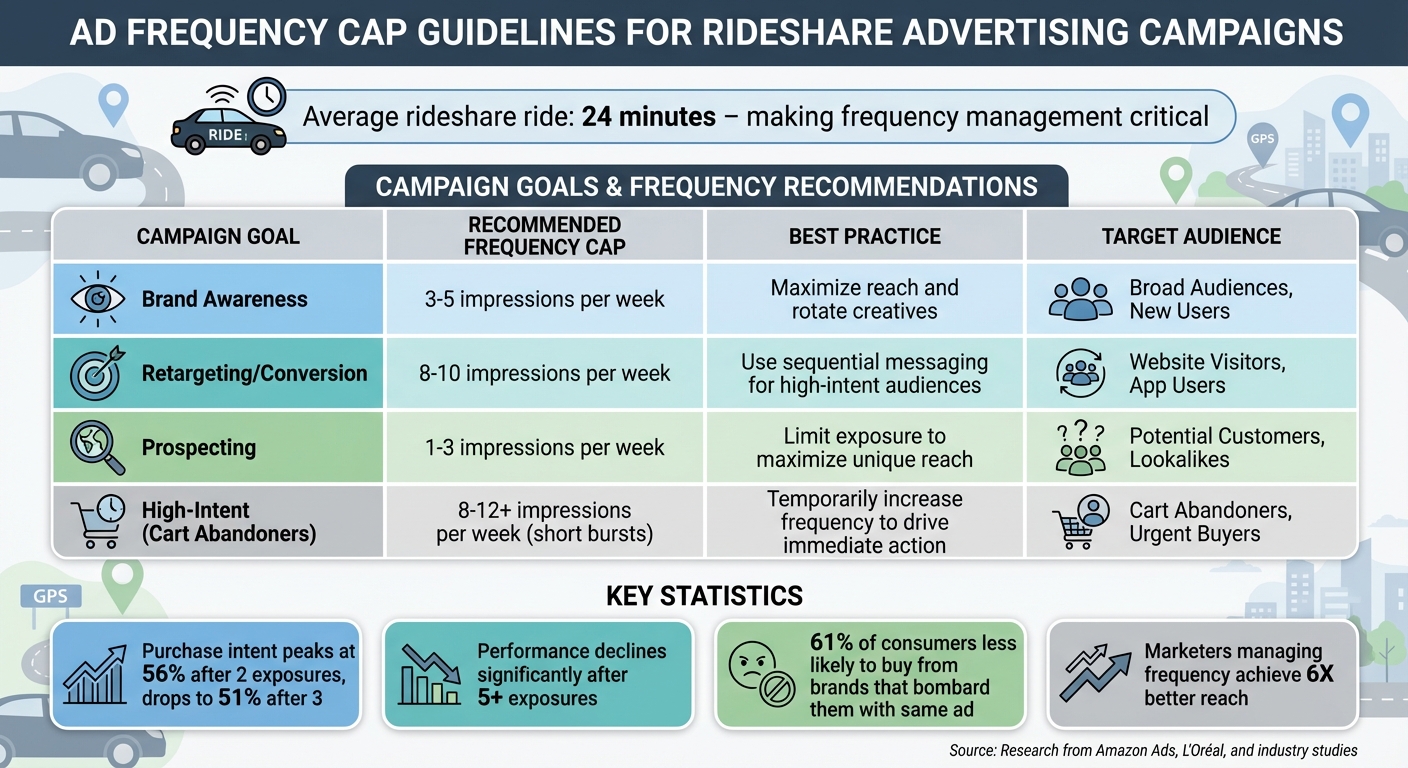
Ad Frequency Cap Guidelines for Rideshare Advertising Campaigns
Once you've identified ad fatigue, it's time to take action. Managing frequency caps effectively can make a huge difference in your campaign's performance. The best approach will depend on your specific goals, creative strategy, and how you've segmented your audience.
Frequency caps should align with what you're trying to achieve. For campaigns focused on brand awareness, aim for 3–5 impressions per week. This strikes a balance between reaching a wide audience and avoiding overexposure. On the other hand, if you're running conversion-focused or retargeting campaigns, you can go higher - around 8–10 impressions weekly. These audiences are already familiar with your brand and are closer to making a decision.
A study by Amazon Ads in 2020 revealed that top-performing audio campaigns used a frequency cap of 5–6 impressions over a 30-day period to enhance brand awareness. Similarly, L'Oréal's research found that ad effectiveness drops significantly after the fourth exposure. Start conservatively and tweak your caps based on performance data. In rideshare settings, think about commuter habits - if someone takes the same route twice a day, a cap of 3 impressions per week ensures they see your ad every other day without feeling overwhelmed.
Even with the perfect frequency cap, showing the same ad repeatedly can lead to disengagement. Regularly updating your creative assets keeps things fresh. The trick isn’t just having multiple ads but making sure each one stands out.
In rideshare advertising, where the average trip lasts 24 minutes, passengers have enough time to engage with detailed messages. Rotate between creatives with varying levels of detail - use bold visuals and minimal text for impact or provide more in-depth copy for key value points. Avoid middle-ground messaging that often underperforms.
Lyft’s analysis of 1,000 display creatives showed that ads with clear calls to action saw a 5.2% boost in engagement, while specific offers increased it by 2.9%. Ads placing human faces in the lower center, just above the call-to-action, achieved a 28% lift in engagement. Tailor your creative rotations to your audience - morning commuters may respond better to practical offers like telecom deals (25–30% higher engagement), while weekend mornings see a 56% bump for health and wellness content.
Audience segmentation allows you to fine-tune frequency caps based on demographics, location, behavior, and where users are in the marketing funnel. This reduces wasted impressions and makes your ads more relevant.
For prospecting campaigns targeting new audiences, keep exposure low - 1–3 impressions per week - to maximize unique reach. Conversely, for bottom-of-funnel audiences, like past customers or cart abandoners, higher frequencies (8–12+ impressions per week) in short bursts can drive action. In rideshare settings, geographic targeting is especially effective. A daily downtown commuter will have different exposure needs compared to someone taking occasional trips to the airport.
"Frequency capping helps maintain a rhythm that respects the user's experience. It ensures that each impression adds value rather than noise." – Caylee Wilson, Marketing Expert
Manually managing frequency caps can be overwhelming, especially across multiple platforms. Automation tools simplify this process by adjusting caps in real time, swapping creatives, and reallocating budgets based on performance.
Dynamic capping, for example, increases exposure for engaged users while reducing it for those who show no interest. Recency capping prevents the same ad from appearing twice in a short time frame (e.g., within 30 minutes to an hour), minimizing irritation.
Demand-Side Platforms (DSPs) like The Trade Desk or DV360 allow you to set both lifetime caps (e.g., 20 impressions total) and periodic caps (e.g., 3 impressions per day) for precise control. Platforms like Google and Meta, which rely on logged-in user data, ensure consistent frequency caps across devices - whether desktop, mobile, or tablet.
In 2021, furniture brand Flexispot combined frequency capping with dayparting after discovering conversions spiked after 2 p.m. Their automated campaigns targeted customers specifically during these high-conversion periods. Marketers who managed frequency within a single environment achieved six times better reach, making it easier to scale budgets and improve results. Tools like Enroute View Media offer centralized monitoring with instant alerts, ensuring your pacing stays on track.
| Campaign Goal | Recommended Frequency Cap | Best Practice |
|---|---|---|
| Brand Awareness | 3–5 impressions per week | Maximize reach and rotate creatives |
| Retargeting/Conversion | 8–10 impressions per week | Use sequential messaging for high-intent audiences |
| Prospecting | 1–3 impressions per week | Limit exposure to maximize unique reach |
| High-Intent (Cart Abandoners) | 8–12+ impressions per week (short bursts) | Temporarily increase frequency to drive immediate action |
Managing ad frequency in rideshare campaigns can be tricky, but the right tools can make it much easier. Enroute View Media's platform tackles issues like overexposure and ad fatigue by offering precision targeting, automation, and flexible campaign controls.
At the heart of Enroute View Media's platform is its DigiStream GTWA (Geotargeting-Time with Advertising) technology, which uses location- and time-based targeting to deliver ads with pinpoint accuracy. Leveraging a 41-channel GPS system with a precision of less than 3.3 feet, advertisers can create geofences around specific locations. This means ads can be served to passengers when they’re within walking distance of a business and scaled back as soon as they leave the area.
The DigiStream View software takes this a step further by allowing remote control of taxi-top LED displays and interior tablet screens. Advertisers can tweak ad frequency in real time, ensuring campaigns stay relevant and effective. With advanced scheduling features, ads can be programmed to appear at specific times and locations, perfectly matching passengers’ daily routines. These tools set the stage for even more advanced targeting and automation options, which are explored further in the next sections.
The DigiStream View platform simplifies ad frequency management by automating many of the tasks that would typically require manual intervention. Ads can be scheduled and adjusted automatically based on factors like location, time of day, and campaign performance. Advertisers can independently manage in-taxi tablets and exterior LED displays, fine-tuning each to meet their specific goals.
Built-in automation tools adapt display settings in real time, ensuring ads are delivered under the best possible conditions. The platform even provides estimated data usage metrics, helping advertisers balance video ads (recommended at 20 seconds) with static images (recommended at 10 seconds) to meet frequency goals without overspending. A subscription-based pricing model adds flexibility, allowing advertisers to experiment with different frequency strategies across multiple vehicles and locations, whether on a monthly or annual basis.
Enroute View Media also offers subscription-based pricing and white-label solutions, giving advertisers and fleet owners more control over ad frequency while maintaining consistent branding. This customizable approach can accommodate specific needs, such as removing built-in cameras from passenger tablets to comply with privacy regulations.
For fleet owners and marketing startups aiming to monetize their vehicles, the white-label option provides tools for independent operation and precise frequency control. The platform's high GPS accuracy ensures ads are shown only when they’re relevant, minimizing wasted impressions. Plus, the durable hardware guarantees reliable ad delivery, no matter the conditions.
Ad frequency caps in rideshare advertising come with their own set of challenges that can heavily influence campaign success. Overexposure risks causing ad fatigue, where passengers start ignoring repetitive messages. On the other hand, poor frequency management can drain your budget by repeatedly targeting the same users instead of expanding your audience.
To tackle this, accurate tools are key. Programmatic platforms with automated controls take the guesswork out of the equation, ensuring ads are delivered to passengers at the right moment and in the right context.
Enter Enroute View Media's DigiStream GTWA technology - a game-changer in this space. This system offers ultra-precise targeting within just 3.3 feet and allows real-time frequency adjustments for both interior tablets and exterior LED displays. With automated scheduling and independent screen management, advertisers can control when and how often their ads appear, creating a more engaging and less intrusive experience for passengers.
Research backs this up: marketers who actively manage ad frequency can achieve up to six times better reach compared to those who don't. In rideshare settings - where passengers are a captive audience but can quickly lose interest - finding the sweet spot between brand recall and annoyance is critical. By managing frequency effectively, you not only safeguard your brand image but also make the most of your ad spend.
Ad frequency caps are essential in rideshare advertising, as they control how often passengers encounter the same ad during their trip. This approach helps avoid ad fatigue while maintaining a positive brand experience. With the average ride lasting about 24 minutes, rideshare vehicles create a high-attention environment, making it crucial to balance ad exposure. By capping the frequency, advertisers can keep ads engaging and minimize wasted impressions.
Finding the right balance is key. If the cap is set too low, it may hinder ad recall - studies suggest that seeing an ad two to three times significantly improves recognition and purchase intent. On the other hand, setting the cap too high can overwhelm riders, reducing engagement and harming the brand's image. Additionally, overly restrictive caps may leave ad slots empty, cutting into revenue opportunities for fleet owners.
Enroute View Media tackles this challenge with its real-time analytics and geo-time targeting features. These tools allow advertisers to fine-tune frequency caps based on the specific market and vehicle. The result? Passengers see fresh, relevant ads without feeling bombarded, ensuring campaigns are both effective and efficient, while maximizing return on ad spend (ROAS).
To avoid ad fatigue in rideshare advertising, start with frequency capping - a method to control how often a rider sees the same ad within a set timeframe, like per trip or per day. This approach keeps ads feeling new, helps maintain a positive image for your brand, and prevents unnecessary spending. Adjust these caps in real time using performance data to focus on audiences with higher engagement while reducing exposure for others.
Other effective tactics include dynamic creative rotation, which automatically swaps out visuals or messaging to keep the content fresh, and audience segmentation to customize ads based on factors like rider demographics, trip length, or location. Timing matters too - syncing ad duration with the average length of a rideshare trip can make your messaging more impactful. Using a cloud-based platform can simplify these efforts, offering tools for geo-targeted ads, real-time updates, and actionable insights.
Consistently reviewing campaign performance - such as click-through rates and engagement stats - allows you to refresh content and tweak strategies before fatigue becomes an issue, ensuring your ads remain effective and engaging.
Managing ad frequency caps in rideshare campaigns takes a mix of real-time tracking, automated tools, and smart adjustments. By keeping an eye on ad impressions as they happen, advertisers can dive into metrics like view-through rates, location-specific trends, and rider engagement. This helps spot signs of ad fatigue - like a drop in click-through rates after too many exposures.
With cloud-based platforms, advertisers can fine-tune frequency caps on the fly using performance data. For instance, caps might be tightened in areas with heavy ad exposure or loosened in regions where ads are less frequent. Tools like Enroute View Media’s ad management system make this process smoother by offering geo-targeted ad delivery, real-time insights, and programmatic integration. The result? Smarter ad exposure and better returns on your investment.
Need pricing details?
EnrouteViewMedia is a Canadian technology company based in Edmonton, Alberta, Canada. The company was founded by a group of media entrepreneurs and engineering executives. Our mission is developing leading-edge digital media display technologies for taxicab rooftops and taxicab interiors advertising market. Through our easy to use ad delivery and management system, we assist our clients in reaching their customers with targeted exposure. EnRouteViewMedia continuously strives to be the global leader in digital geo-time targeted advertising media systems for modern taxi fleets.